

On November 21, 2010, in the Marjah district of Helmand Province, Afghanistan, 21-year-old U.S. Marine Lance Corporal William Kyle Carpenter performed an act of extraordinary courage that made him one of the best-known living recipients of the Medal of Honor.
Childhood and Youth
Kyle Carpenter was born on October 17, 1989, in Jackson, Mississippi. He grew up in the small town of Flowood in a loving family headed by his parents, Jim (James) and Robin Carpenter. He has younger twin brothers, Price and Payton, who were born when Kyle was a little over six years old. Before their birth, the family suffered the loss of a stillborn son when Kyle was about four.
His parents raised their children with unconditional love and strong support. His father encouraged Kyle’s fearlessness from an early age — even in kindergarten he helped build bike ramps so the boy could practice jumps. His mother focused on broadening her children’s horizons. Kyle has described himself as an energetic, fearless, restless, and relentless blond “ball of energy” who climbed, jumped, ran, and broke things. As a toddler he insisted his father draw a Superman logo on his chest with permanent marker and refresh it whenever it faded.
Because of his father’s work in sales and business, the family moved frequently. Kyle lived in Mississippi (including Forest and Brandon), then Georgia (Gainesville for about six years), Tennessee (Savannah), and eventually settled in South Carolina (Gilbert). The moves were often difficult, especially when he had to start over as the “new kid” in high school. Looking back, Carpenter has said those experiences of constant change prepared him for the uncertainty of military life.
Sports played a big role. In first grade he made the Brandon Allstars baseball team. In high school he played football (running back) and baseball and competed in powerlifting. Despite his small stature (around 5’5″–5’7″ and never more than about 160 pounds), he won a state powerlifting championship in his weight class — squatting 425 pounds and bench-pressing 205 pounds. He graduated in 2008 from the small private Christian school W. Wyman King Academy in Batesburg, South Carolina. The school felt almost like family; students helped paint field lines, maintain grounds, and even build facilities.
Kyle was active in his church youth group and went on mission trips. Meetings with Marines and a conversation with Vietnam veteran Clebe McClary (who lost an arm and an eye to a grenade yet continued living a full life) strongly influenced his decision to enlist. After high school he briefly attended junior college and worked odd jobs (including construction and restaurant work) before deciding he wanted something greater.
In February 2009, at age 19, he joined the Marine Corps Delayed Entry Program and completed recruit training at Parris Island in July of that year.
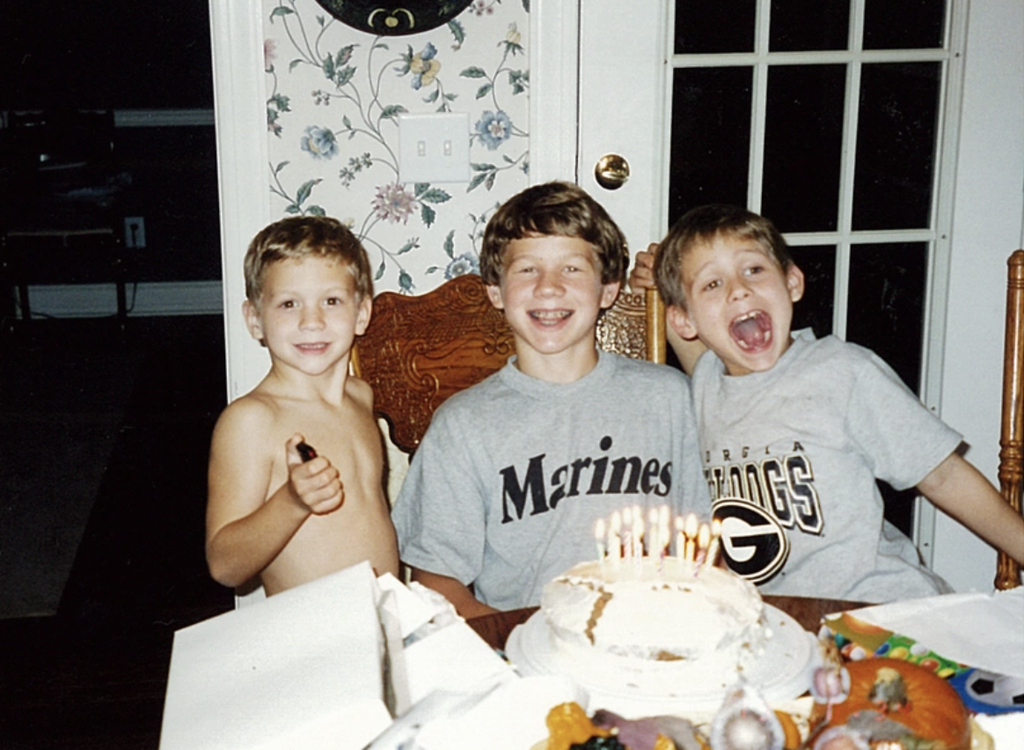
Childhood photo — Young Kyle Carpenter (wearing a Marines T-shirt) with his younger twin brothers, Price and Payton (official U.S. Marine Corps / DVIDS release, public domain):
What Happened in Afghanistan
Carpenter and fellow Lance Corporal Nicholas Eufrazio were manning a rooftop security post at Patrol Base Dakota. Their platoon (Company F, 2nd Battalion, 9th Marines) had established the position only two days earlier.
Enemy forces attacked with grenades. One landed inside their sandbagged position. Without hesitation, Carpenter moved between the grenade and Eufrazio, using his own body as a shield. The blast was almost entirely absorbed by Carpenter.
Eufrazio suffered a serious head wound from shrapnel but survived. Carpenter sustained catastrophic injuries:
- Loss of his right eye
- Nearly complete destruction of his lower jaw and most of his teeth
- Multiple facial and skull fractures (including a depressed skull fracture requiring brain surgery)
- Punctured carotid artery
- Fully collapsed right lung
- Right arm shattered in more than 30 places
- Numerous shrapnel wounds to his arms, legs, and body
- Both eardrums ruptured
His heart stopped three times. Doctors revived him each time. He spent about five weeks in a coma, then nearly three years in hospitals (primarily Walter Reed), undergoing roughly 40 surgeries that included facial and jaw reconstruction, a prosthetic eye, and multiple skin grafts.
The Award
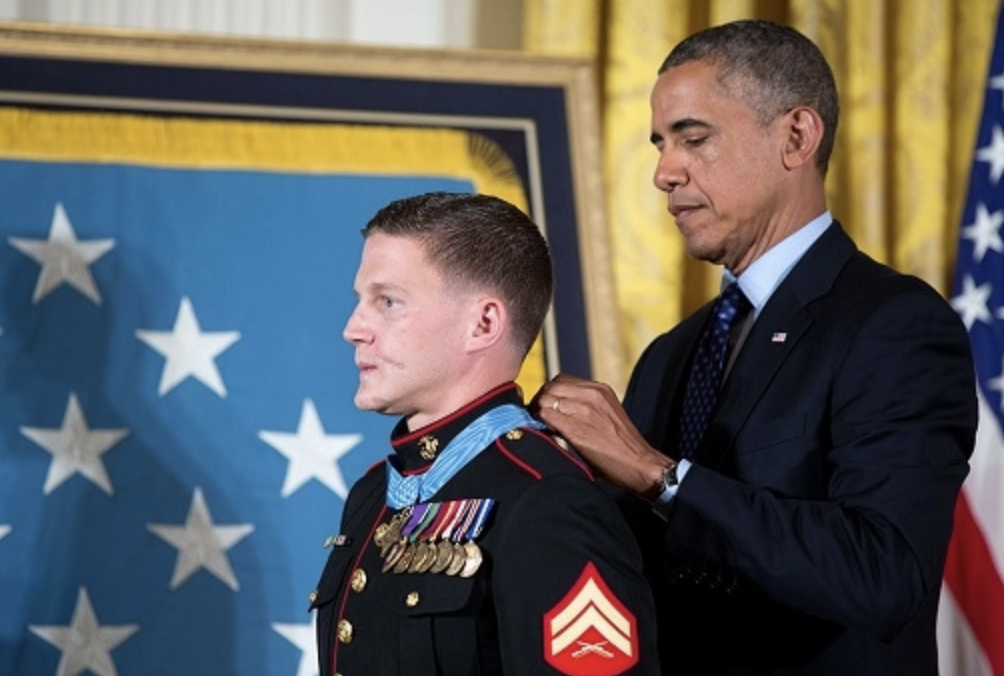
On June 19, 2014, President Barack Obama presented Carpenter with the Medal of Honor, the United States’ highest military decoration. At the time he was the youngest living recipient of the medal among those who served in Iraq and Afghanistan (and the eighth living recipient for actions in those conflicts).
The official citation states: “Without hesitation, and with complete disregard for his own safety, Lance Corporal Carpenter moved toward the grenade in an attempt to shield his fellow Marine from the deadly blast. When the grenade detonated, his body absorbed the brunt of the blast, severely wounding him, but saving the life of his fellow Marine.”
Photo 1 — Official U.S. Marine Corps portrait of Cpl. William Kyle Carpenter taken shortly before the Medal of Honor ceremony (public domain, U.S. Marine Corps photo by Cpl. Michael C. Guinto):
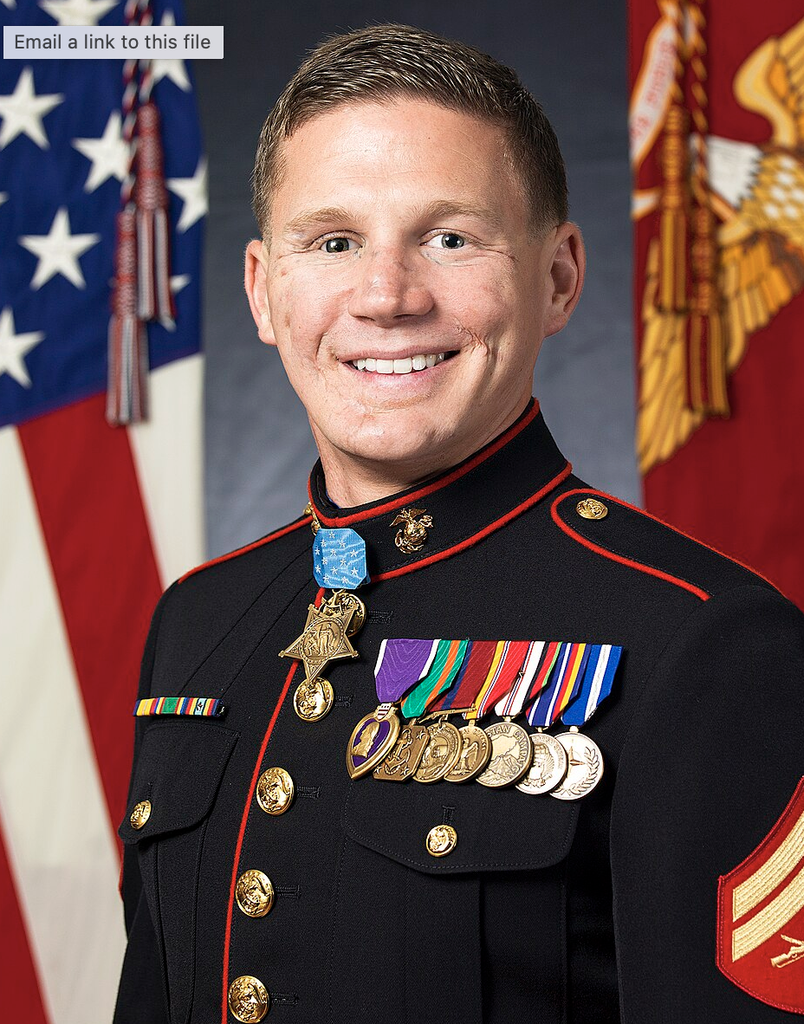
Photo 2 — President Barack Obama awarding the Medal of Honor to Cpl. Kyle Carpenter at the White House on June 19, 2014 (public domain):
Life After
In July 2013 Carpenter was medically retired as a Corporal. He enrolled at the University of South Carolina, graduating in 2017 with a degree in international studies. He became a motivational speaker and authored the book You Are Worth It: Building a Life Worth Fighting For (2019), in which he writes in detail about his childhood, family, recovery, and the value of perseverance.
Despite his severe injuries he has run marathons, gone skydiving, and continued living an active life. Carpenter has repeatedly said he has no memory of the moment he covered the grenade — the fact was established through investigations and forensic analysis showing the blast seat under his body.
The Meaning of the Story
Kyle Carpenter’s story is not only about a split-second decision on a rooftop in Marjah. It is the story of a boy from an ordinary Southern family whose parents taught him to believe in himself, face challenges, and look out for others. Frequent moves, sports, faith, and the example of those around him shaped a character that revealed itself fully when it mattered most.
Some heroes do not have time to think about being heroes. They simply choose to protect someone else.
Semper Fi.