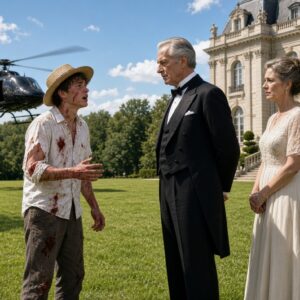

The sun hung high over the von Auerbach estate, pouring gold across the manicured lawn that stretched like a green carpet toward the great house. It was the kind of afternoon that postcards were made of—the kind that made the rich feel untouchable. And at the center of it all, a sleek black helicopter sat waiting, its rotors already spinning, whipping the summer air into a furious, deafening rhythm.
Friedrich von Auerbach, sixty years old and immaculate in his black tuxedo, adjusted his bow tie and strode toward the aircraft. He had a meeting in Vienna—a merger that would make him the most powerful industrialist in Central Europe. Nothing would stand in his way. Not today. Not ever.
Beside the helicopter stood his wife, Helene. Forty-five, elegant, her cream-colored dress catching the sunlight like a pearl. She smiled—a thin, careful smile that didn’t quite reach her eyes. She was watching her husband with the patience of a woman who had waited a very long time for something.
And then there was Thomas.
He came sprinting across the lawn like a man possessed, straw hat flying off his head, white shirt torn at the shoulder and stained with blood. His nose was broken—a fresh, ugly gash—and a purple bruise bloomed beneath his left eye. He was seventeen years old, a stable boy, the lowest of the low on the von Auerbach payroll. But right now, he was running as if the devil himself were at his heels.
“Sir! Sir, Sir! Steigen Sie nicht in diesen Hubschrauber! Ihre Frau hat eine Bombe darin platziert!”
The words cut through the rotor noise like a knife. Don’t get in that helicopter. Your wife has placed a bomb inside it.
Friedrich stopped. His hand, already reaching for the door handle, froze in midair. For a single heartbeat, the world seemed to hold its breath.
Helene turned. Her face, which had been serene moments before, twisted into something ugly and contemptuous. “Wovon zum Teufel reden Sie, Sie verrückter Stalljunge!” she spat. What the hell are you talking about, you crazy stable boy!
Thomas skidded to a halt a few feet away, chest heaving, blood dripping from his nose onto the pristine grass. “Please, sir,” he gasped, switching to English in his desperation. “You have to believe me. I saw her. I saw her go into the hangar last night. I saw her place something under the seat. I’m not crazy. I’m not.”
Helene laughed—a sharp, brittle sound. “This is absurd. Friedrich, this boy is clearly unwell. Look at him. He’s been fighting again, no doubt. Probably drunk.” She stepped forward, her heels sinking slightly into the turf. “Gehen Sie zurück in die Ställe, wo Sie hingehören!” Go back to the stables where you belong!
Thomas didn’t move. He looked past her, directly at Friedrich, his eyes burning with a desperate sincerity that was impossible to fake. “Wenn Sie mir nicht glauben, Sir, bitten Sie sie, jetzt mit Ihnen in diesen Helikopter zu steigen!” If you don’t believe me, sir, ask her to get in the helicopter with you right now!
The silence that followed was louder than the rotors.
Friedrich’s gaze shifted from Thomas to Helene. The confusion in his eyes deepened. He was a man who had built an empire on reading people—on knowing when someone was lying. And right now, two people were telling him two very different stories. One of them was lying. He just didn’t know which one.
Helene’s expression flickered. Just for a moment. A tiny, almost imperceptible crack in her mask of outrage. Her eyes widened—not with anger, but with something else. Fear.
Friedrich saw it.
“Helene,” he said slowly, his voice low and measured. “Come with me.”
She blinked. “What?”
“Get in the helicopter with me. If the boy is lying, we’ll fly to Vienna together. And when we land, I’ll have him arrested for slander.” He paused. “But if you refuse…”
He didn’t finish the sentence. He didn’t need to.
Helene’s face went pale. Her hands, clasped in front of her, began to tremble. “Friedrich, this is ridiculous. I have a luncheon at the club. I can’t just—”
“Get in the helicopter, Helene.”
“No.”
The word hung in the air between them like a guillotine blade.
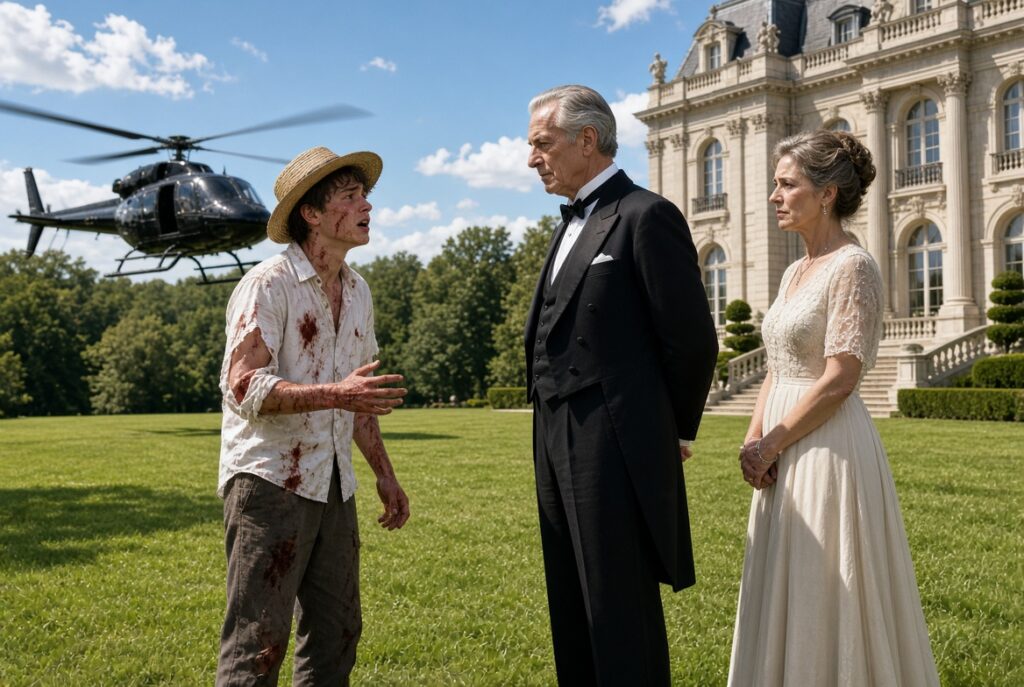
Thomas let out a breath he didn’t know he’d been holding. “Sir,” he said quietly, “there’s a bomb under the passenger seat. It’s on a timer. I don’t know how long you have, but it was set for two o’clock. It’s one fifty-five now.”
Friedrich’s blood ran cold. He checked his watch. One fifty-six.
He looked at his wife—the woman he had married twenty-three years ago, the woman who had borne him two children, the woman who had stood by his side at every gala and every board meeting. And he saw, for the first time, a stranger.
“Why?” he asked. The word was barely a whisper.
Helene’s composure finally shattered. Her face crumpled, and for a moment she looked older—much older. “You know why,” she hissed. “You’ve been planning to divorce me for months. You think I didn’t know? You think I didn’t see the papers in your study? You were going to leave me with nothing. Nothing! After everything I gave you!”
“So you decided to kill me instead?”
“You were going to destroy me!” she screamed. “I was protecting myself!”
Thomas took a step back, his heart pounding. He had suspected—he had feared—but hearing it confirmed was something else entirely. He had worked in those stables for two years. He had mucked out stalls, groomed horses, and kept his head down. But he had also seen things. He had seen Helene meeting with strange men in the dead of night. He had seen her slip into the hangar when she thought no one was watching. And last night, he had finally gathered the courage to follow her.
What he saw had sent him running—first to the house, then to the stables, then here. He had tried to tell the head gardener, but the man had laughed him off. He had tried to call the police, but the line had been cut. So he had done the only thing left: he had run to the helicopter himself.
And now, here he was. Bleeding. Exhausted. Terrified. But standing.
Friedrich turned to him. “You,” he said. “What’s your name?”
“Thomas, sir. Thomas Weber.”
“Thomas.” Friedrich nodded slowly. “You saved my life.”
Thomas opened his mouth to respond, but before he could, a new sound cut through the air—the wail of police sirens, growing louder by the second. Someone had called them after all.
Helene’s eyes went wide. She turned to run, but her heels caught in the grass, and she stumbled, falling to her knees. Two security guards came sprinting from the house, followed by a team of uniformed officers.
Within minutes, the lawn that had been so peaceful was a chaos of flashing lights and shouted orders. Helene was led away in handcuffs, her cream dress stained with grass and dirt. She didn’t look at her husband as she passed. She didn’t look at anyone.
Friedrich stood in the middle of it all, his tuxedo still immaculate, his face unreadable. When the police had finished questioning him, he walked over to Thomas, who was sitting on the grass, pressing a handkerchief to his nose.
“You should see a doctor,” Friedrich said.
Thomas shrugged. “It’s just a nosebleed, sir. I’ve had worse.”
Friedrich almost smiled. “You’re a brave young man, Thomas. Braver than most.” He paused. “I’d like to offer you a job. A real one. Not in the stables—in the house. As my personal assistant. If you want it.”
Thomas looked up at him, disbelief written all over his bruised face. “Sir, I… I don’t know what to say.”
“Say yes.”
Thomas hesitated. Then, slowly, he nodded. “Yes. Yes, sir.”
Friedrich extended his hand. Thomas took it, and the old man pulled him to his feet.
As the sun began its slow descent toward the horizon, the two of them stood there on the lawn, surrounded by the wreckage of a marriage and the ruins of a plan. The helicopter sat silent now, its rotors still. Somewhere inside it, a bomb ticked toward two o’clock—a bomb that would never go off.
Thomas looked at the house—the great, gleaming house that had always seemed so untouchable. He thought about his mother, who had died when he was twelve. He thought about his father, who had disappeared years ago. He thought about all the nights he had spent in the stables, alone and afraid, dreaming of something more.
And he thought about the moment he had seen Helene place that bomb. The moment he had made a choice. The moment he had decided that doing nothing was not an option.
“Sir,” he said quietly, “what happens now?”
Friedrich looked at him. “Now? Now we rebuild. We start over. We learn to trust again.” He paused. “And we never, ever forget what you did today.”
Thomas nodded. He didn’t know what the future held. He didn’t know if he was ready for it. But for the first time in a long time, he felt something he had almost forgotten.
Hope.
***
The weeks that followed were a blur. Thomas moved into the guest wing of the von Auerbach estate—a room so large it could have fit his entire childhood home inside it. He was given new clothes, a new phone, and a new name: Thomas Weber, Personal Assistant to Friedrich von Auerbach.
But the transition wasn’t easy.
The staff whispered behind his back. The butler, an ancient man named Gerhard, looked at him like he was something stuck to the bottom of his shoe. The maids giggled when he walked past. And the cook, a formidable woman named Frau Schmidt, refused to make him anything other than porridge for the first two weeks.
“You’re a stable boy,” she said flatly when he asked for eggs. “Stable boys eat porridge.”
Thomas didn’t argue. He ate the porridge. Every single morning.
But Friedrich noticed. And one morning, he sat down at the kitchen table—something he had never done before—and said, “Frau Schmidt, from now on, Thomas eats what I eat. Is that understood?”Frau Schmidt’s face went red. “Yes, sir. Of course, sir.”
Thomas tried not to smile. He failed.
As the weeks turned into months, Thomas learned the rhythms of the house. He learned how to manage Friedrich’s schedule, how to handle his correspondence, how to deflect the endless stream of people who wanted a piece of the great industrialist’s time. He learned how to read a balance sheet, how to negotiate a contract, how to spot a lie.
And he learned about Friedrich himself.
The old man was not the cold, distant figure the world believed him to be. He was lonely. His children—a son in New York, a daughter in London—rarely called. His friends were business associates, not confidants. And his wife… his wife had tried to kill him.
“I should have seen it,” Friedrich said one evening, as they sat in his study, the fire crackling in the hearth. “The signs were there. The arguments. The distance. The way she looked at me toward the end.” He shook his head. “I was so focused on the company that I forgot to look at my own marriage.”
Thomas didn’t know what to say. He had never been married. He had never even been in love—not really. But he understood loneliness. He had felt it every day of his life.
“Sir,” he said finally, “you’re not responsible for what she did. She made her own choices.”
Friedrich looked at him. “You’re wise for your age, Thomas.”
Thomas shrugged. “I’ve had a lot of time to think.”
Friedrich smiled—a real smile, the first Thomas had ever seen from him. “I’m glad you’re here.”
“So am I, sir.”
***
But the past had a way of catching up.
Three months after the helicopter incident, Thomas received a letter. It was addressed to him in careful, elegant handwriting, and it bore the return address of a women’s prison outside Vienna.
He opened it with trembling hands.
Dear Thomas,
I hope this letter finds you well. I know you have no reason to read it, but I hope you will.
I wanted to tell you that I don’t blame you for what happened. I blamed you at first—I blamed everyone—but I’ve had a lot of time to think in here. And I’ve realized that you were just doing what was right. You saved my husband’s life. You saved him from me.
I don’t expect your forgiveness. I don’t deserve it. But I wanted you to know that I’m sorry. Not for getting caught—for what I did. For who I became.
You’re a good person, Thomas. Don’t ever let anyone tell you otherwise.
Helene
Thomas read the letter three times. Then he folded it carefully and placed it in the drawer of his desk.
He didn’t write back. But he didn’t throw the letter away either.
***
Winter came, and with it, a new challenge. Friedrich’s son, Maximilian, arrived from New York—a tall, handsome man in his thirties with his mother’s cold eyes and his father’s ambition. He had heard about the stable boy who had become his father’s assistant, and he was not pleased.
“This is absurd,” he said at dinner on his first night, not even bothering to lower his voice. “A stable boy? Running your affairs? Father, have you lost your mind?”
Friedrich set down his fork. “Thomas saved my life, Maximilian. He has more than earned his place.”
“He’s a peasant.”
“He’s a hero.”
Maximilian laughed. “Heroes don’t muck out stalls.”
Thomas, who was sitting at the far end of the table, said nothing. He had learned long ago that words were sometimes less powerful than silence.
But Friedrich was not done. “You will treat Thomas with respect,” he said, his voice cold as steel. “Or you will leave this house and never come back.”
Maximilian’s face went white. He opened his mouth to argue, then closed it again. He had seen his father like this before—and he knew better than to push.
“Fine,” he muttered. “But I don’t have to like it.”
“No,” Friedrich agreed. “You don’t.”
***
Christmas Eve arrived, and the von Auerbach estate was transformed. Strings of golden lights hung from the eaves. A massive tree stood in the great hall, decorated with heirlooms that had been in the family for generations. The smell of gingerbread and mulled wine filled the air.
Thomas stood by the window, watching the snow fall. He had never had a Christmas like this. His mother had tried—she had always tried—but money had been tight, and the holidays had always felt more like a reminder of what they didn’t have than a celebration of what they did.
Friedrich appeared beside him. “You’re quiet tonight.”
Thomas shrugged. “Just thinking.”
“About what?”
“My mother. She would have loved this.”
Friedrich was silent for a moment. Then he said, “Tell me about her.”
So Thomas did. He told him about Anna Weber—a seamstress who had worked sixteen-hour days to put food on the table. A woman who had sung lullabies in a language she barely remembered. A woman who had died of pneumonia when Thomas was twelve, leaving him alone in a world that had never wanted him.
“She sounds like a remarkable woman,” Friedrich said when he had finished.
“She was.”
Friedrich placed a hand on his shoulder. “You honor her memory, Thomas. Every day.”
Thomas looked away, blinking back tears. “I try, sir.”
***
Spring came, and with it, a new beginning.
Friedrich announced that he was stepping down as CEO of von Auerbach Industries. Maximilian would take over—under Thomas’s supervision, of course. The board was furious. The press was baffled. But Friedrich didn’t care.
“I’ve spent forty years building an empire,” he told Thomas. “Now I want to build something else. Something that matters.”
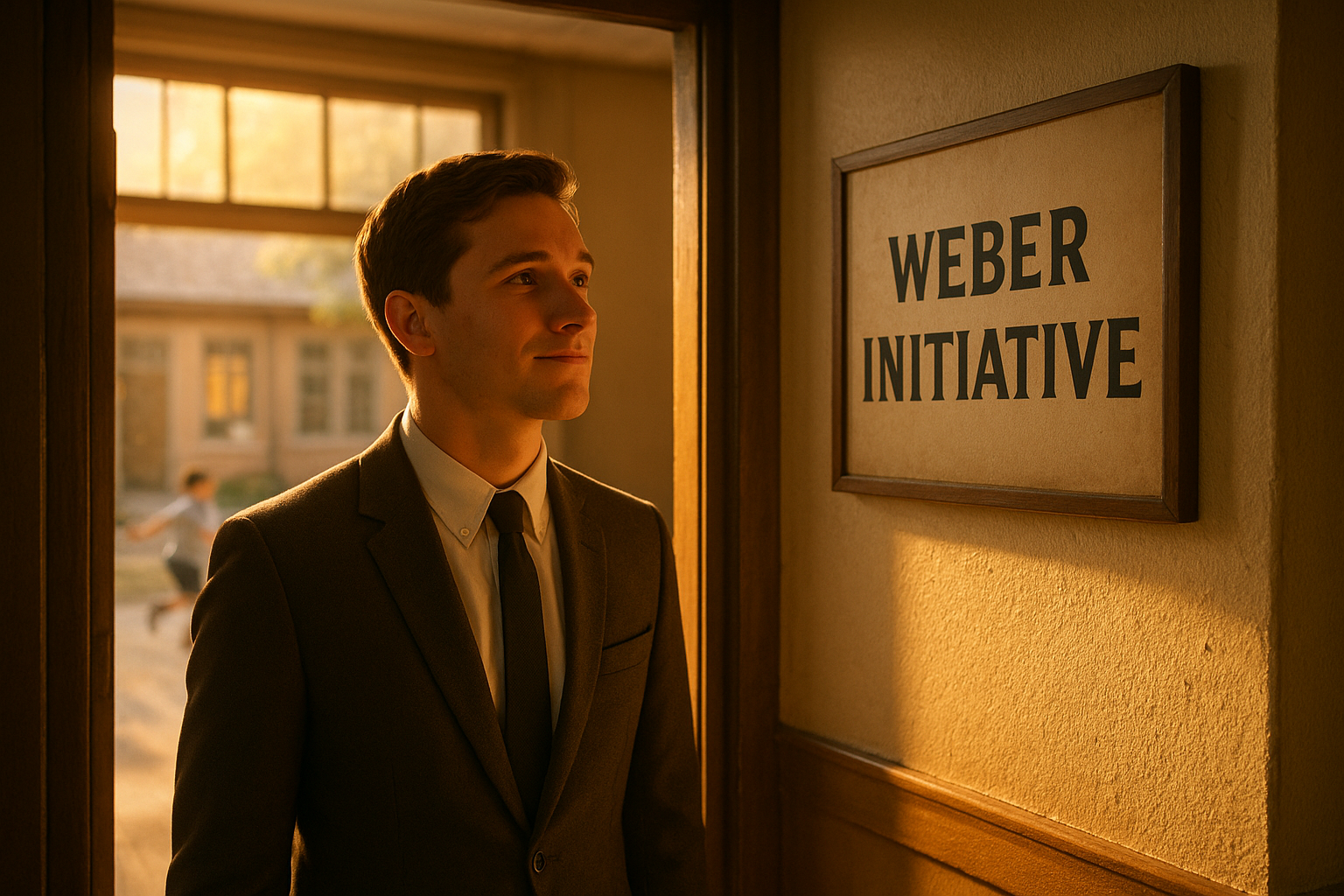
He founded a foundation—the Weber Initiative—dedicated to helping orphans and underprivileged youth. Thomas was named its director. It was a role he had never imagined for himself, but one he embraced with everything he had.
The first time he walked into the foundation’s offices—a modest building on the outskirts of Vienna—he felt something he had never felt before. Pride. Not the hollow pride of a promotion, but the deep, quiet pride of knowing that he was making a difference.
***
Years passed. Thomas grew into his role. He learned to navigate the treacherous waters of high society, to hold his own in boardrooms and ballrooms alike. He never forgot where he came from—the stables, the blood, the fear. And he never forgot the moment that had changed everything.
Friedrich died peacefully in his sleep at the age of seventy-two. His funeral was attended by dignitaries from around the world. Maximilian gave the eulogy, his voice steady and solemn. But it was Thomas who spoke last—Thomas, the stable boy, the hero, the son Friedrich had never had.
“He was a great man,” Thomas said, standing before the assembled crowd. “But more than that, he was a good man. He saw something in me that no one else did. He gave me a chance when the world told him not to. And I will spend the rest of my life trying to be worthy of that chance.”
He paused, looking at the coffin. “Thank you, sir. For everything.”
***
Thomas was thirty-five when he returned to the estate for the first time in years. The house was the same—the same gleaming windows, the same manicured lawn, the same sense of untouchable wealth. But it felt different now. Smaller. Less intimidating.
He walked across the lawn, past the spot where the helicopter had once stood. It was gone now, sold years ago. In its place was a garden—a riot of color, roses and lilies and lavender.
He stopped at the edge of the garden and looked up at the sky. The sun was shining, just as it had on that day. The day he had run across this lawn, screaming, desperate, terrified. The day he had saved a life.
He thought about Helene, still in prison, still writing letters he never answered. He thought about Friedrich, gone now, but never forgotten. He thought about his mother, who had believed in him when no one else did.
And he thought about the boy he had been—the stable boy with the broken nose and the torn shirt, the boy who had refused to stay silent.
“You did good,” he whispered to the memory. “You did good.”
He turned and walked back toward the house, where a new generation of children waited—children who had been given a chance, just as he had. Children who would grow up knowing that they mattered.
And somewhere, in the quiet of his heart, Thomas Weber smiled.
***
The story of the stable boy who saved the industrialist became a legend in certain circles. It was told at dinner parties, whispered in boardrooms, passed down from one generation to the next. Some said it was a fairy tale. Others said it was a miracle. But those who knew the truth—the real truth—knew that it was neither.
It was simply the story of a boy who had seen something wrong and had refused to look away. A boy who had run toward danger instead of away from it. A boy who had believed that even a stable boy could make a difference.
And in the end, that was all that mattered.
***
Verpassen Sie nicht die ganze Geschichte. Schauen Sie sich den ersten Kommentar an.