
The lantern sputtered against the log walls, throwing long, restless shadows across the cabin. Mary Campbell set the last empty plate down on the rough timber table with a small, final clatter. The sound echoed in the silence like a period at the end of a sentence she had not wanted to write.
She stood still for a moment, her bare feet cold against the floorboards, and let out a breath that carried the weight of a hundred miles and a thousand disappointments. Then she turned, reached for the smaller of her two daughters, and gathered the girl’s hand into her own.
“Finished,” she said, her voice tired but steady. “Come, girls. We’ll sleep in the barn.”
The older girl, Ruth, looked up from the corner where she had been folding a scrap of cloth into a doll. Her reddish hair hung in tangled waves past her shoulders, and her brown dress was patched at both elbows. She did not move.
“Outside, Mama?” she asked, and the fear in her voice was small and sharp, like a splinter.
Mary forced her expression to soften. She would not let her daughters see the cold knot tightening in her stomach. “Only for tonight,” she said. “We shouldn’t take more than we earned.”
It was a lie, and she knew it. They had earned nothing. They had been bought.
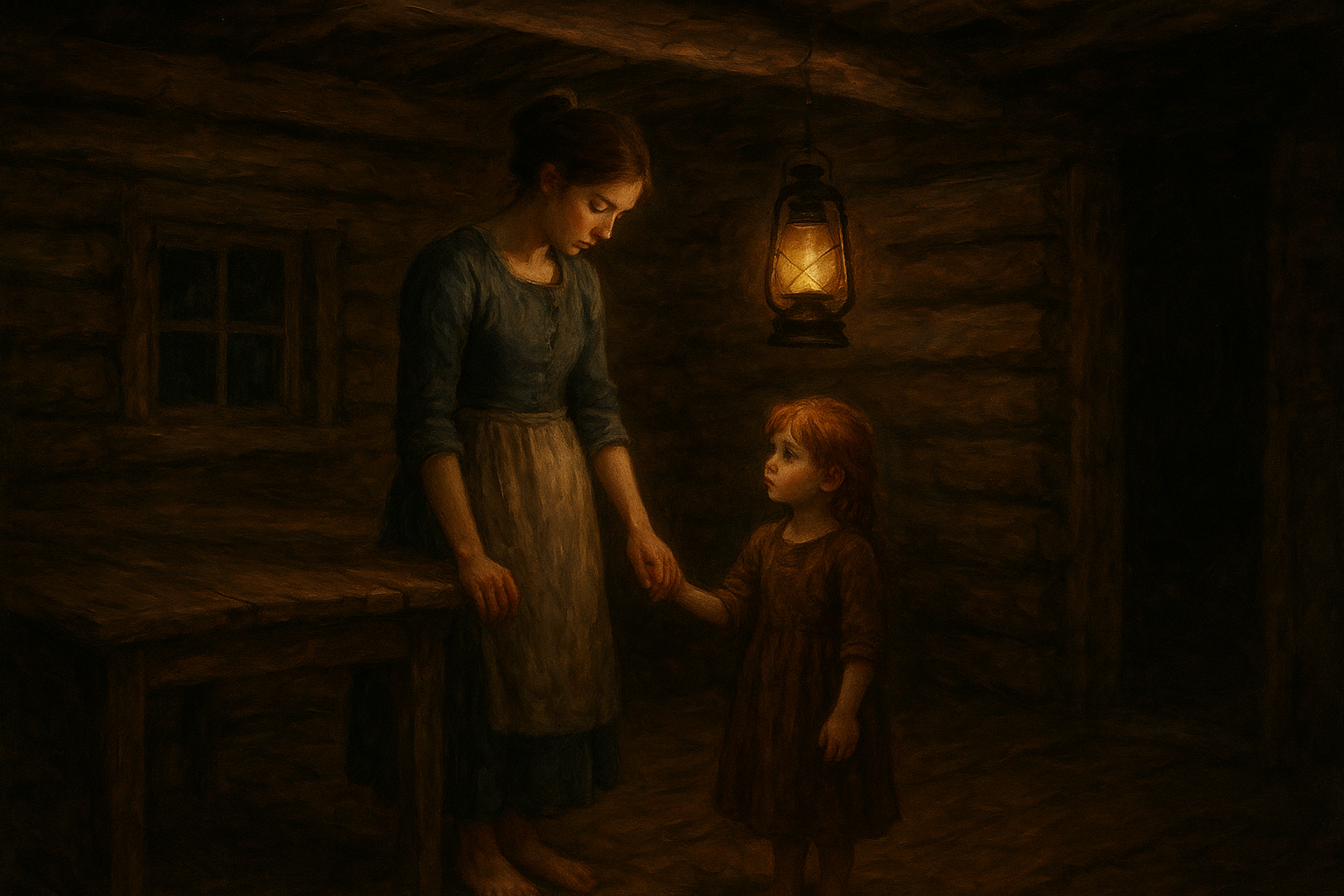
She led both girls toward the door. The younger one, Sarah, clutched a fistful of Mary’s apron and pressed her face against the fabric. Ruth walked stiffly at her mother’s side, her chin lifted in a way that reminded Mary painfully of her father.
The door was three steps away. Mary’s hand reached for the iron latch.
Then a heavy hand slammed against the wood above her head.
The sound cracked through the cabin like a gunshot. Mary flinched hard, her body curling instinctively around her daughters. She pulled them tight against her apron and turned.
Jesse Brand stood over them.
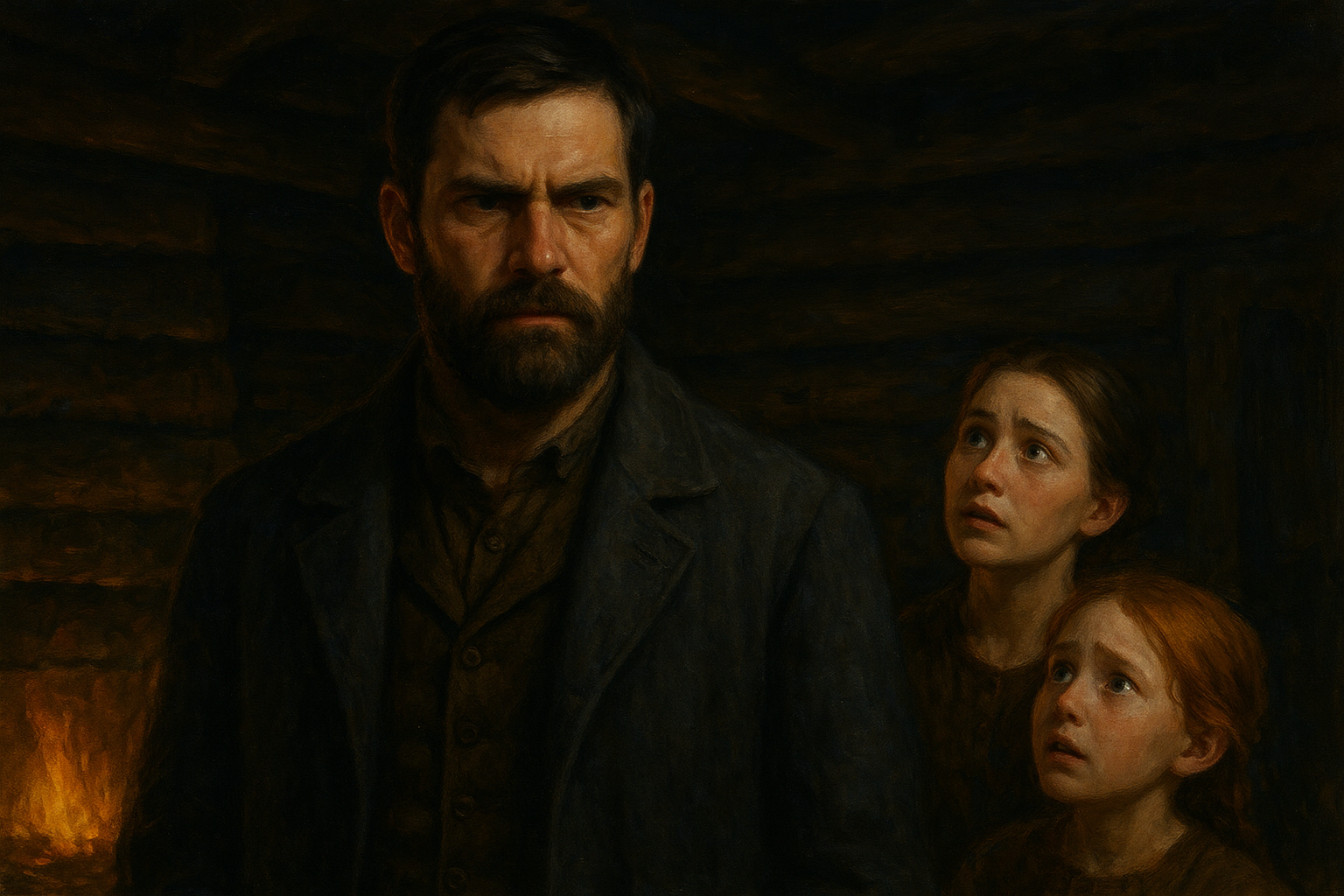
He was taller than she remembered. Broad-shouldered, with a thick beard and short chestnut hair, a dark grey coat hanging open over a brown shirt and vest. His eyes were dark and unreadable, and his hand remained flat against the door, blocking the way out.
“No,” he said.
The word was not loud. It did not need to be.
Mary’s heart hammered against her ribs. She had prepared herself for many things when she signed the papers in the county office three days ago. She had prepared for coldness. For rules. For the quiet humiliation of being a purchased thing in a stranger’s house. She had not prepared for this.
“We won’t cause trouble,” she said. Her voice shook, but she did not lower her gaze. “The barn is enough.”
Jesse’s jaw tightened. For a long moment he simply looked at her, and Mary felt as though he were reading something written beneath her skin. Then he answered with absolute certainty.
“No child sleeps in my barn.”
Mary went still.
The lantern hissed. Somewhere outside, a night bird called once and fell silent. Ruth’s small hand tightened around her mother’s fingers.
Mary had expected conditions. She had expected a man who counted every crust of bread and every hour of labor. She had expected to be told where she could sleep and when she could speak and how long she was permitted to remain. She had not expected a refusal that sounded almost like protection.
Her daughters stayed hidden close behind her. Sarah’s breath was warm against her hip. Mary swallowed hard, and then she asked the question she had been too afraid to say aloud since the moment the transaction was complete.
“Then why did you buy me?”
The room changed.
Jesse stepped closer into the lantern light. His expression softened by only a fraction, a loosening at the corners of his mouth, a shift in the set of his shoulders. But Mary saw it.
He held her gaze.
“You’re not sleeping in my barn because—”
Mary’s breath caught.
He stopped. The sentence hung in the air between them, unfinished, and in the silence Mary understood that the real reason Jesse Brand had brought her and her daughters into his home had never been explained.
Not to her. Not to the county clerk. Not even, perhaps, to himself.
“Because what?” she whispered.
Jesse looked at the two girls pressed against her apron. He looked at their bare feet on the cold floor. He looked at the empty plates on the table, and at the small, stubborn dignity in Mary’s eyes that she had refused to surrender even now.
“Because I know what it is,” he said quietly, “to sleep in a barn when you’re small. And I swore a long time ago that no child would ever do it under a roof that belonged to me.”
Mary stared at him.
He turned away before she could answer, crossing to the far side of the cabin where a curtain hung across a narrow alcove. He pulled the curtain back. Behind it was a bed, small but clean, with a wool blanket folded at the foot and a pillow stuffed with straw.
“The girls take this,” he said. “You take the cot by the stove. I’ll sleep in the barn.”
“Mr. Brand—”
“Jesse.”
“Jesse,” she repeated, and the name felt strange and warm in her mouth. “That isn’t right. You own this house.”
“I own the house,” he agreed. “That means I decide who sleeps where. Tonight, I decide the barn.” He paused. “Tomorrow, we’ll talk about what comes next.”
Mary did not move. She had spent the last three years learning to distrust kindness, because kindness always came with a price, and she had already paid more than she could afford. But there was something in the way Jesse said tomorrow—as though tomorrow were a real place, and not simply another day to survive—that made her throat ache.
“Why?” she asked again. “Why us?”
Jesse was silent for a long moment. Then he crossed to the stove and fed a piece of wood into the fire, and the flames rose and painted his face in gold.
“Because the advertisement said a woman and two girls,” he said. “And I knew what kind of man usually answers that advertisement. I decided to answer it first.”
Mary’s knees nearly gave way.
She had answered that advertisement in the county paper because she had no other choice. Her husband had died of fever two winters ago, and the farm had gone to his brother, and the brother had made it clear that a widow and two daughters were not welcome under his roof. She had sold her wedding ring. She had sold her mother’s brooch. She had sold everything except her daughters, and she had begun to fear that even that would not be enough.
The advertisement had read: Wanted. A woman of good character to keep house. Two children acceptable. Room and board provided. Apply in person.
She had applied. She had been interviewed by a man with soft hands and a hard smile, and she had felt something cold move through her when he looked at Ruth and Sarah. She had left the office without signing anything.
Then Jesse Brand had found her in the street outside.
He had not introduced himself well. He had simply said, “I saw you leave that office. Don’t go back.” And then, after a pause that seemed to cost him something, “I have a house. It’s small. It’s clean. There’s a stove and a barn, and I don’t need a wife, I need help. If you can cook and keep things tidy, you and your girls can stay.”
Mary had stared at him. “Why?”
“Because I know what happens to women who answer that man’s advertisement,” he had said. “And I’d rather not know about it.”
She had signed the papers the next morning. She had not asked what he expected. She had been too afraid of the answer.
Now, standing in his cabin with the fire crackling and her daughters safe behind a curtain, she understood that she had been asking the wrong question all along.
She had been asking what he wanted from her.
She should have been asking what he wanted to protect her from.
“Jesse,” she said, and her voice was steadier now. “I don’t know how to thank you.”
“You don’t,” he said. “You work. You keep the house. You raise your girls. That’s the arrangement.” He paused, and something almost like humor flickered in his dark eyes. “And you don’t argue with me about who sleeps in the barn.”
Mary almost smiled. “I can’t promise that.”
“Then we’ll argue tomorrow,” he said. “Tonight, sleep.”
He took his coat from the peg by the door and stepped outside. The door closed behind him, and Mary stood alone in the warm, quiet room with her daughters.
Ruth tugged at her sleeve. “Mama? Is he angry?”
“No, sweetheart,” Mary said. She knelt down and pulled both girls into her arms. “He’s not angry.”
“Then why is he sleeping outside?”
Mary looked at the door. Through the small window, she could see the shape of him crossing the yard toward the barn, his breath fogging in the cold air.
“Because he’s a better man than he wants us to know,” she said.
Part Two: What Comes Next
The first week was a careful dance.
Mary woke before dawn and had coffee boiling and bread warming by the time Jesse came in from the barn. He ate standing up, his back to the stove, and spoke only when necessary. He left for the fields before the sun cleared the treeline and returned after dark. He slept in the barn every night, and every night Mary lay awake on the cot by the stove and listened to the wind and wondered what she was supposed to do with a man who refused to take anything from her.
The girls adapted faster than she did. Ruth followed Jesse to the woodpile one afternoon and came back with a small pile of kindling and a look of fierce pride. Sarah, who had not spoken more than ten words in the first three days, began to hum while she helped Mary knead dough.
On the fifth day, Jesse came in from the fields early. He set a wooden box on the table and pushed it toward Mary.
“What is it?” she asked.
“Open it.”
Inside were three pairs of shoes. Small ones for the girls, and a larger pair for her, plain leather, sturdy and new.
Mary looked up at him. “We can’t afford—”
“I can,” he said. “And you can’t keep walking on that floor barefoot in winter.”
She wanted to argue. She had spent three years arguing with every kindness offered to her, because kindness always came with a hook buried inside it. But Jesse was already turning away, already reaching for his coat, already pretending he had not just done something that made her chest ache.
“Jesse.”
He stopped.
“Thank you.”
He nodded once, and went back outside.
By the end of the second week, Mary had learned three things about Jesse Brand.
The first was that he had been a soldier. She found the uniform folded in the bottom of a trunk, the fabric worn thin at the shoulders, a small brass button missing from the collar. She did not ask. He did not offer.
The second was that he had a brother. A photograph on the shelf showed two young men standing side by side, one with Jesse’s dark eyes and one with a gentler face. When Mary asked, Jesse said only, “He died.” And then, after a long pause, “In the barn. When we were boys.”
Mary did not ask anything else.
The third was that he was lonely. She saw it in the way he lingered at the table after meals, in the way he listened when she read aloud to the girls at night, in the way he stood at the window and watched the snow fall as though he were waiting for something that had not yet arrived.
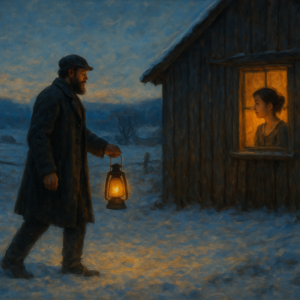
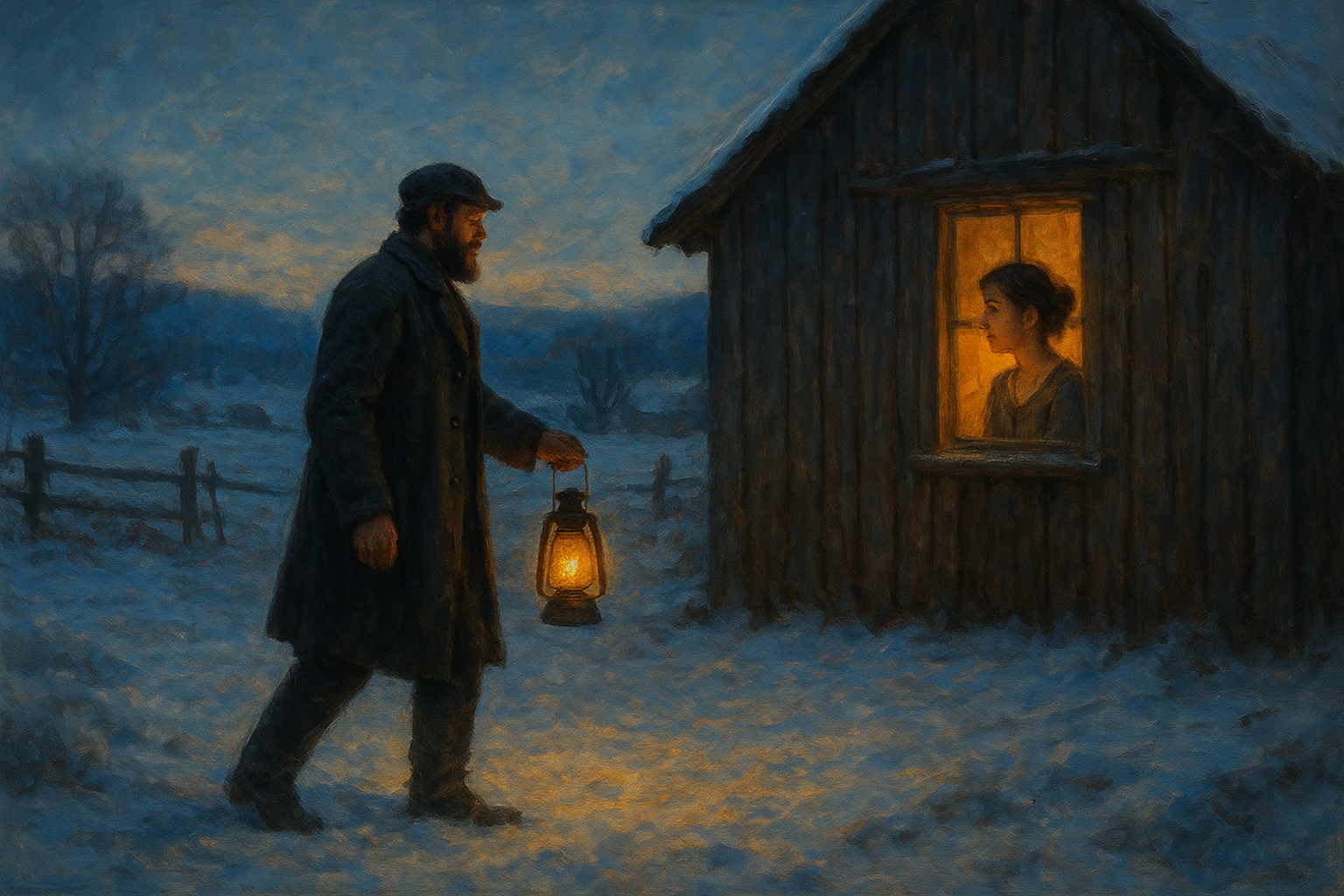
On the fifteenth night, Mary waited until the girls were asleep and then pulled on her coat and went out to the barn.
Jesse was sitting on a bale of hay with a lantern at his feet and a book open in his hands. He looked up when she came in, and his expression flickered with something that might have been surprise.
“You should be inside,” he said. “It’s cold.”
“So is the barn.”
He did not answer.
Mary sat down on the hay beside him. For a long moment, neither of them spoke. The lantern hissed. Somewhere in the dark, one of the horses shifted in its stall.
“I’ve been thinking,” Mary said finally, “about what you said. About your brother.”
Jesse closed the book but did not look at her.
“I was eight,” he said. “He was six. Our father sent us out to the barn to sleep because there wasn’t room in the house. There was a storm. The roof came down.” He paused. “I got out. He didn’t.”
Mary’s throat tightened. “Jesse—”
“I’ve slept in a barn every night for twenty years,” he said. “Because I can’t stand to sleep in a house. Because every time I close my eyes under a roof, I see him.” He finally looked at her. “But I couldn’t let your girls sleep out here. Not after what I saw in that office. Not after what I knew was waiting for them if I didn’t step in.”
Mary reached out and took his hand. His fingers were cold and rough, and they trembled slightly in hers.
“You saved us,” she said. “You know that, don’t you?”
Jesse shook his head. “I just did what any decent man would do.”
“No,” Mary said. “You did what no one else did. That’s different.”
They sat together in the lantern light, and outside the snow began to fall, soft and steady, covering the yard and the fields and the long road that had brought her here.
“Jesse,” she said after a while. “You don’t have to sleep out here anymore.”
He looked at her.
“The girls are asleep,” she said. “And I’m not afraid of you. I haven’t been afraid of you since the first night, when you told me no child would sleep in your barn.”
He was silent for a long time.
Then he nodded, once, and stood, and offered her his hand.
They walked back to the cabin together, and the lantern swung between them, and the snow fell, and somewhere in the dark a night bird called once and fell silent.
And Mary Campbell, who had spent three years learning to survive, began to learn something else entirely.
She began to learn how to hope.