
The 7:42 train to Alexanderplatz was always half-empty on Tuesday mornings. The fluorescent lights hummed their sterile white hymn, bleaching the orange seats and the tired faces of the few commuters who had nowhere better to be. Jonas Keller stood near the doors, one hand wrapped loosely around a worn leather leash, the other buried in the pocket of his dark blue coat. At his side sat a black Doberman, muscles coiled beneath a sleek obsidian coat, ears alert, eyes tracking the rhythm of the tunnel like a sentry on watch.
Jonas had owned Max for three years. Or perhaps it was more accurate to say that Max had owned him. The dog had come into his life at a moment when everything else had fallen apart—a relationship ended, a job lost, an apartment emptied of everything but echoes. Max had been a gift from a friend who couldn’t keep him, and Jonas had accepted the animal with the same numb resignation with which he had accepted everything else that year. But the dog had refused to let him stay numb. Max demanded walks, demanded attention, demanded that Jonas get out of bed every morning and put one foot in front of the other. In return, Jonas had given the dog his loyalty, his discipline, and a love he hadn’t known he still possessed.
The train lurched through a curve, and Max shifted his weight, claws clicking softly against the floor. Jonas glanced down at him, and for a moment, the ghost of a smile crossed his face. The Doberman looked up, brown eyes meeting his, and Jonas felt the familiar warmth of that silent understanding. They were a team. They needed no one else.
That was when the old man moved.
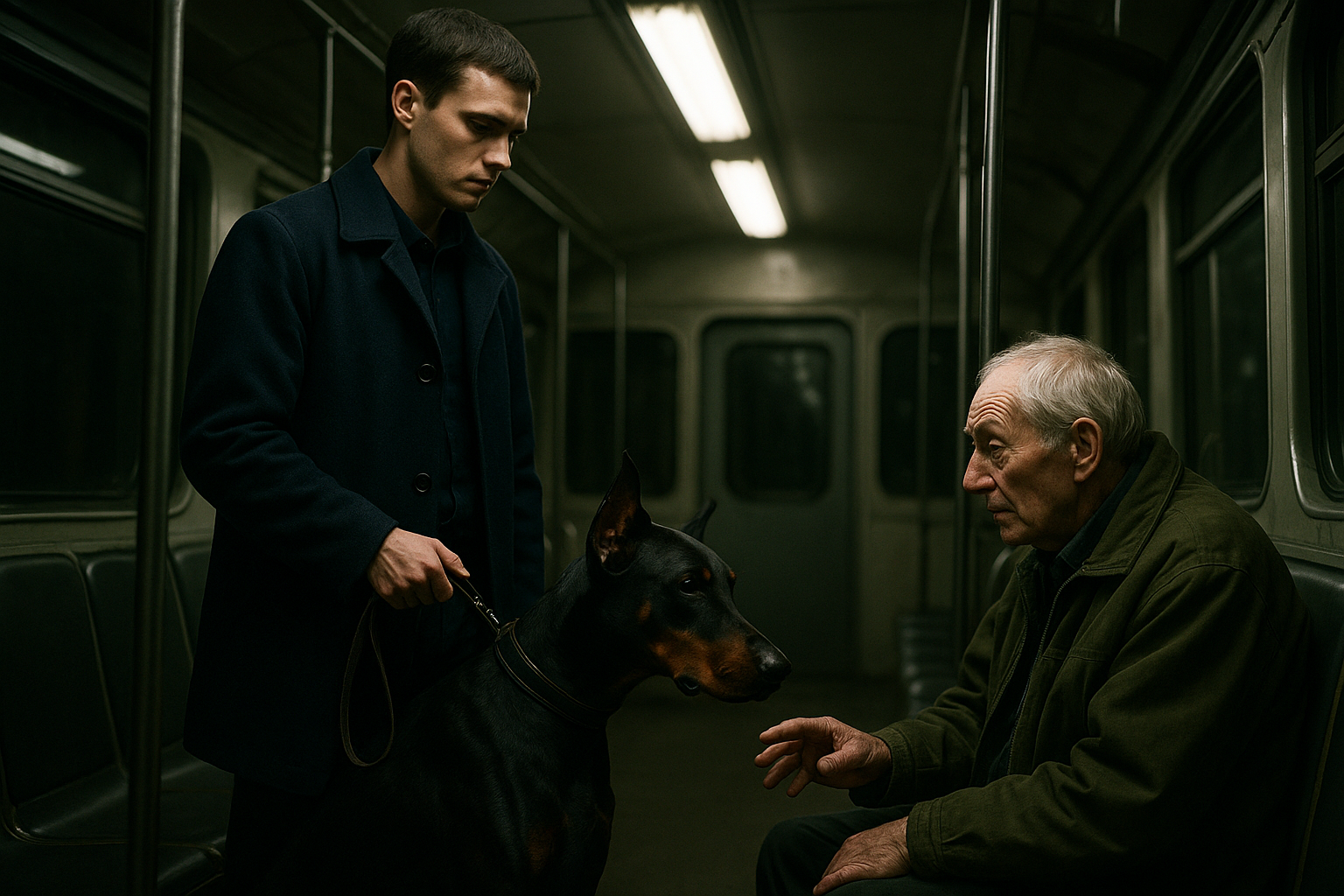
He was sitting on the bench to Jonas’s left, a small, hunched figure in a faded green jacket and grey trousers. His hair was white as winter frost, and his hands, resting on his knees, were gnarled with age. Jonas had noticed him when he’d boarded—had noticed the way the old man’s eyes had fixed on Max with an intensity that made something in his chest tighten. He had ignored it. People looked at Max all the time. The dog was striking, imposing, the kind of animal that drew glances wherever he went.
But this old man wasn’t just glancing. He was staring. And then, slowly, impossibly, he was reaching out.
His hand extended toward Max’s head, fingers trembling, face soft with something that looked almost like longing. Jonas moved before he could think, yanking the leash back sharply. Max stumbled, caught off guard, and let out a low whine of confusion.
“Don’t touch him,” Jonas said, his voice cold and hard, cutting through the hum of the train.
The old man flinched as if he’d been struck. His hand withdrew, falling back to his lap, and for a moment, he looked so utterly defeated that Jonas felt a flicker of something that might have been guilt. But he pushed it down. He had learned long ago not to trust strangers, not to let his guard down, not to let anyone close enough to hurt him or the dog he had come to love more than anything else in the world.
“I’m sorry,” the old man said, his voice thin and reedy. “I didn’t mean to… I just…” He trailed off, his eyes still fixed on Max, and Jonas saw something in them that made his throat tighten. Grief. Deep, old grief, the kind that never quite healed.
“He’s not friendly,” Jonas lied. Max was the gentlest dog he had ever known, but the lie came easily, a shield against the unfamiliar. “You shouldn’t approach strange dogs.”
The old man nodded, but he didn’t look away from Max. “I know,” he said. “I know. It’s just… he looks so much like…” He stopped, swallowing hard, and Jonas saw his eyes glisten in the harsh white light.
Silence stretched between them, broken only by the rhythmic clatter of the train. Jonas should have looked away. He should have turned his attention back to the doors, to the tunnel, to anything but the old man’s grief-stricken face. But something held him there, something he couldn’t name.
“I’m sorry,” the old man said again, and this time his voice cracked. “He just looks like someone I lost.”
Jonas said nothing. What could he say? He had lost people too. He knew the way grief could ambush you in the most ordinary moments—a song on the radio, a scent in the air, a stranger’s face on a crowded train. He knew how it could make you reach for things you had no right to touch.
The old man looked at Max again, and his lips moved, forming a word that Jonas almost didn’t catch.
“Max?”
The name hit Jonas like a physical blow. He stared at the old man, his mind racing, his heart suddenly pounding in his chest. “What did you say?”
The old man looked up at him, and there were tears in his eyes now, tracing silver lines down his weathered cheeks. “Max,” he repeated, his voice barely above a whisper. “That was his name. My dog’s name.”
Jonas felt the world tilt beneath his feet. He looked down at the Doberman, who was watching the old man with an expression that seemed almost… knowing. The dog’s tail gave a single, hesitant wag.
“Your dog?” Jonas repeated, his voice coming out strange and hollow.
The old man nodded, wiping his eyes with the back of his hand. “Three years ago,” he said. “I lost him. Or rather… he was taken from me.” He paused, his jaw tightening. “I was in the hospital. A long stay. And when I came home, he was gone. My neighbor had sold him. Said I couldn’t take care of him anymore. Said it was for the best.”
Jonas’s blood ran cold.
“I looked for him,” the old man continued, his voice breaking. “God, I looked everywhere. Shelters, breeders, the internet. But he was just… gone. Like he’d never existed.” He looked at Max again, and a sob escaped his throat. “And now… now he’s here. On this train. With you.”
Jonas’s mind was a whirlwind. Three years ago. He had gotten Max three years ago, from a friend who had gotten him from a shelter, who had said he’d been surrendered by someone who couldn’t care for him anymore. The timeline fit. The name fit. And the way the dog was looking at the old man—the way he was pulling at the leash now, straining toward him—
“Max,” the old man said again, and this time it wasn’t a question.
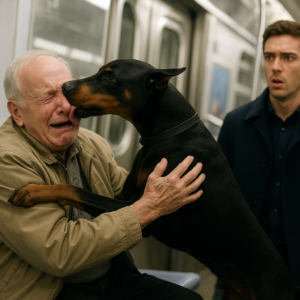
And Max broke free.
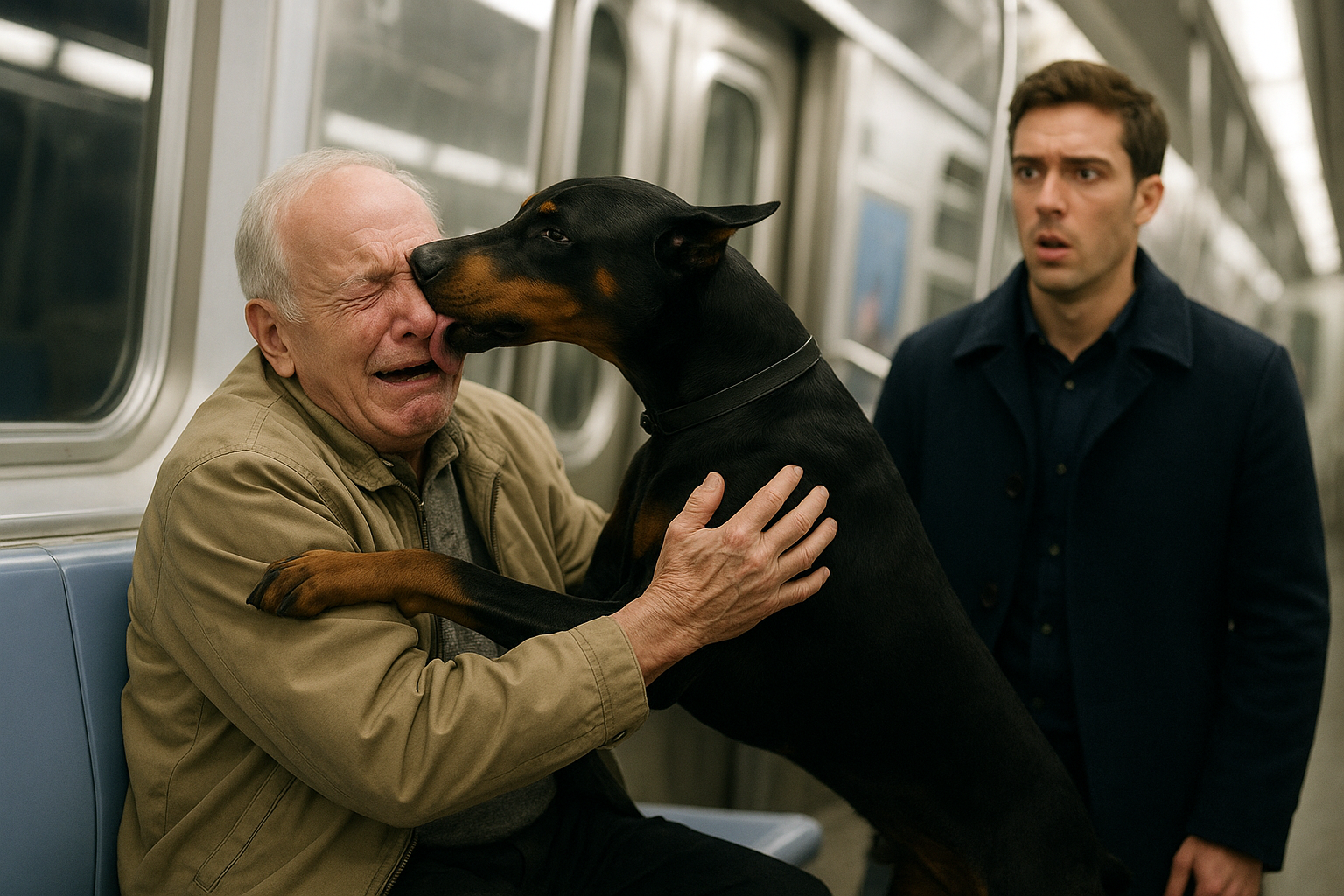
Jonas didn’t even feel the leash slip from his fingers. One moment Max was beside him, and the next he was airborne, a sleek black missile launching itself at the old man. Jonas lunged after him, a cry of alarm rising in his throat, but the sound died when he saw what happened next.
Max didn’t attack. He didn’t growl or snap or bare his teeth. He landed in the old man’s lap and began licking his face with a frantic, desperate joy, his tail wagging so hard it was a blur. The old man let out a sob—a sound of pure, unadulterated happiness—and wrapped his arms around the dog, pulling him close, burying his face in the sleek black fur.
“Oh God,” the old man wept. “Oh God, Max. Max, it’s you. It’s really you.”
The other passengers were staring. Jonas could feel their eyes on him, could hear their whispered comments, but he couldn’t bring himself to care. He stood frozen, watching the reunion unfold before him, and something inside him cracked open.
He had never seen Max like this. The dog was always calm, always controlled, a model of discipline and restraint. But now he was a puppy again, whining and wriggling and licking the old man’s face with an enthusiasm that bordered on manic. And the old man—the old man was laughing through his tears, his hands trembling as they stroked Max’s head, his voice a broken litany of endearments and apologies.
“I thought I’d never see you again,” he whispered. “I thought you were gone forever.”
Jonas’s throat was tight. His eyes were burning. He wanted to look away, wanted to give them privacy, but he couldn’t. He was rooted to the spot, a witness to something he had no right to see.
And then the old man looked up at him, and Jonas saw the question in his eyes. The fear. The hope.
“Where did you get him?” the old man asked, his voice trembling. “Please. I need to know.”
Jonas swallowed hard. “A friend,” he said. “Three years ago. He said he got him from a shelter.”
The old man closed his eyes, a tear escaping down his cheek. “The shelter,” he breathed. “I checked there. I checked everywhere. They told me he’d been adopted. They wouldn’t tell me by whom.”
“I didn’t know,” Jonas said, and his voice sounded strange to his own ears. “I didn’t know he belonged to someone. I thought… I thought he was just a dog who needed a home.”
The old man opened his eyes and looked at him, and there was no anger in his gaze. Only gratitude. “You took care of him,” he said. “You gave him a home. You kept him safe.” He looked down at Max, who was now resting his head on the old man’s chest, eyes closed, tail still wagging lazily. “He’s healthy. He’s happy. You did that.”
Jonas shook his head. “I didn’t—”
“You did,” the old man insisted. “And I will be grateful to you for the rest of my life.”
They sat in silence for a moment, the train rattling on through the darkness. Jonas’s mind was still reeling, still trying to process what was happening. He had spent three years with Max. Three years of early morning walks and late-night cuddles, of training sessions and quiet companionship. Three years of learning to love again, of letting a dog teach him how to trust. And now, in the space of a single train ride, everything had changed.
“What’s your name?” the old man asked.
Jonas blinked. “Jonas. Jonas Keller.”
The old man nodded, a small smile crossing his weathered face. “I’m Walter,” he said. “Walter Huges.”
He extended his hand, and Jonas took it. The old man’s grip was surprisingly strong, his palm rough with callouses that spoke of a lifetime of hard work. “Thank you, Jonas,” he said. “Thank you for taking care of my boy.”
Jonas opened his mouth to respond, but before he could, the old man’s hand moved to Max’s collar. He turned it gently, exposing the small brass tag that hung from the leather.
And there, engraved in neat, precise letters, was a name.
Walter Huges.
Jonas stared at the tag, his heart stopping in his chest. He had seen that tag a hundred times. He had read that name a hundred times. But he had never thought to question it. He had assumed it was a previous owner’s name, a remnant of a past life that had nothing to do with him. He had never imagined—
“Walter Huges,” he said, his voice barely a whisper.
The old man—Walter—nodded, his eyes shining with fresh tears. “That’s me,” he said. “That’s my name.”
Jonas looked from the tag to the old man to the dog, and the full weight of the moment crashed over him like a wave. This wasn’t a coincidence. This wasn’t a chance encounter. This was something else entirely—something that felt almost like fate.
“I don’t understand,” Jonas said, his voice cracking. “How… how is this possible?”
Walter smiled, a sad, knowing smile. “I don’t know,” he said. “But I stopped believing in coincidences a long time ago.” He looked down at Max, who was now licking his chin with lazy contentment. “I prayed for this,” he admitted. “Every night for three years, I prayed that I would see him again. Just once. Just to know he was okay.” He looked up at Jonas, and his eyes were bright with wonder. “And now here he is. Here you are. On this train. At this moment.”
Jonas felt tears prick at his own eyes. He had never been a religious man, had never believed in fate or destiny or any of that. But standing here, watching this old man hold his dog—his dog—he couldn’t help but wonder if there was something more at work. Something bigger than chance.
The train began to slow, and a voice announced the next station. Jonas looked up, startled. He had been so absorbed in the moment that he had lost track of where they were. He glanced at the map above the doors and realized they were only two stops from his own.
Walter must have seen the look on his face, because his grip on Max tightened. “You’re getting off soon,” he said, and it wasn’t a question.
Jonas nodded slowly. “Two more stops.”
Silence fell between them again, heavy with unspoken questions. Jonas knew what Walter was thinking. He could see it in the old man’s eyes, in the way he held Max as if he would never let go. And Jonas knew what he was thinking too—what he had to think, even though it felt like tearing out a piece of his own heart.
“You want him back,” Jonas said.
Walter looked at him, and for a long moment, he said nothing. Then, slowly, he shook his head.
“No,” he said. “I don’t.”
Jonas blinked. “What?”
Walter smiled, and there was something in that smile that broke Jonas’s heart and healed it at the same time. “I want him to be happy,” he said. “And he is happy with you. I can see it. The way he looks at you, the way he responds to your voice—he loves you, Jonas. He loves you the way he used to love me.”
“But—”
>“I’m old,” Walter said, and his voice was gentle. “I’m seventy years old. I don’t know how much time I have left. And Max—Max deserves someone who can run with him, who can take him on long walks, who can be there for him for years to come.” He looked down at the dog, and a tear slid down his cheek. “I can’t give him that anymore. But you can.”
Jonas shook his head, his own tears falling now. “That’s not fair,” he said. “You’ve waited three years. You’ve prayed for this. You can’t just—”
“I can,” Walter said, and his voice was firm. “Because I love him. And loving someone means wanting what’s best for them, even if it’s not what you want for yourself.” He reached up and cupped Jonas’s face in his hand, a gesture so tender it made Jonas’s breath catch. “You gave him a home when I couldn’t. You gave him love when I thought he was lost forever. And now… now I’m giving him back to you.”
Jonas was crying openly now, tears streaming down his face, and he didn’t care who saw. “I can’t take him from you,” he said. “Not after everything—”
“You’re not taking him,” Walter said. “I’m giving him. There’s a difference.” He smiled, and it was the most beautiful smile Jonas had ever seen. “Besides, I have a feeling we’ll see each other again. Don’t you?”
Jonas looked at him, and despite everything—despite the tears and the heartbreak and the impossible weight of the moment—he found himself smiling back. “Yeah,” he said. “I think we will.”
The train began to slow again, and Jonas knew it was time. He reached down and gently took Max’s leash, and the dog looked up at him, then back at Walter, as if asking permission. Walter nodded, his eyes shining.
“Go on, boy,” he said softly. “Go with Jonas.”
Max hesitated for a moment, then licked Walter’s hand one last time before turning and pressing himself against Jonas’s leg. Jonas looked at Walter, and Walter looked at him, and in that moment, something passed between them—an understanding, a promise, a bond that would never be broken.
“I’ll take care of him,” Jonas said. “I swear.”
Walter nodded. “I know you will.”
The doors opened, and Jonas stepped out onto the platform, Max at his side. He turned back, and through the closing doors, he saw Walter raise his hand in a wave. Jonas waved back, and then the train was gone, disappearing into the tunnel, taking Walter with it.
Jonas stood there for a long moment, the cold air of the station swirling around him, Max’s leash warm in his hand. He looked down at the dog, and Max looked up at him, and Jonas felt something shift inside him—something that had been closed off for a long time, finally opening.
He had spent years building walls, keeping people out, protecting himself from the pain of loss. But Walter had shown him something different. Walter had shown him that love wasn’t about holding on—it was about letting go. It was about trusting that the people we love will be okay, even when we can’t be there to see it.
Jonas knelt down and wrapped his arms around Max, burying his face in the dog’s warm fur. “We’re going to be okay,” he whispered. “We’re both going to be okay.”
Max licked his ear, and Jonas laughed, a sound that was half sob and half joy. He stood up, wiped his eyes, and began to walk toward the exit, the click of Max’s claws on the concrete a familiar, comforting rhythm.
But as he walked, he made a decision. He would find Walter. He would bring Max to visit him, as often as he could. Because Walter was right—they would see each other again. And when they did, Jonas would make sure that the old man knew he wasn’t alone. That he had a family now, too. A strange, unlikely family, bound together by a dog and a chance encounter on a Tuesday morning train.
Three weeks later, Jonas stood outside a small apartment building on the outskirts of the city, Max’s leash in one hand and a bag of groceries in the other. He had spent the past three weeks tracking down Walter Huges, following a trail of phone calls and dead ends and frustrating conversations with bureaucrats who didn’t understand why he was so insistent. But he had done it. He had found him.
He knocked on the door, his heart pounding in his chest. For a moment, there was silence. Then the door opened, and Walter stood there, his eyes wide with shock.
“Jonas?” he said, his voice barely a whisper.
Jonas smiled, and Max’s tail began to wag so hard it was a blur. “We brought dinner,” he said. “And someone wanted to see you.”
Walter’s eyes filled with tears, and he opened the door wide, his hands trembling. “Come in,” he said. “Please. Come in.”
Jonas stepped inside, and Max bounded forward, launching himself at Walter with the same joyful abandon he had shown on the train. Walter laughed, a sound of pure, unadulterated happiness, and wrapped his arms around the dog, holding him close.
“I can’t believe you found me,” he said, looking up at Jonas. “How did you—”
“It wasn’t easy,” Jonas admitted. “But I had a good reason.” He set the groceries down on the small kitchen table and looked around the apartment. It was modest but clean, filled with books and photographs and the small, quiet details of a life well-lived. And there, on the mantelpiece, was a framed picture of a black Doberman puppy, ears too big for his head, eyes bright with mischief.
“That’s him,” Walter said, following his gaze. “That’s Max. When he was a puppy.”
Jonas walked over to the mantelpiece and picked up the photograph, studying it. “He was beautiful,” he said.
“He still is,” Walter said, and his voice was soft with love. “Thanks to you.”
They spent the evening together, the three of them—Jonas and Walter and Max—sharing stories and laughter and a simple meal of soup and bread. Walter told Jonas about his life, about his late wife and his years as a carpenter, about the day he had brought Max home as a tiny puppy and the years of joy that had followed. Jonas told Walter about his own struggles, about the darkness he had been living in before Max had come into his life, about the way the dog had saved him.
And as the night wore on, something began to grow between them—a friendship, a kinship, a bond that went beyond the dog they both loved. They were two lonely men, separated by age and circumstance, brought together by a chance encounter and a shared love for a remarkable animal.
When Jonas finally left, promising to return the following week, Walter stood in the doorway and watched him go, Max trotting at his side. The old man’s heart was full in a way it hadn’t been in years. He had lost so much—his wife, his dog, his sense of purpose. But now, somehow, he had found something new. A friend. A companion. A reason to keep going.
And as he closed the door and turned back to his quiet apartment, he smiled. Because he knew, with a certainty that surprised him, that this was only the beginning.
The story of Max and Walter and Jonas was far from over. It was, in fact, just beginning. And whatever came next, Walter knew that he would face it with an open heart and a grateful spirit. Because sometimes, the universe had a way of giving back what we thought was lost forever. Sometimes, if we’re lucky, we get a second chance.
And sometimes, that second chance comes in the form of a black Doberman on a Tuesday morning train, with a name tag that reads Walter Huges.