
No one in the diner stirred.
Not the waitresses. Not the bikers. Not even Rex.
The words felt too surreal to belong in that room.
Your grandfather’s cane.
Rex stared at the old man as if he had heard him wrong.
Then the diner door swung open, and two men in dark suits walked in with a woman carrying a leather file case. They weren’t police. They didn’t need to be. The way they moved made the whole place clear out without a word.
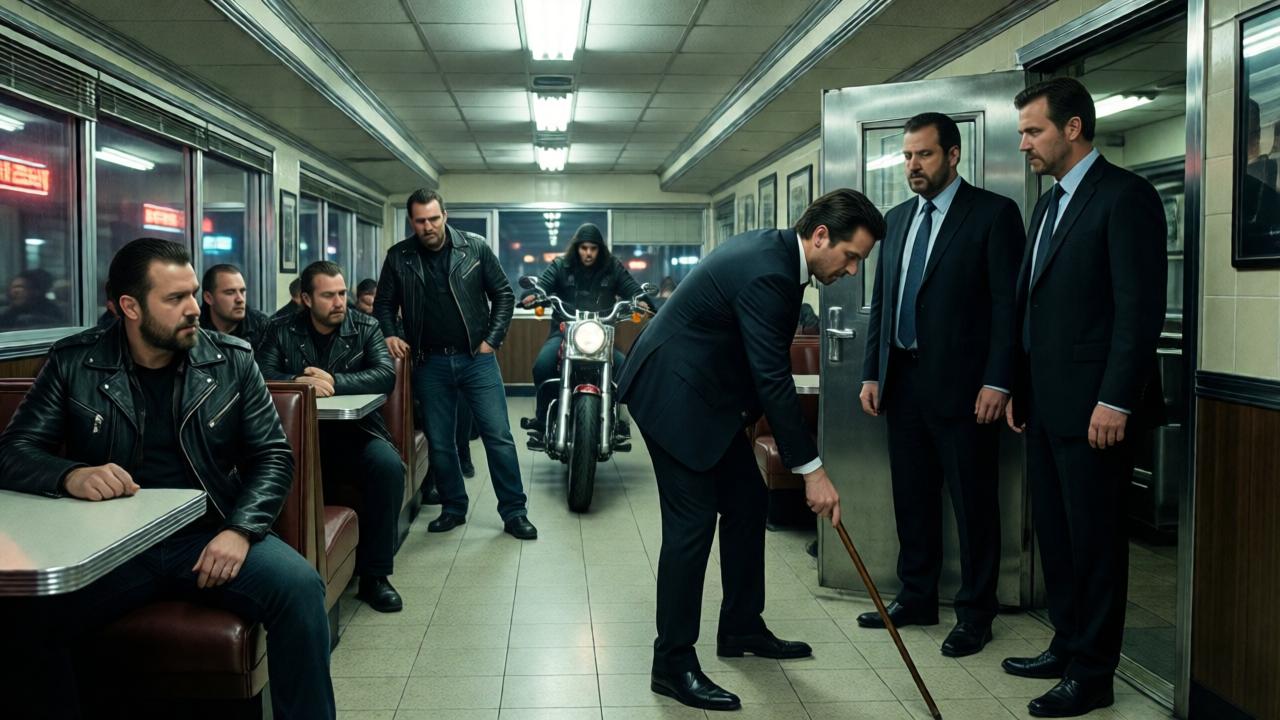
One of them bent down, picked up the cane from the floor, and handed it carefully back to Mr. Hale.
The old man took it without breaking eye contact with Rex.
“What kind of game is this?” Rex asked, but now his voice had a tremor.
Mr. Hale didn’t answer.
Instead, he said, “Take off the vest.”
Rex’s shoulders immediately tensed.
One of the bikers behind him muttered, “Rex…”
The old man gave a slight nod toward the woman with the file.
She opened it and took out a photograph.
Then she set it down on the table.
It depicted a young man in a leather vest, standing next to a motorcycle, grinning recklessly at the camera.
On the inside of his collar was the same faded silver hawk emblem.
Rex looked down at it.
Because the man in the photograph had his eyes.
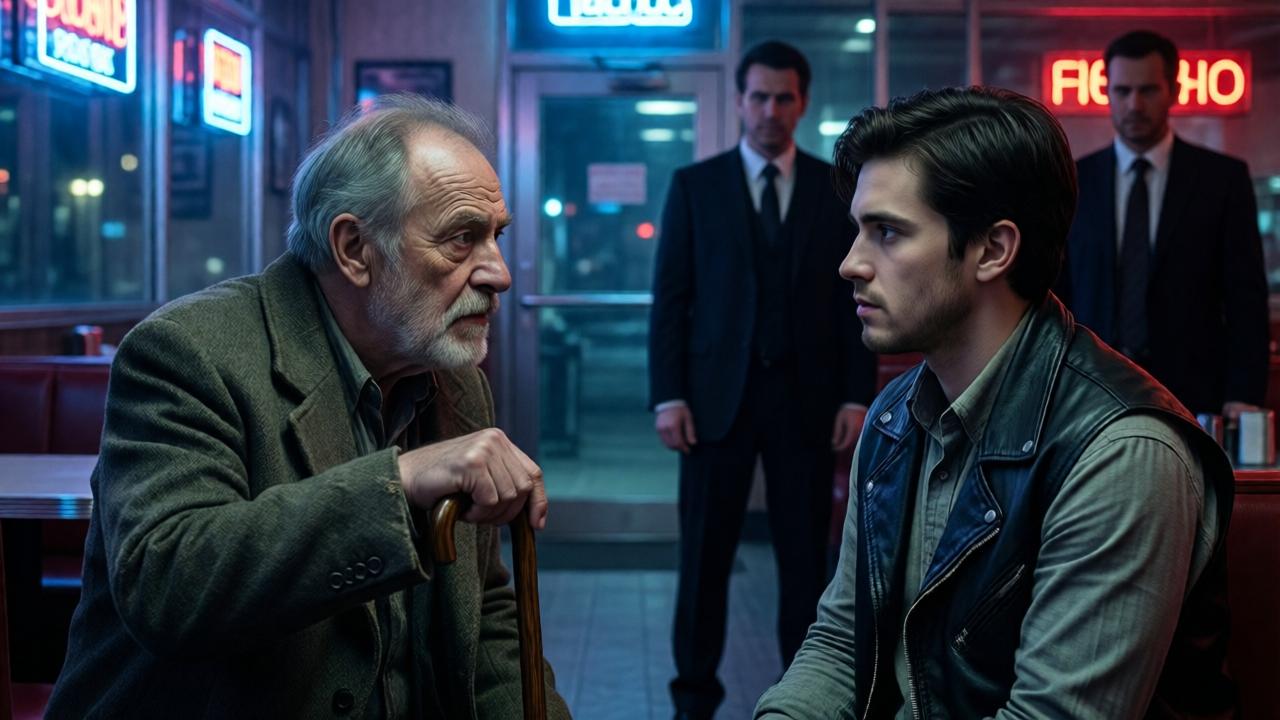
His exact lopsided half-smile.
The old man finally spoke again.
“His name was Ethan Hale. He was my son.”
The entire diner fell silent.
“My mother told me my father was dead,” he said quietly.
Mr. Hale’s face tightened.
“He is,” he said. “For twenty-two years.”
“Then how do you know me?”
The old man rested both hands on his cane and answered as if it cost him something to breathe.
“Because Ethan disappeared before he could bring you home.”
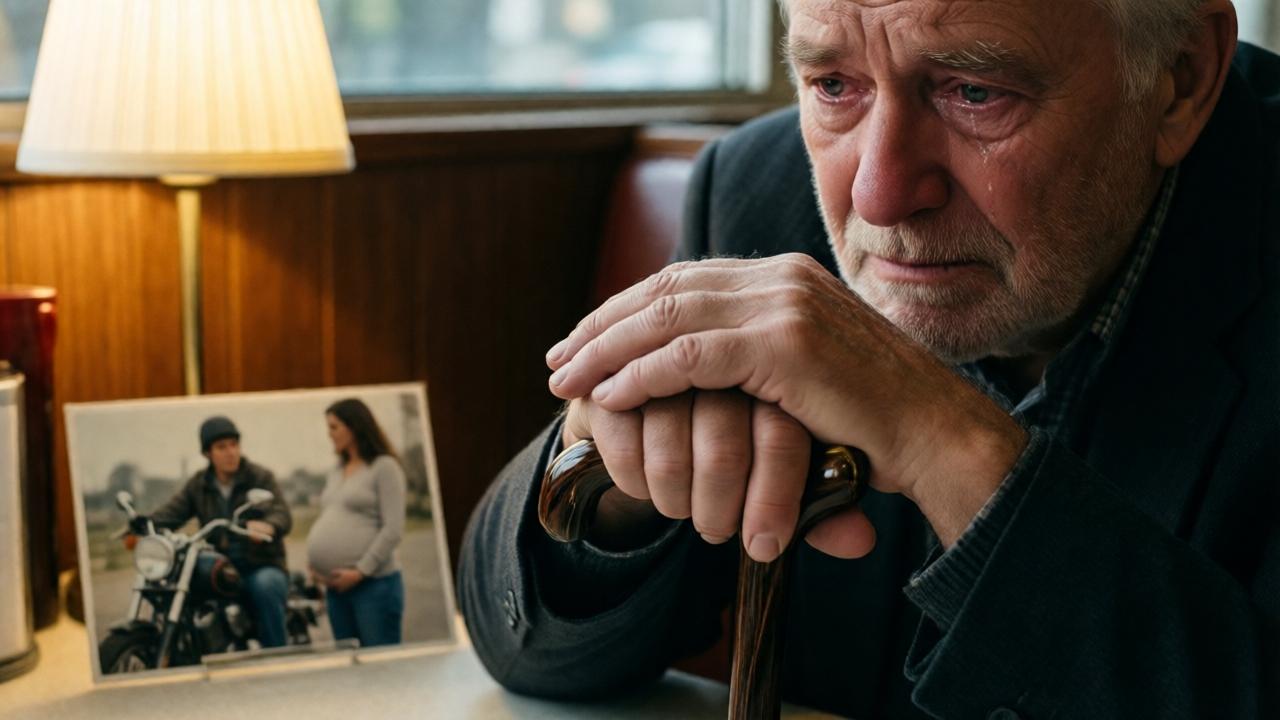
The woman next to him reopened the folder and pulled out a second photo—this one older, with worn edges. A younger Ethan stood beside a pregnant woman outside a trailer, one hand placed protectively over her belly.
Rex’s face turned pale.
That was his mother.
“I hired people to look for him for years,” Mr. Hale said. “But your mother ran after Ethan was killed. She thought I blamed her for taking him away from the family. I didn’t.” His voice grew rough. “I just never found her.”
Rex stared at the photos as if they were shifting beneath his gaze.
The entire diner—the leather, the tough attitude, the laughter—all suddenly seemed fragile.
“My mom…” he began, then paused. “She passed away last winter.”
The old man shut his eyes for a moment.
When he opened them, they were moist.
“She kept you from me because she was afraid,” he said. “And I stayed away too long because I was stubborn.” Then he looked at Rex with raw honesty. “We both let you down.”
That struck harder than any yell ever could.
One of the bikers in the back slowly dropped into a booth, speechless.
Rex looked down at the silver hawk patch on his vest.
“My mom sewed that back on every time it ripped,” he said. “She told me it was the only thing my father left me.”
Mr. Hale reached into his coat and took out a small metal box. Inside was an identical patch—old, faded, kept safe for years.
“Your grandmother made them,” he said. “One for Ethan. One to keep at home.” His voice cracked. “I never thought I’d see the other one again.”
Rex’s expression then shifted.
The arrogance vanished.
The mockery disappeared.
He suddenly appeared much younger than the giant biker everyone had feared.
More like a lost boy draped in too much leather.
He glanced at the cane in Mr. Hale’s hands.
Then at the shattered glass on the floor.
Then at the old man himself.
“I didn’t know,” he said.
Mr. Hale slowly nodded.
Rex took a single step forward.
This time, the other bikers didn’t laugh.
He bent down, retrieved the old man’s spilled napkin from the table, then looked ashamed at how insignificant that gesture was compared to what he had done.
“I’m sorry,” he said, and his voice had lost all its cockiness. “I thought you were just some old man.”
Mr. Hale offered a sad, slight smile.
“I was,” he said. “Until I saw my son in your face.”
That shattered whatever remained of Rex’s composure.
He ripped off the leather vest, stared at the silver hawk patch sewn inside, and for the first time in his life understood why his mother had wept every time she touched it.
“My real name isn’t Rex, is it?” he asked.
Mr. Hale’s grip on the cane tightened.
“No,” he said softly. “Your name is Eli Hale. Ethan named you before you were born.”
Rex — Eli — let out a shaky breath and collapsed into the empty diner booth across from him, as if his legs could no longer trust the floor.
For a long moment, grandfather and grandson simply gazed at each other across the same table where humiliation had begun just minutes earlier.
Then Eli whispered the question that had been absent from his entire life:
Mr. Hale answered immediately.
“With everything he had.”
But this time it wasn’t cruel.
Mr. Hale slowly extended the cane.
Eli looked puzzled.
The old man’s voice trembled.
Eli rose immediately, stepped forward, and gently placed the cane into his grandfather’s grasp.
Then, with equal care, he offered his arm.
The old man accepted it.
And in that roadside diner, with broken glass scattered on the floor and black SUVs waiting outside, the biker who had entered laughing helped his grandfather rise—
not because he was commanded to,
but because family had finally reunited with family.