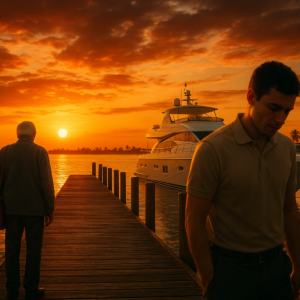

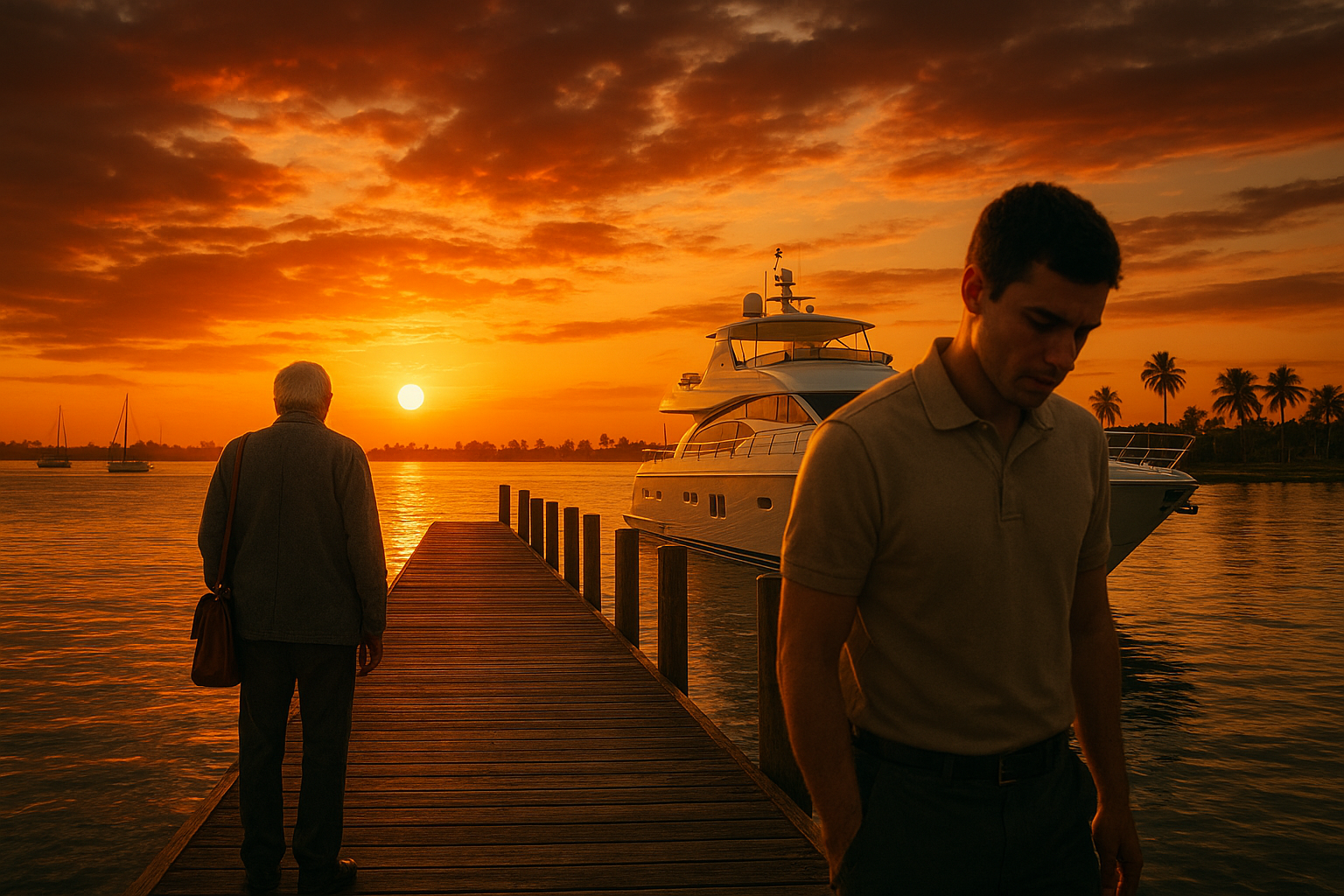
The sun hung low over the marina, bleeding orange and gold across the water. The wooden pier creaked gently underfoot as an elderly man walked slowly toward the end of the dock. His name was Arthur, and he carried a brown leather bag that had seen better days. His gray jacket was worn at the elbows, his brown shoes scuffed from years of walking. He stopped in front of a large white yacht, its hull gleaming like a pearl in the dying light. Palm trees swayed in the background, their fronds whispering secrets to the evening breeze.
Arthur reached out and touched the hull. The fiberglass was cool under his fingertips. He closed his eyes for a moment, and when he opened them, a young man had appeared beside him. He was in his late twenties, with short dark chestnut hair and a beige polo shirt that fit him too well to be off the rack. His name was Leo, and he smiled easily.
“Beautiful, isn’t she?” Leo said, his voice calm and neutral.
Arthur didn’t look at him. He kept his hand on the hull. “She still is.”
Leo tilted his head, studying the old man. There was something in Arthur’s voice—a weight that didn’t match the lightness of the evening. Leo had been selling yachts for six years, and he’d learned to read people. Arthur wasn’t just admiring the boat. He was remembering something.
“You’ve seen her before,” Leo said. It wasn’t a question.
Arthur finally turned. His gray eyes were tired but sharp. “A long time ago.”
Leo pointed at the yacht. “The main lounge opens straight onto the aft deck. Teak flooring, retractable glass doors. She’s one of the finest vessels we’ve ever had in this marina.”
Arthur nodded slowly. “You know her well.”
Leo shrugged, a small smile playing on his lips. “I try to.”
Before Arthur could respond, a third man approached. He was in his fifties, with short dark hair graying at the temples and a well-trimmed beard. He wore a dark navy blazer over a light purple shirt—the uniform of someone who believed authority could be tailored. His name was Victor, and he was the owner of the dealership. His eyes narrowed as he took in the scene.
“What are you doing?” Victor asked, his voice stern.
Leo didn’t flinch. “Helping a customer.”
Victor glanced at Arthur—at his worn jacket, his scuffed shoes, the leather bag that looked like it had been through a war. Then he looked back at Leo with an expression that said everything his words didn’t.
“You have real buyers waiting,” Victor said, his tone demanding. “Mr. and Mrs. Harrington are inside. They’re ready to sign.”
Leo stood his ground. “He deserves the same service.”
Victor’s jaw tightened. “Then you’re done here. Turn in your badge.”
The words hung in the air like a thundercloud. Arthur watched the exchange with a strange calm, as if he had seen this play before and knew how it ended. Leo’s face flushed, but he didn’t argue. He reached into his pocket, pulled out a laminated badge, and held it out to Victor.
Victor snatched it. “Clean out your desk. Security will walk you out.”
Leo nodded once. Then he turned to Arthur. “I’m sorry,” he said quietly. “I hope you find what you’re looking for.”
Arthur smiled—a real smile, the first of the evening. “I already have.”
Victor watched Leo walk away, then turned back to Arthur. “I’m going to have to ask you to leave,” he said. “This is a private showing.”
Arthur didn’t move. Instead, he reached into his brown leather bag and pulled out a car key. It was sleek and black, with a silver emblem that Victor didn’t recognize. Arthur held it up, and Victor’s eyes widened.
“I believe this works,” Arthur said calmly.
He pressed the button. On the yacht, lights flickered to life. The cabin windows glowed warm amber. The aft door slid open with a soft hydraulic hiss. Music—soft jazz—drifted across the water. Victor’s mouth fell open.
“Where did you get that?” Victor asked, his voice barely a whisper.
Arthur pocketed the key. “I bought this yacht thirty years ago,” he said. “I sold her when my wife died. I couldn’t bear to look at her anymore. But I kept the key. I always told myself I’d come back.”
Victor’s face went pale. “You’re Arthur Ellington?”
Arthur nodded. “I am.”
Victor took a step back. Arthur Ellington was a legend in the maritime world. He had built the largest yacht brokerage on the West Coast before retiring to a quiet life in the mountains. The dealership Victor now owned had once been Arthur’s. The yacht—The Sunset Key—had been his crown jewel.
“I didn’t know,” Victor stammered. “I didn’t—”
“You didn’t know because you didn’t ask,” Arthur said. “You saw an old man in a worn jacket and assumed he had nothing to offer. That’s the problem with this business. You’ve forgotten that boats are about people, not profits.”
Victor opened his mouth to respond, but a fourth figure emerged from the yacht. He was in his sixties, with short dark hair and a crisp white captain’s uniform. His name was Captain James, and he had served on The Sunset Key for twenty years—first under Arthur, then under the dealership.
“Mr. Ellington,” James said, his voice thick with emotion. “We’ve been waiting for you.”
Arthur’s eyes glistened. “Hello, old friend.”
James stepped onto the pier and clasped Arthur’s hand. “The crew never left. We’ve maintained her exactly as you specified. Every system, every finish, every detail. We knew you’d come back.”
Victor looked between them, his face a mask of confusion and dawning horror. “Wait—the crew? You mean the staff I’ve been paying for? They’ve been working for him?”
James turned to Victor with a cold stare. “We’ve been working for the rightful owner. You were just a caretaker.”
Arthur stepped onto the yacht. The deck felt familiar under his feet, like a handshake from an old friend. He walked to the helm, ran his fingers over the wheel, and closed his eyes. For a moment, he was thirty years younger, with his wife beside him, laughing as the wind whipped through her hair.
“I’m home,” he whispered.
Leo, who had been watching from the end of the pier, turned back. He had heard everything. He walked toward the yacht, and Arthur saw him.
“You,” Arthur said. “What’s your name?”
“Leo.”
“Leo, you lost your job because you treated me like a human being. That’s the kind of person I want on my crew. How would you like to work for me?”
Leo’s eyes widened. “Doing what?”
“Learning the business. The real business. The one where people matter more than paychecks.”
Leo looked at Victor, who was standing frozen on the pier. Then he looked back at Arthur. “I’d be honored.”
Arthur smiled. “Good. Now, let’s take her out. The sunset won’t last forever.”
Victor watched as the yacht’s engines hummed to life. The gangway retracted. The lights of The Sunset Key grew brighter as she pulled away from the dock. Arthur stood at the helm, Leo beside him, Captain James at the ready. The sun dipped below the horizon, and the sky turned from orange to purple to deep, starry black.
Victor was left alone on the pier, holding a laminated badge that no longer meant anything. He looked at it for a long moment, then dropped it into the water. It sank without a sound.
Onboard, Arthur handed Leo the key. “Hold onto this,” he said. “One day, it’ll be yours. But only if you remember what it stands for.”
Leo looked at the key, then at the old man. “What does it stand for?”
Arthur gazed out at the darkening sea. “Second chances.”
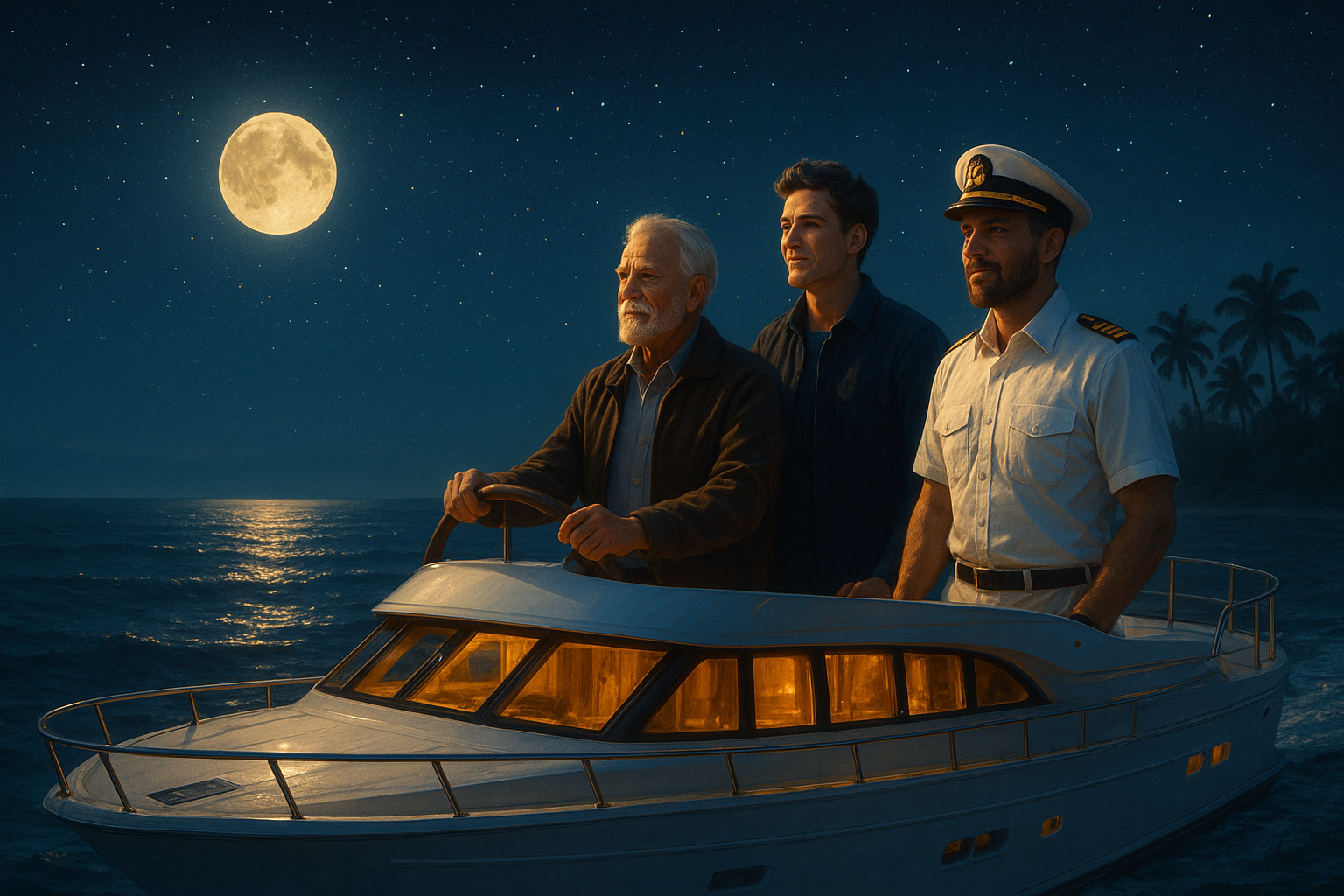
The yacht cut through the water, leaving a trail of white foam that glittered under the moonlight. Arthur steered her toward the open sea, away from the marina, away from the memories that had haunted him for three decades. Leo stood beside him, silent, watching the horizon.
“You know,” Arthur said after a while, “I almost didn’t come tonight. I drove down here three times last week and turned around each time. I told myself it was too late. That she’d be gone. That someone else would have ruined her.”
“But you came,” Leo said.
“I came because I realized something. It’s never too late to reclaim what’s yours. Not the boat—the boat is just fiberglass and teak. But the life. The memories. The person you were before you let fear take over.”
Captain James appeared with three glasses of champagne. “A toast,” he said. “To Mr. Ellington. To The Sunset Key. And to new beginnings.”
They clinked glasses. The champagne was cold and crisp, and it tasted like victory.
“What happens now?” Leo asked.
Arthur took a sip of his champagne. “Now we sail. We visit every port I ever promised my wife we’d see. We take on charters for people who’ve been told they don’t belong. We prove that kindness is not a weakness.”
“And Victor?”
Arthur laughed—a deep, genuine laugh that echoed across the water. “Victor will learn. Or he won’t. Either way, he’s not my problem anymore.”
They sailed through the night, and by morning, they were far from the marina. The sun rose behind them, painting the sky in shades of pink and gold. Arthur handed the wheel to Leo and went below deck. In the master cabin, he opened a drawer and pulled out a photograph. It was his wife, Sarah, smiling at the camera, her hair blowing in the wind. She had been gone for twelve years, but she was still with him. She was in every plank of wood, every stitch of fabric, every breath of sea air.
“I kept my promise,” he whispered. “I came back.”
He kissed the photograph and placed it on the nightstand. Then he went back up to the deck, where the sun was waiting.
***
Three months later, The Sunset Key docked in a small coastal town in Maine. Arthur had turned the yacht into a floating classroom, teaching young people from underprivileged backgrounds the art of sailing and the business of hospitality. Leo had become his right hand, and Captain James had trained a new crew—all of them handpicked for their kindness, not their credentials.
One afternoon, a young woman named Maya approached the yacht. She was nineteen, with tired eyes and a duffel bag that held everything she owned. She had heard about the program from a friend and had hitchhiked three hundred miles to apply.
Arthur met her at the gangway. “You look like you’ve been through a lot,” he said.
Maya nodded. “I have.”
“Good. That means you’ll appreciate this more than most.” He handed her a key. “Welcome aboard.”
Maya looked at the key, then at the yacht, then at Arthur. “Why me?”
Arthur smiled. “Because someone once gave me a second chance. I’m just paying it forward.”
He led her onto the deck, where Leo was teaching a group of six young people how to tie a bowline knot. The sun was setting, casting the same orange glow that had bathed the marina all those months ago. But this time, Arthur wasn’t standing on the outside, looking in. He was home.
And The Sunset Key was exactly where she belonged—on the water, under the sky, carrying people toward their own second chances.
As the sun dipped below the horizon, Arthur stood at the bow and watched the stars appear. He thought of Sarah, of the life they had built, of the years he had spent running from his grief. He thought of Leo, who had risked his job for a stranger. He thought of Victor, who had lost everything because he couldn’t see past a worn jacket.
And he thought of the key in his pocket—the one he had kept for thirty years, the one that had unlocked not just a yacht, but a future.
“Thank you,” he whispered to the sea. “For waiting.”
The sea, as always, kept its secrets. But it also kept its promises. And so did Arthur Ellington.
The End