

Tales

The Tears in the Soup: A Story of Compassion That Built a Legacy

The air in the bistro was thick with the clatter of cutlery and murmured conversations, but it all seemed to hush when she walked in. A young woman, alone, carrying an invisible weight that made her beauty seem almost secondary. All eyes followed her to a corner table. “Some stared because she was very beautiful,” the story goes. “Some whispered, why is she alone?” She ordered quietly, a simple soup, and tried to become one with the wallpaper.

Then, the first tear fell. Then another. Silent and relentless, they dripped into her bowl as she mechanically continued to eat. The room’s atmosphere shifted from curiosity to acute discomfort. The men who had admired her from afar now found their napkins suddenly fascinating. A woman at the next table clicked her tongue in thinly veiled disgust. In that sea of averted gazes, only one person moved: Leo, the waiter with kind eyes and a patient stride.

A cinematic shot from behind a young woman sitting alone at a restaurant table, her shoulders slightly slumped. A bowl of soup is before her, and a single, perfect tear is caught in the light as it falls from her cheek towards the broth. The restaurant background is softly blurred, with other patrons as indistinct, judgmental shapes. Warm, golden-hour lighting streams through a window, highlighting the tear and her profile, creating a mood of poignant isolation. Style: photorealistic, emotional, with a shallow depth of field.


He didn’t ask if she was okay; he could see she wasn’t. Instead, he sat near her, not across from her, to avoid feeling confrontational. “I don’t know what you’re going through,” Leo said softly, his voice a gentle anchor in her storm, “but I hope you’re okay.” She looked up, her eyes glistening. “I have a rare condition,” she explained, her voice trembling. “Sometimes I cry or laugh without control. People think I’m strange. They leave.” With a tenderness that spoke volumes, Leo took a napkin and kindly wiped her cheeks. “There is nothing strange about you,” he said. “You are beautiful just the way you are, and you don’t have to sit alone.”

At that moment, the manager, a stern-looking man named Arthur, approached. Leo sprang to his feet, bracing for a reprimand for sitting with a customer. But Arthur’s face softened into a proud smile. “You showed her respect when others judged her,” he said to Leo. Then he turned to the young woman, his voice thick with emotion. “This is my daughter, Clara,” he announced to the now-attentive room. “Many men saw her beauty, but today, someone saw her heart.”
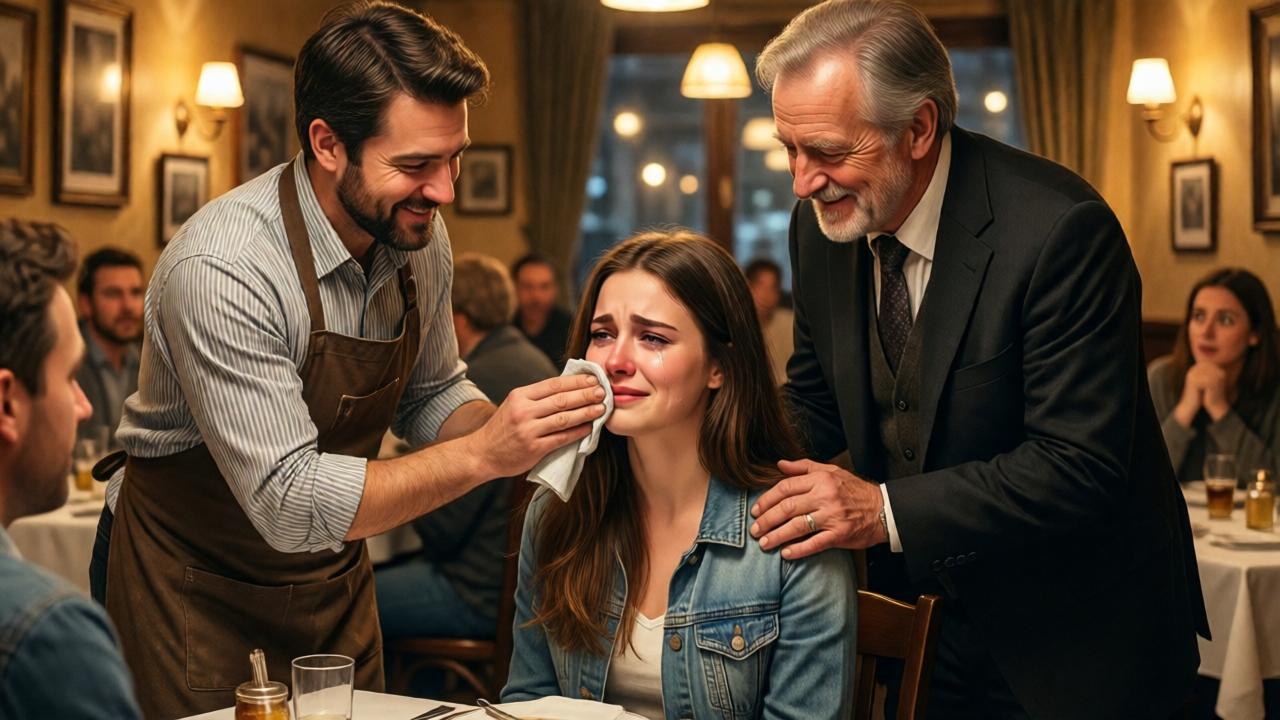
A heartwarming scene in a cozy restaurant. A kind-faced waiter in an apron is gently wiping the cheek of a tearful young woman at a table. An older man, the manager, stands beside them with a hand on the waiter's shoulder, smiling warmly down at the pair. The lighting is soft and amber, casting a glow on the intimate moment. Other customers in the background are watching with softened, surprised expressions. Style: realistic painting, emphasizing emotional connection and warmth.


That moment was the first page of their story. Part Two began not with a grand gesture, but with a quiet coffee after her father’s shift ended. Leo learned that Clara’s condition was neurological, called Pseudobulbar Affect, and he made it his mission to learn everything about it. Their friendship, built on that initial compassion, slowly blossomed into love. “You never made me feel like I needed to be fixed,” Clara told him one evening. “You just learned my weather.” Years later, they stood in that same restaurant, now as husband and wife, beaming at their own children playing in a refurbished corner.

When Arthur finally retired, he didn’t auction the family business. He called Leo and Clara into his office. Placing the old keys into Leo’s hand, he said, “I’m not giving this to my son-in-law. I’m giving it to the man who saw a person crying and saw a person, not a spectacle.” They renamed the place “The Compassion Plate,” and it became known not just for its food, but for its ethos. They trained their staff to see beyond the surface, creating a sanctuary where anyone could dine in peace, tears or laughter included.

A vibrant, joyful scene years later inside 'The Compassion Plate' restaurant. A now-married couple, Leo and Clara, stand behind the counter smiling, with an older man, Arthur, sitting contentedly at a table nearby. Two small children are laughing and drawing on paper placemats. The restaurant is bustling and full of light, with plants and photos on the walls. The mood is one of legacy, family, and enduring kindness. Style: bright, detailed illustration, reminiscent of a heartwarming storybook finale.


The story that began with tears in a soup bowl became a local legend, a testament to a simple truth Leo often shared with new hires: “Anyone can be dazzled by a smile. But it takes a different kind of sight to see the beauty in someone’s tears, and the courage to walk toward them. That’s where real connections are built.” Sometimes love doesn’t start with beauty; it starts with a napkin, a kind word, and the compassion to sit beside someone, even when the world tells you to look away.

Related Posts

Close-up of a tense conversation between an older gentleman in a navy suit and a young maid in a black uniform, the woman's face determined yet anxious, the man's expression angry and demanding, with a blurred elegant woman in the background, cinematic lighting.

The Envelope of Truth

The marble floors of the villa gleamed under the soft glow of the crystal chandelier, casting dancing shadows across the high ceilings. In this palace of opulence, secrets…

A bustling American diner interior with red and white checkered tablecloths and red vinyl booths, bright natural light streaming through large windows, a young European waitress with dark chestnut hair in a black blouse and white apron smiling as she serves a plate of eggs and toast to an elderly homeless man with long gray hair and beard in a worn brown jacket, cinematic realistic style, warm morning ambiance

The Owner’s Test

The morning sun streamed through the windows of Rosie’s Diner, casting a warm glow over the red-and-white checkered tablecloths and the gleaming chrome of the counter. The air…

A cinematic street scene outside a bustling diner on a sunny day. A man in a black suit aggressively points at an older man in a denim jacket seated at a table. The suited man's face is red with anger, while the older man remains calm. The background shows blurred patrons and a silver trash bin. Realistic, natural lighting, shallow depth of field, tense atmosphere.

The Lease on the Table

The midday sun beat down on the cracked pavement outside Rosie’s Diner, where the smell of grilled onions and stale coffee mingled with the exhaust of passing cars….

A close-up dramatic shot of an elderly man with grey hair and beard holding a black smartphone to his ear, his expression unreadable, while a bald tattooed man stands behind him with a mocking smirk, other bikers visible in the background, glass shards glinting on the table, moody lighting with a sense of impending confrontation

The Glass Rooster and the Coming Storm

The kitchen smelled of stale bread and fresh violence. Viktor, sixty-eight, sat motionless at the oak table, a half-eaten sandwich on the plate before him. His black leather…

A wide shot of a luxurious modern office lobby with high ceilings, polished floors, and glass walls, golden turnstiles with green lights in the foreground, an elderly man in a worn coat holding an old flip phone, a stern executive in a suit, and a young female assistant in the background, cinematic lighting, warm golden tones mixing with cool glass reflections

The Chairman’s Call

The lobby of Meridian Tower was a cathedral of glass and polished stone, a monument to corporate success. Sunlight streamed through the vast windows, catching the golden turnstiles…

A grey sky over an asphalt road, a convoy of black Mercedes-Benz G-Wagen and Bentley SUVs approaching a modern building with concrete walls, ominous and powerful mood, cinematic wide shot

The Call That Changed Everything

The air in the modern canteen was thick with tension, a stark contrast to its minimalist design of grey concrete walls and warm wooden floors. Dim lighting cast…