
The echo of the church doors slamming shut behind Ricardo and Clara was the last sound of Sofia’s old world. Standing alone at the altar, she didn’t collapse; she crystallized. The pitying stares of the guests, the viral livestream clips, the city’s whispers—they all became fuel. That night, in the silence of her apartment, she didn’t weep over her wedding dress. Instead, she methodically folded it away, a relic of a person she would never be again. As the first light of dawn touched the São Paulo skyline, Sofia was already at her desk, the cold blue glow of her monitor reflecting in determined eyes. ‘Project Phoenix’ wasn’t just code on a screen; it was a declaration of war.
For the next three months, Sofia lived in the digital realm. Her AI, which she named ‘Aethel,’ evolved from a complex algorithm into something resembling intuition. It was a predictive engine for urban logistics, capable of optimizing everything from traffic flow to supply chain management with eerie precision. She funded the initial phase by selling a patent she’d quietly filed years prior, a move her so-called friends never saw coming. “They thought my mind was occupied with floral arrangements,” Sofia mused to her only remaining confidant, a veteran investor named Marcos. “They mistook focus for fragility.”

The launch was a masterclass in stealth. Sofia bypassed the traditional tech circles that had scorned her. Instead, she offered Aethel’s services directly to the city’s struggling municipal departments as a ‘beta test.’ The results were undeniable. Within weeks, ambulance response times in key districts dropped by 40%. A major festival passed without the usual traffic gridlock. The city began to run smoother, and a mysterious, unnamed tech startup became the whispered answer. Ricardo and Clara, now publicly entangled in their own shallow romance, were too busy enjoying their notoriety to notice the tectonic shift happening under their feet.
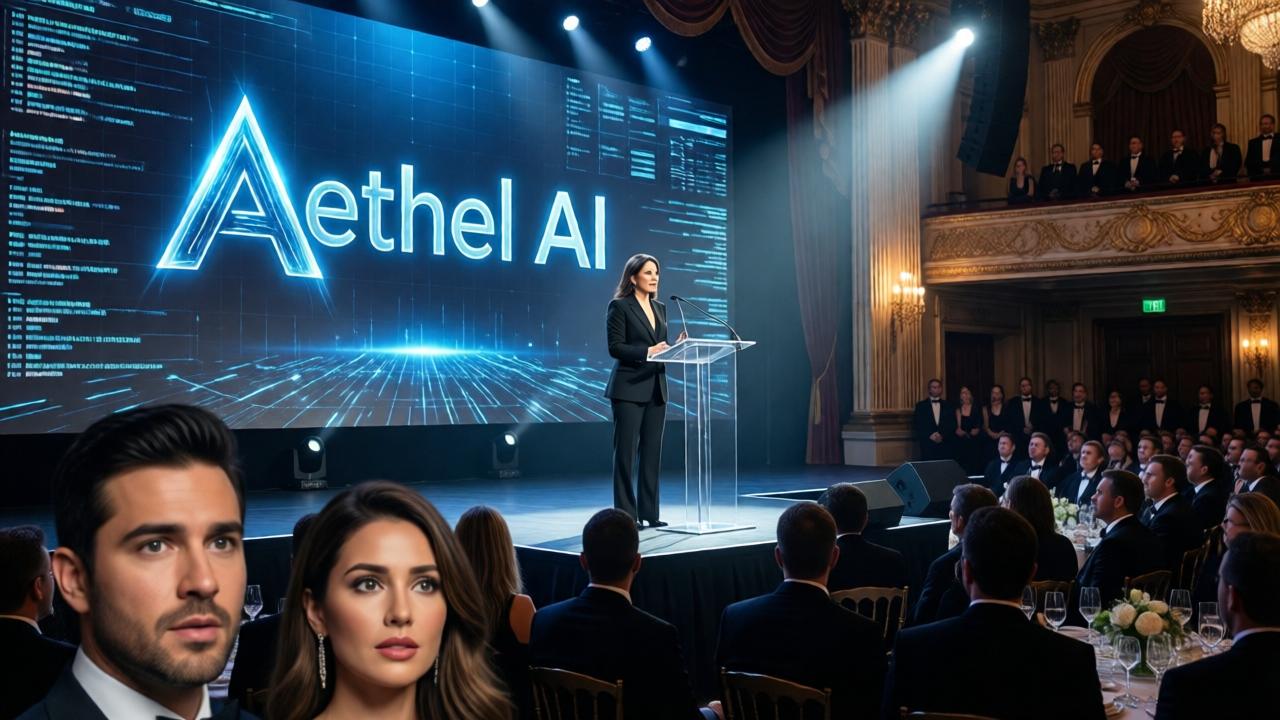
The moment of confrontation arrived at the annual ‘Future Cities’ tech gala, an event Ricardo’s family had always sponsored. Sofia arrived not as a guest, but as the keynote speaker. The murmurs in the crowd were palpable as she took the stage, elegant in a sharp black suit, a world away from the bride in white. She presented Aethel’s full capabilities, and the audience was spellbound. From her podium, she locked eyes with Ricardo and Clara, who sat frozen in the front row. “True innovation,” Sofia said, her voice clear and carrying, “often comes from the ashes of what was supposed to destroy you. It’s not about forgetting the fire; it’s about learning to forge steel in its heat.”
In the aftermath, the city council offered her an exclusive contract, making Aethel the operational brain of São Paulo’s infrastructure. Her company, Phoenix Dynamics, was suddenly valued in the billions. The humiliation video was long forgotten, replaced by profiles hailing her as a visionary. When a journalist finally dared to ask about the wedding, Sofia simply smiled. “That day was a necessary system crash,” she stated. “It allowed for a complete and superior reboot.” Ricardo’s family business, heavily reliant on old-guard municipal contracts, began to flounder without her. Clara’s socialite status evaporated as the city’s elite now vied for an invitation to Sofia’s table.

Sofia’s final act was not one of petty vengeance, but of absolute transcendence. She established a foundation for women in STEM, naming its flagship scholarship after her grandmother, not herself. Standing on the terrace of her new headquarters, looking over the city she now helped guide, she felt no hatred, only a profound sense of clarity. The abandoned bride was a ghost story. The woman here now was a creator. The fire had not consumed her; it had purified her, forging a legacy that would long outlast the memory of a broken promise. Her revenge was a world remade in her own image, resilient, intelligent, and utterly unstoppable.