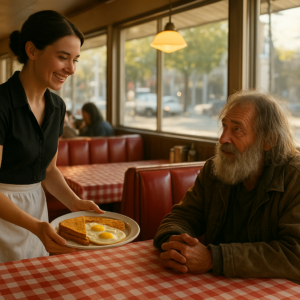

The helicopter’s roar still echoed in her ears, a phantom sound that haunted her dreams. Yet, in the quiet warmth of the old woman’s kitchen, Elara found a different rhythm: the steady simmer of soup, the soft scratch of a broom, the determined beat of her own heart. “You’re still here,” she had whispered to her unborn child, and that promise became her creed. With hands now raw from lye soap and scrubbing floors, she built a fortress one coin at a time. The luxury of her past life felt like a story about someone else, a character she no longer recognized.
Meanwhile, in his glass penthouse high above the city, Marcus Thorne tried to laugh louder, drink deeper, and spend more wildly. But the specter from his nightmare—the little boy with piercing, accusatory eyes—would not leave him. At a charity gala, clinking champagne with investors, he suddenly froze. A woman across the room, her back turned, had the same curve of her shoulder, the same defiant set of her neck. It was just a stranger, but it was enough. His financier, Alistair, nudged him. “Everything alright, Marcus? You look like you’ve seen a ghost.” Marcus drained his glass, the bubbles tasting like ash. “Just a draft,” he muttered, but the chill was bone-deep.
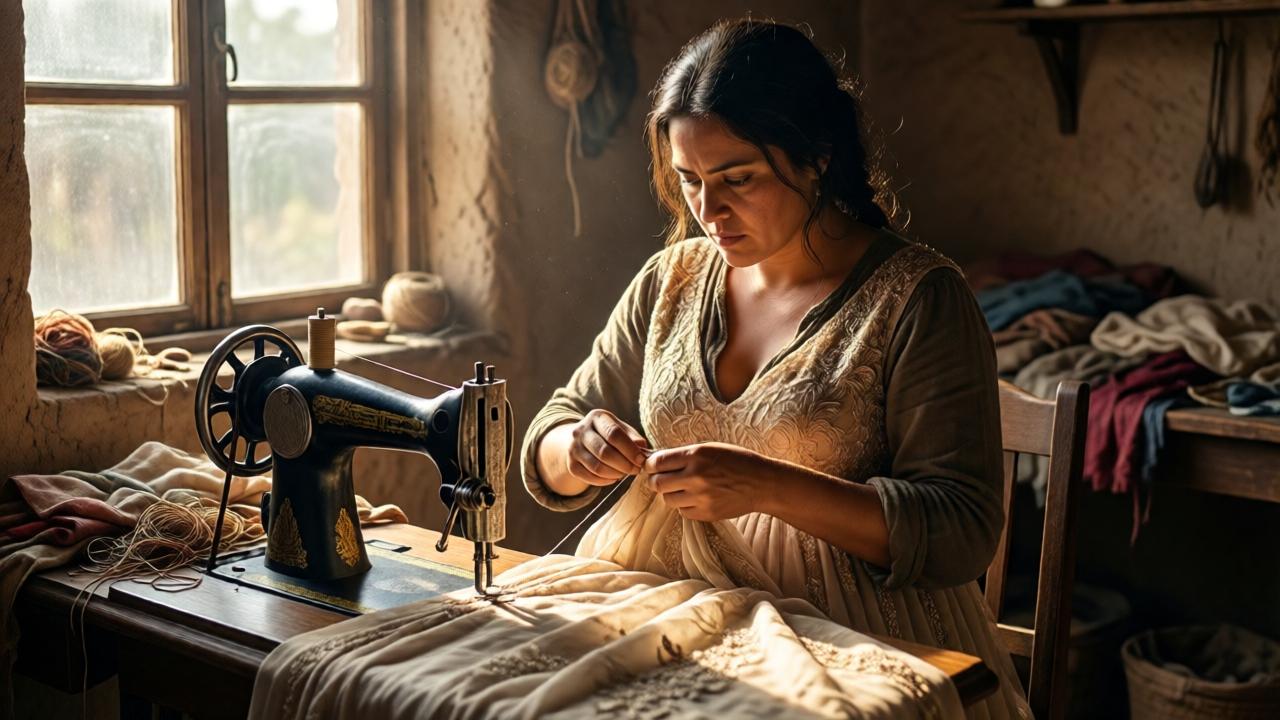
Elara’s salvation came not from pity, but from skill. The elderly baker, Mrs. Gable, noticed her carefully mending a torn lace curtain. “You have a gift, my dear,” she said, placing a weathered fashion magazine on the table. That magazine became a textbook. Elara taught herself to sew, her innate eye for design—once used to select couture—now applied to patterns and fabrics bought with painstakingly saved money. She started with simple alterations, then began creating original pieces. Her first sale, a beautifully tailored coat, made her cry. Not from sadness, but from power. “This is for us,” she whispered, her hand resting on her swelling belly.
The night Leo was born, the world did not soften. The delivery room was shabby, the pain was seismic, but when she held him—this tiny, furious boy with a cry that sounded like a battle horn—Elara felt an unbreakable steel form within her. “You are my life,” she whispered, her tears mingling with his. His eyes, when they finally opened, were a clear, startling gray. They held a knowing depth that made her catch her breath. Miles away, Marcus jolted awake again, gasping, the phantom cry of an infant ringing in his ears. His luxurious bedroom felt like a cage.

Years became a decade. Elara’s humble sewing grew into ‘Phoenix Rise,’ a boutique label whispered about in fashion circles for its exquisite, fierce elegance. Leo, now nine, was her shadow and her spark. He had his mother’s resilience and a quiet intensity in those gray eyes. One afternoon, as Elara prepared for her first major fashion week show, Leo showed her a business magazine left in a cafe. On the cover was Marcus Thorne. Leo pointed, his small finger tapping the glossy page. “He looks sad,” Leo said, with a child’s blunt perception. Elara’s blood ran cold. She knelt, taking his hands. “Some people have everything and feel nothing. We have each other, and we built everything.”
The night of the Phoenix Rise show arrived. The venue thrummed with energy. Backstage, Elara adjusted the final model’s gown—a stunning piece of blood-red silk and obsidian beading, inspired by survival. As the music swelled, she peeked through the curtain. And there, in the front row, flanked by his usual entourage, sat Marcus Thorne. He was there to scout investment opportunities, his expression one of bored entitlement. Then the first model walked out in the signature gown. His eyes tracked the fabric, the cut, the undeniable artistry. A flicker of recognition, then confusion, crossed his face. He leaned to his aide, “Who is the designer?”
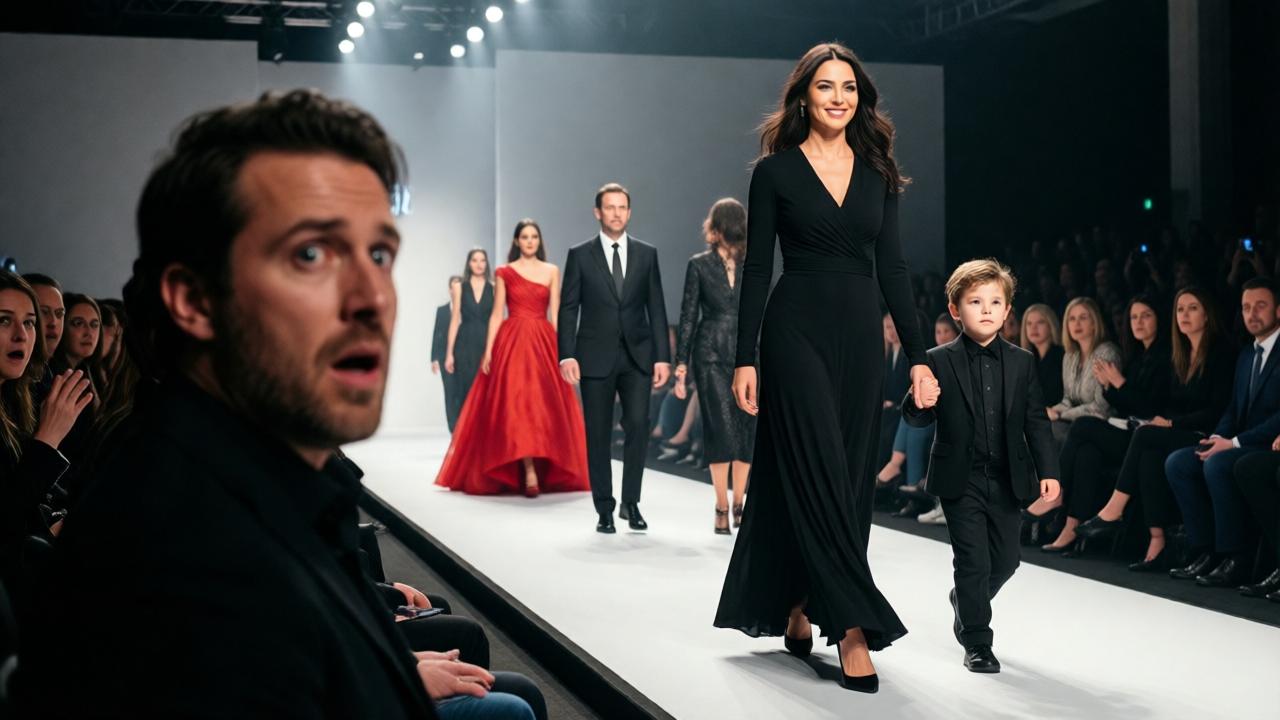
The show was a triumph. As the final notes faded, Elara took her bow. Then, breaking all protocol, she walked back onto the runway and extended her hand toward the wings. Leo walked out, holding her hand, standing tall beside his mother. The crowd applauded the touching moment. But in the front row, Marcus Thorne turned to stone. He saw the woman he had tried to erase, more powerful and radiant than ever. And he saw the boy—the boy from his nightmares, with those clear, sharp, gray eyes now staring directly, knowingly, at him. The applause muffled into a roar in his ears as the truth, violent and absolute, crashed down. The story was far from over. It had just found its stage.