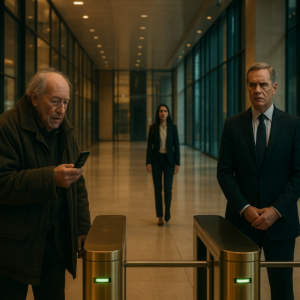

Julian’s laughter died the moment the black Mercedes-Benz S-Class glided to a stop beneath the string lights. The engine cut out with the quiet finality of a door closing on a vault. Guests turned. Champagne flutes paused halfway to lips. The warm night air, thick with perfume and chlorine, suddenly felt thinner.
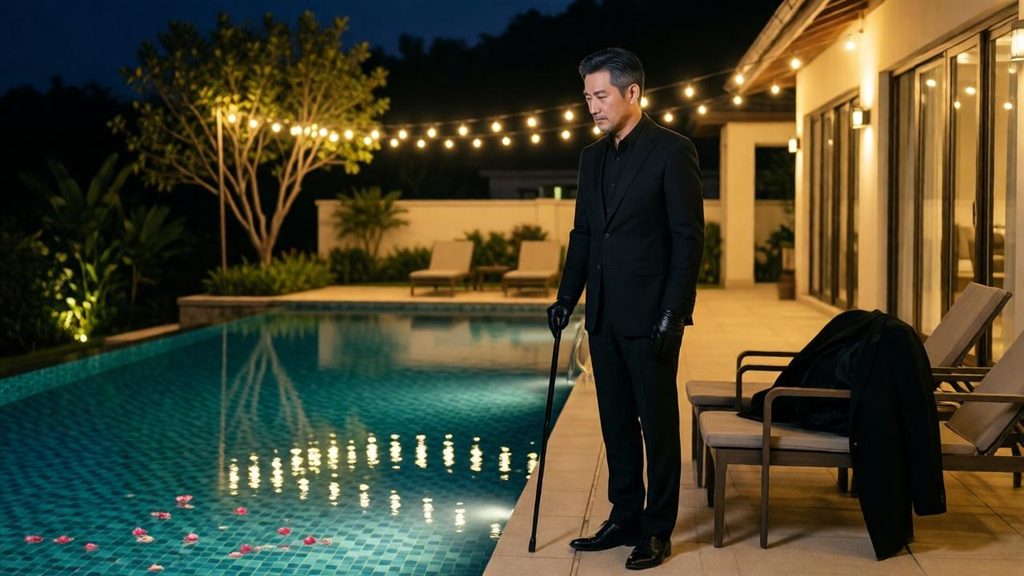
The rear door opened slowly. A tall man stepped out into the golden haze of the fairy lights. Black coat, black suit, black gloves, black cane held lightly in one gloved hand. Short black hair silvering only at the temples. Face expressionless, eyes fixed on the pool.
Lila was still in the water, white dress clinging to her like wet silk, long white hair plastered to her face and shoulders. Makeup ran in dark tracks down her cheeks. She clung to the tiled edge with both hands, shoulders shaking.
The man walked forward without haste. Guests parted for him the way water parts for a prow. He stopped at the edge of the pool and looked down at the girl.
“Who touched my daughter?”
The question was quiet, almost polite, yet it carried across the entire terrace. Julian felt every eye swing toward him. He forced a smile, the same arrogant curve of the mouth he had worn when he pushed her.
“Mr. Wei,” he said, spreading his hands. “It was just a joke. She slipped. I was—”
“Lila.”
The single word cut him off. The girl looked up, eyes red and swollen.
“Father…”
Mr. Wei did not look at Julian yet. He extended the cane toward the water, tip hovering just above the surface.
“Get out.”
Lila tried. Her arms trembled. The soaked dress weighed her down. Two of the waiters rushed forward, but Mr. Wei raised one gloved hand and they froze. She managed to pull herself onto the stone coping, water streaming from her hair and the ruined white fabric. She stood barefoot, shivering, arms crossed over her chest.
Only then did Mr. Wei turn his head toward Julian.
“You pushed her.”
It was not a question.
Julian’s smile faltered. “Look, it was harmless. Everyone saw. She was being dramatic. These Asian girls always—”
The cane moved so fast the eye barely tracked it. The silver tip struck the stone at Julian’s feet with a sharp crack that made several guests flinch. A chip of marble flew.
“Choose your next words carefully,” Mr. Wei said. “They may be the last ones you speak without assistance.”
Silence. Even the soft music from the hidden speakers seemed to lower itself. Julian’s friends—three young men in expensive black suits who had laughed with him moments earlier—took half a step back.
Mr. Wei’s gaze swept the terrace once, cataloguing faces the way a man catalogues threats.
“Everyone who is not family or staff will leave. Now.”
No one argued. Guests set down glasses, collected purses, murmured apologies that no one answered. Within three minutes the terrace was almost empty. Only the string lights remained, swaying gently, and the soft lap of water against the pool walls.
Lila stood dripping, eyes fixed on the ground. Mr. Wei removed his coat and placed it over her shoulders without looking at her. The black fabric swallowed her completely.
He turned back to Julian.
“You will apologize.”
Julian laughed, short and brittle. “You’re serious? Over a little shove? Do you know who my father is?”
“I know exactly who your father is,” Mr. Wei replied. “I know the number of his private jet, the names of the three mistresses he keeps in different cities, and the amount of money he still owes certain people in Singapore. I also know that if I make one telephone call, those debts become due tonight. With interest.”
Julian’s face lost colour.
Mr. Wei continued in the same even tone.
“You will kneel. You will look my daughter in the eye. And you will apologize as if your future depends on it. Because it does.”
Julian glanced around for support that was no longer there. The remaining staff watched from a respectful distance, faces carefully blank. One of the security men who had arrived with Mr. Wei—broad, silent, earpiece visible—stood near the open rear door of the S-Class, hands folded.
Julian’s jaw tightened. Pride warred with calculation. Calculation won.
He sank to one knee on the wet stone.
“I’m… sorry,” he muttered.
“Louder.”
“I’m sorry.”
Mr. Wei’s eyes did not leave him. “For what, precisely?”
Julian swallowed. “For pushing you into the pool. For laughing. For humiliating you.”
Lila stared at him, tears still sliding down her face, but something harder had entered her expression. She said nothing.
Mr. Wei nodded once.
“Acceptable. Now stand up and leave my property. If I ever see your face again, or hear that you have spoken her name, the conversation will be shorter.”
Julian rose. His expensive shoes were soaked at the toes. He opened his mouth as if to say something else, then closed it, turned, and walked toward the driveway without looking back. His friends followed in silence.
Only when the last of them had disappeared beyond the gates did Mr. Wei speak again.
“Lila.”
She flinched.
“You will change. Then you will come to the study. We need to discuss why you were at this party at all.”
She nodded, clutching the coat tighter, and walked barefoot toward the house, leaving a trail of water on the stone.
Mr. Wei remained by the pool a moment longer, cane resting lightly against the ground. The string lights reflected in the dark water like scattered gold. One of the security men approached.
“Shall we have the young man followed, sir?”
Mr. Wei’s voice was almost weary.
“No. His father will hear of this before morning. That will be sufficient.”
He turned and walked into the house, black gloves and black cane vanishing into the warm interior light.
Behind him the pool settled back into stillness, broken only by the soft, rhythmic sound of water dripping from the edge where a white dress had been.
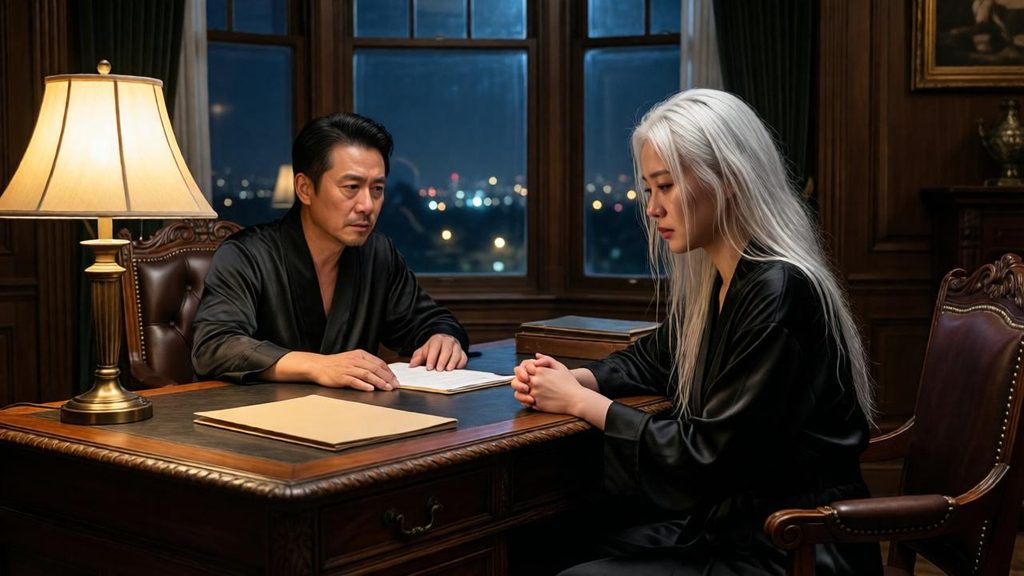
Inside the house the air was cooler, scented with cedar and something floral Lila’s mother had always preferred. Mr. Wei removed his gloves one finger at a time and set them on the antique console table. The cane he kept.
Lila emerged twenty minutes later in a simple black silk robe, hair towelled dry but still damp, face scrubbed clean of the ruined makeup. She looked younger without it. She also looked afraid.
Mr. Wei sat behind the wide desk of dark wood that dominated the study. A single lamp cast a circle of light. Outside the tall windows the party lights still glowed, now absurdly festive.
“Sit.”
She sat on the edge of the leather chair opposite him.
“Explain.”
Her voice was small. “It was supposed to be a small gathering. Julian said—”
“Julian.” The name was spoken like something distasteful. “The same Julian whose father has been trying to buy influence in our shipping routes for three years. The same Julian who has a reputation for treating women as entertainment.”
Lila’s hands twisted in her lap. “I didn’t know.”
“You should have known. Or you should have asked. Instead you accepted an invitation from a man who views you as a trophy and then allowed him to make a spectacle of you in front of fifty people.”
She flinched as if struck.
Mr. Wei leaned back. For a moment the hard mask slipped and something older, tired, showed through.
“Your mother would have been disappointed.”
The words landed harder than any raised voice. Lila’s eyes filled again.
“I’m sorry.”
“Sorry is not enough.” He opened a drawer, withdrew a slim folder, and placed it on the desk between them. “As of tomorrow morning you will leave for the estate in Kyoto. You will remain there for six months. No parties. No social media. No contact with anyone from this city except me. You will study. You will train. And you will learn what it means to carry the Wei name without endangering it.”
Lila stared at the folder. “You’re sending me away?”
“I am protecting you. And I am protecting everything your mother and I built. That boy’s father is already making calls. By morning there will be pressure. Lawyers. Threats disguised as negotiations. I will handle them. You will not be here while I do.”
She opened her mouth, closed it, then whispered, “What about Julian?”
Mr. Wei’s expression did not change.
“Julian will discover that some jokes have consequences that cannot be laughed off. His father will discover the same. Neither of them will enjoy the lesson.”
Silence stretched. Somewhere in the house a clock struck one.
Lila finally asked, “Are you angry with me?”
Mr. Wei looked at her for a long time. When he spoke, the anger was gone, replaced by something quieter and more permanent.
“I am disappointed. And I am afraid. Those are more dangerous feelings than anger. Anger passes. Fear for one’s child does not.”
He stood, walked around the desk, and rested a hand briefly on her damp hair—the first gesture of tenderness all night.
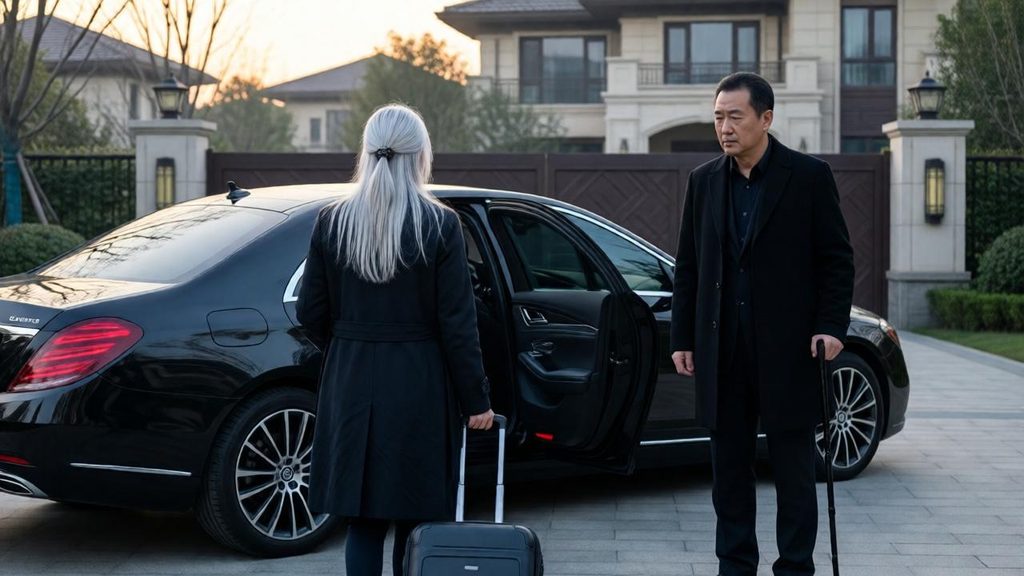
“Go to bed. The car leaves at six.”
She rose, hesitated, then stepped forward and pressed her face against his chest for a single second before turning and leaving the study without another word.
Mr. Wei remained standing in the circle of lamplight. He picked up the black cane, turned it once in his hands, then set it carefully against the desk. Outside, the string lights continued to glow over the empty pool, as if the party had never ended and a girl in a white dress had never been pushed into the water.
He reached for the telephone.
“Connect me to Singapore,” he said quietly. “And then to the young Mr. Hale’s father. Tell them both that Wei is calling.”
The night was far from over.
, cinematic composition.