
Tales

The Soup, the Manager, and the Man Who Waited

The chandeliers of The Gilded Ox threw warm pools of light across the mahogany tables, and the clink of silverware rose and fell like distant music. Emma had worked the evening shift for three years, and she still loved the hush that settled over the dining room just before the dinner rush. Tonight, however, the hush had teeth.

At table nine sat Mr. Arthur Bellweather, a retired clockmaker with a snow-white beard and a brown leather satchel slung across his shoulder. He came in every Tuesday, ordered the same soup, and tipped exactly fifteen percent, no matter what. Emma liked him. He always asked about her mother’s garden.

“Here you are, sir. Please enjoy,” she said, setting the bowl of minestrone and the basket of warm sourdough in front of him. Her smile was real, and so was his.

“Thank you, Emma,” Arthur said, his voice soft as worn velvet. He unfolded his napkin with the careful reverence of a man who had eaten alone for too many years.

Then the air changed. Mr. Vance, the floor manager, crossed the room in four long strides, his dark grey tie swinging like a metronome. He stopped at table nine and pointed a finger at Arthur as if the old man were a stain on the carpet.

“Are you finished yet?” Vance demanded.

Arthur looked up, spoon hovering. “I’m sorry?”

“We have paying customers waiting for tables.”
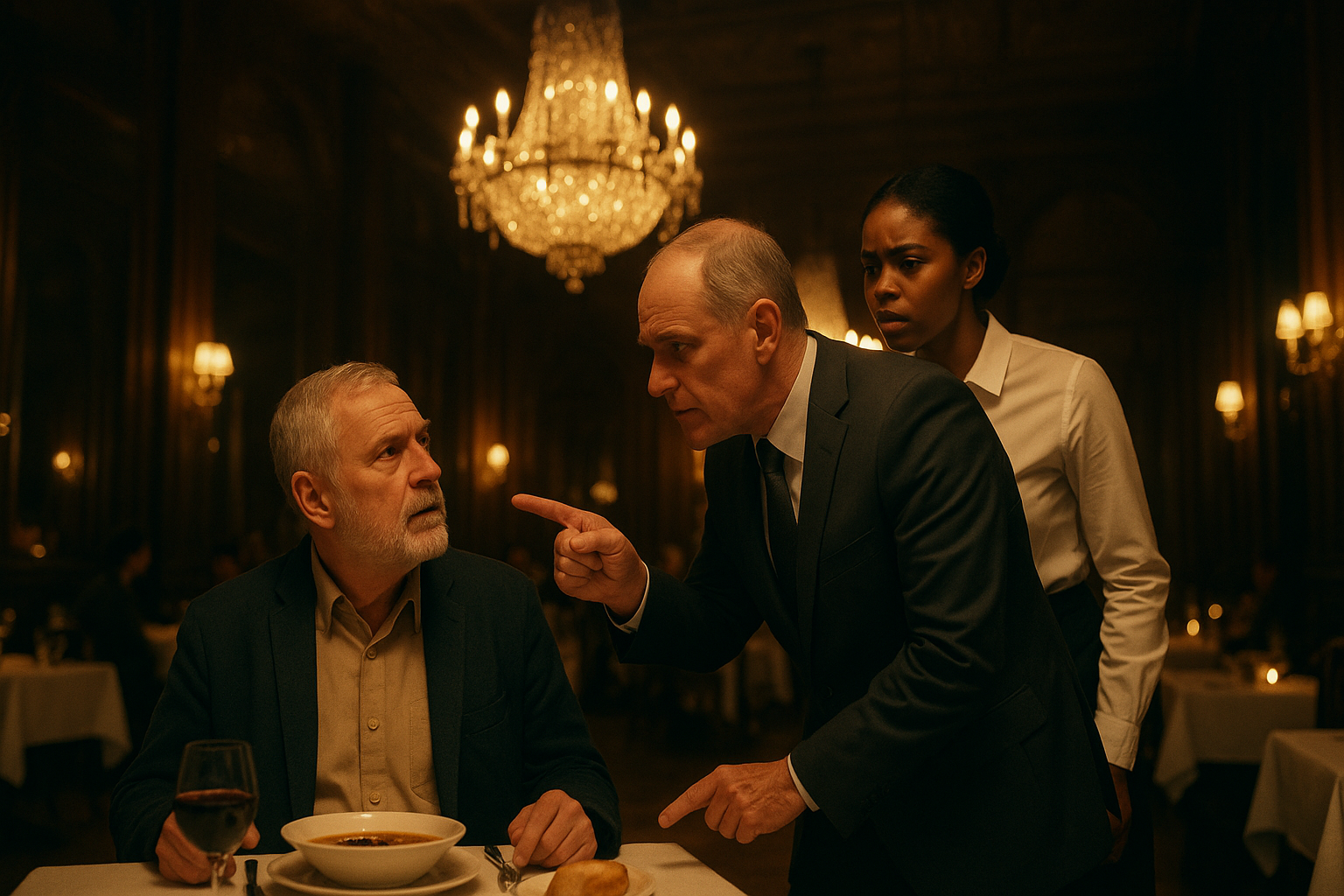
Cinematic wide shot of a luxurious restaurant with soaring ceilings, ornate crystal chandeliers and dark wood panelling. An elderly European man, 70, grey beard and short grey hair, in a blue jacket and beige shirt, sits alone at a table with soup, bread and a glass of red wine, looking up in confusion. A stern manager in a dark grey suit leans over the table pointing a finger, while a young African American waitress in a white shirt and black skirt stands behind him, her face tense with worry. Warm golden lighting, shallow depth of field, realistic film still, muted amber and deep brown palette.

Emma’s hand tightened around her notepad. “Mr. Vance, he’s still eating.”

“He’s been eating for forty minutes, Emma. That’s a table for two, and there are people at the bar who’ve been waiting since six.” Vance straightened and smoothed his lapel. “Mr. Bellweather, I’m going to have to ask you to settle your check.”

Arthur set down his spoon. He did not argue. He had spent sixty years learning when not to. He reached into his satchel and pulled out a worn leather wallet, counting bills with fingers that trembled just slightly. Emma watched the colour rise in his cheeks and felt something hot and tight behind her ribs.

“I’ll walk you out,” she said quietly.

Outside, the November wind smelled of rain and roasted chestnuts. Arthur buttoned his jacket and smiled at her, but the smile didn’t reach his eyes. “It’s all right, Emma. He’s right. A restaurant is a business.”

“That doesn’t make it kind,” she said.

He chuckled, a dry, papery sound. “No. It doesn’t.” He hesitated, then pressed something into her palm — a small brass key, warm from his pocket. “My shop. 14 Lantern Row. I close at five, but if you ever want to see how a clock works, the door is open.”

Emma turned the key over in her hand. “Why me?”

“Because you asked about my soup,” he said. “And because you looked at me like I was a person, not a table.”

She watched him walk down the wet pavement until the fog swallowed him whole. Then she went back inside, where Vance was already seating a young couple at table nine, beaming as if he had done something heroic.
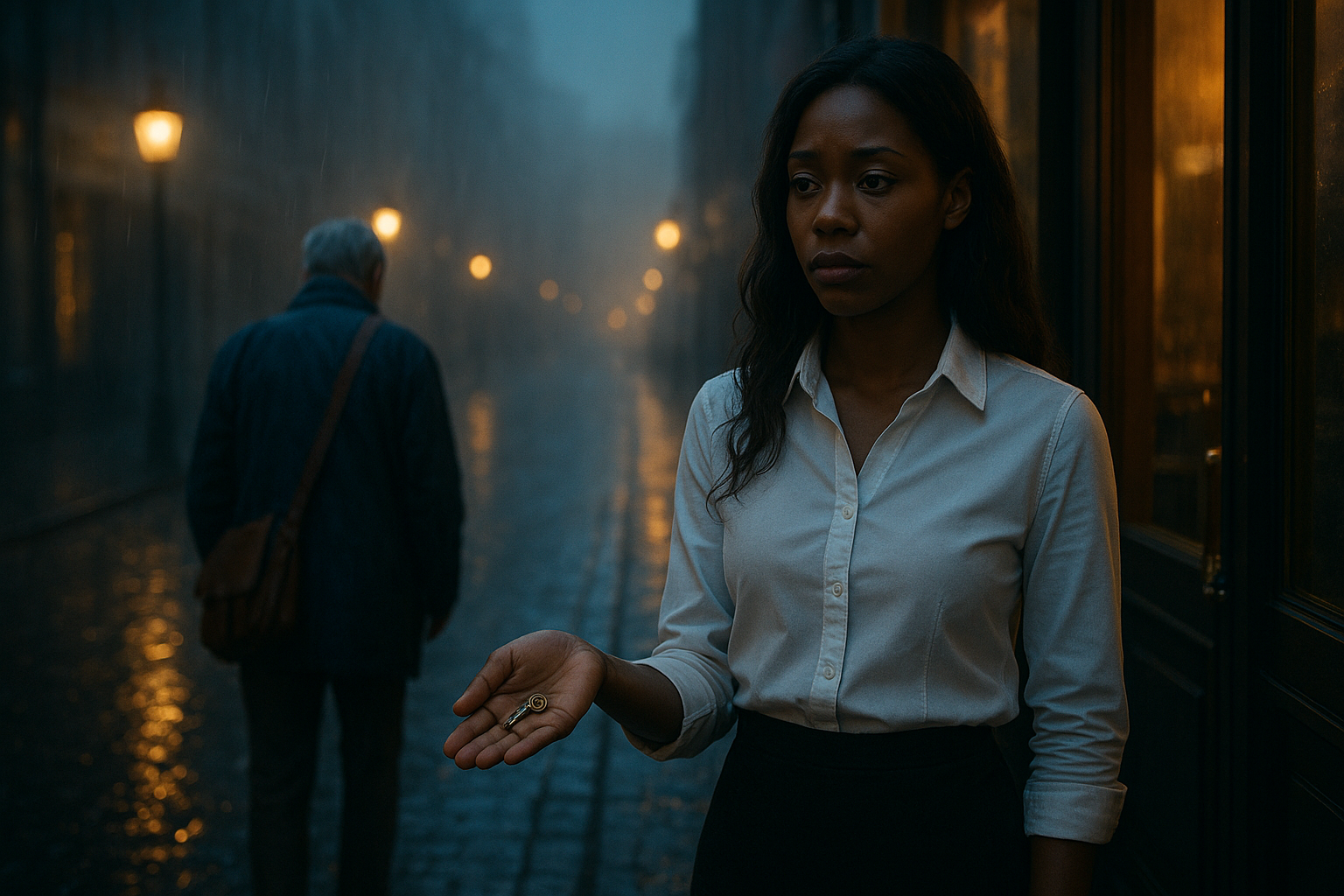
Cinematic medium shot on a rainy city street at night. An elderly European man with a grey beard and blue jacket walks away into the fog, shoulders slightly hunched, a brown leather satchel across his chest. In the foreground, a young African American waitress with long chestnut hair, white button-up shirt and black skirt stands outside the restaurant door, holding a small brass key in her open palm, her expression a mix of sadness and quiet resolve. Wet cobblestones reflect amber streetlamps, shallow depth of field, moody blue and gold tones, realistic film still.

The next Tuesday, Arthur did not come. Nor the Tuesday after. Emma served soup to strangers and smiled at Vance when he praised her, and each time she did, she felt the brass key growing heavier in her apron pocket.

On the third Tuesday, she took the bus to Lantern Row. Number 14 was a narrow shop wedged between a bakery and a shuttered laundromat, its window crowded with clocks — cuckoo clocks, mantel clocks, a grandfather clock whose pendulum swung like a slow heartbeat. The door was unlocked.

Arthur was at his workbench, a jeweller’s loupe screwed into one eye, a tiny screwdriver in his hand. He didn’t look surprised to see her. He simply set down his tools and poured two cups of tea from a chipped enamel pot.

“You came,” he said.

“I came,” Emma said. “I quit the restaurant.”

Arthur raised his eyebrows. “Because of me?”

“Because of me,” she said. “I want to learn something that lasts longer than a dinner rush.”

He laughed then, a real laugh, the kind that crinkled the corners of his eyes. He handed her a small brass gear and a pair of tweezers. “Then we’ll start with the escapement,” he said. “It’s the part that keeps the clock from running too fast. Funny thing — a good restaurant needs one too.”
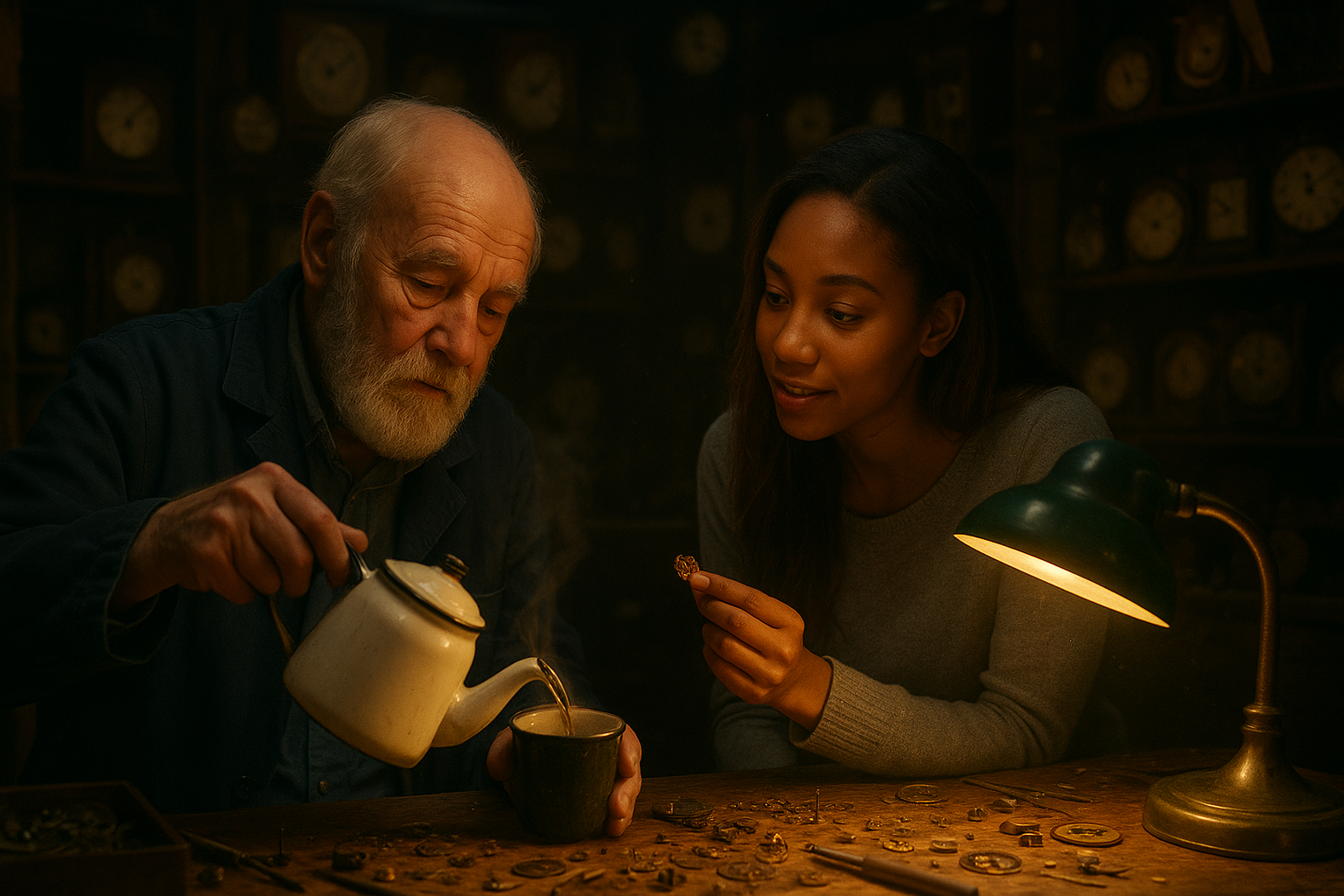
Cinematic interior shot of a small, cluttered clockmaker's shop at dusk. An elderly European man with a white beard and blue jacket sits at a wooden workbench covered with tiny gears, tools and a jeweller's loupe, pouring tea from an enamel pot. Beside him, a young African American woman with long chestnut hair, now wearing a simple grey sweater, leans in with curiosity, holding a small brass gear in her fingers. Warm tungsten light from a green banker's lamp, shelves of ticking clocks in soft focus behind them, dust motes in the air, realistic film still, intimate and hopeful mood.

By spring, Emma could disassemble a movement and put it back together blindfolded. By summer, she had repaired the grandfather clock in the town hall and been paid more than a month of waitressing. By autumn, she had a small sign above the door of 14 Lantern Row that read Bellweather & Emma — Fine Horology.

And every Tuesday, at exactly noon, they closed the shop, walked three blocks to a small bistro with checkered tablecloths, and ordered soup. No one ever asked them to leave. The owner, a round woman named Marta, always brought an extra basket of bread and said the same thing every time: “Take your time, gentlemen. And lady.”

Arthur would smile at that, and Emma would smile back, and somewhere in the shop behind them, a hundred small clocks kept ticking, patient and precise, measuring out the hours they had been given — and the ones they had chosen to give each other.
Related Posts

Cinematic wide shot of a luxurious restaurant with soaring ceilings, ornate crystal chandeliers and dark wood panelling. An elderly European man, 70, grey beard and short grey hair, in a blue jacket and beige shirt, sits alone at a table with soup, bread and a glass of red wine, looking up in confusion. A stern manager in a dark grey suit leans over the table pointing a finger, while a young African American waitress in a white shirt and black skirt stands behind him, her face tense with worry. Warm golden lighting, shallow depth of field, realistic film still, muted amber and deep brown palette.

The Soup, the Manager, and the Man Who Waited

The chandeliers of The Gilded Ox threw warm pools of light across the mahogany tables, and the clink of silverware rose and fell like distant music. Emma had…

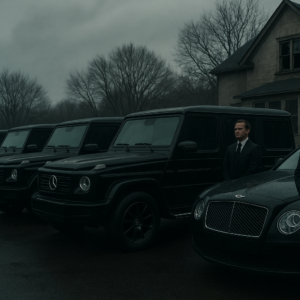
A line of black Mercedes-Benz G-Wagens and Bentleys parked on an asphalt driveway under a gray, overcast sky. Men in dark suits stand beside the vehicles, their postures rigid and expectant. The house with a broken window is visible in the background. The mood is tense and foreboding, with cool, muted colors and a sense of impending confrontation.

The Old Man’s Call: A Storm of Black SUVs

The glass shattered in a glittering cascade, shards skittering across the polished floor of the spacious living room. White walls, minimalist decor—a sanctuary violated by the intrusion. Sam…

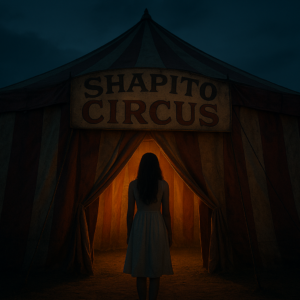
A young woman with long dark hair and a white sundress stands at the entrance of a vintage circus tent at dusk. The tent is striped red and white, slightly weathered, with a hand-painted sign reading 'Shapito Circus'. Warm golden light spills from inside, contrasting with the cool blue evening sky. The atmosphere is mysterious and inviting, with a hint of unease. Cinematic, realistic, moody lighting.

The Cursed Lottery of LakeFold A Night of Running and the Promise of Escape

Elena had been staring out the car window for what felt like an eternity. The endless stretch of highway, flanked by dense pine forests and occasional glimpses of…

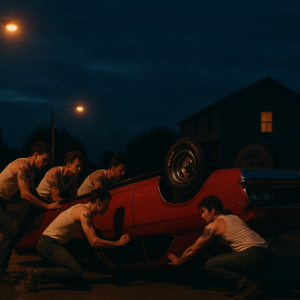
Cinematic evening scene, dark blue sky, orange street lamps casting warm pools of light on a quiet suburban road, a group of young European men in white tank tops and jeans with eagle tattoos surrounding a bright red 1967 Chevrolet Impala, flipping it onto its roof, a two-story house behind them with a single window lighting up, moody thriller atmosphere, deep shadows, high contrast, film grain

The Quiet Teacher Who Broke a Gang: Walter’s Lesson

The bell rang at 3:15, but Walter never left with the crowd. He stayed behind, wiping chalk dust from his hands, watching the empty desks as if they…

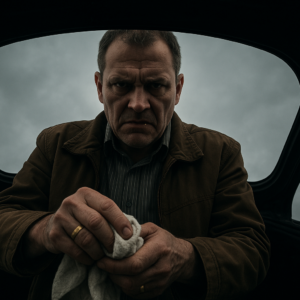
A dramatic shot from inside a car trunk, looking up at a 50-year-old man in a brown jacket and striped shirt. He has a gold ring and a gold tooth, and his face is cold and displeased. He is wiping his hands with a cloth. The trunk lid is open, and the background shows a grey sky. The lighting is harsh, emphasizing his features. The mood is threatening and ominous.

The Gathering Storm: A Test of Power at the Bennett Estate

The sprawling courtyard of the modern country house lay under a cold, diffuse daylight, a light fog clinging to the air. A long wooden table, set for a…

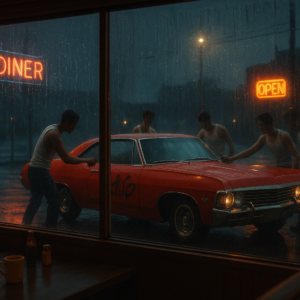
Cinematic wide shot from inside a warm diner looking out through rain-streaked windows at a bright red 1967 Chevrolet Impala being vandalized by a group of young men in white tank tops, moody blue-grey exterior lighting contrasting with warm amber interior, neon signs reflecting on wet asphalt, film noir atmosphere

The Man Who Didn’t Have a Car

The rain fell in steady sheets against the diner’s windows, turning the world outside into a blurred watercolor of neon and asphalt. Inside, the warm glow of fluorescent…