
The chandeliers of La Maison Verte hung like frozen constellations above the dining room, their crystals throwing small warm stars across the mahogany panels. It was the kind of restaurant where the silverware weighed more than most people’s rent, where the air smelled of butter, thyme, and quiet money. And at table fourteen, near the tall arched window, sat an old man named Henrik Bauer.
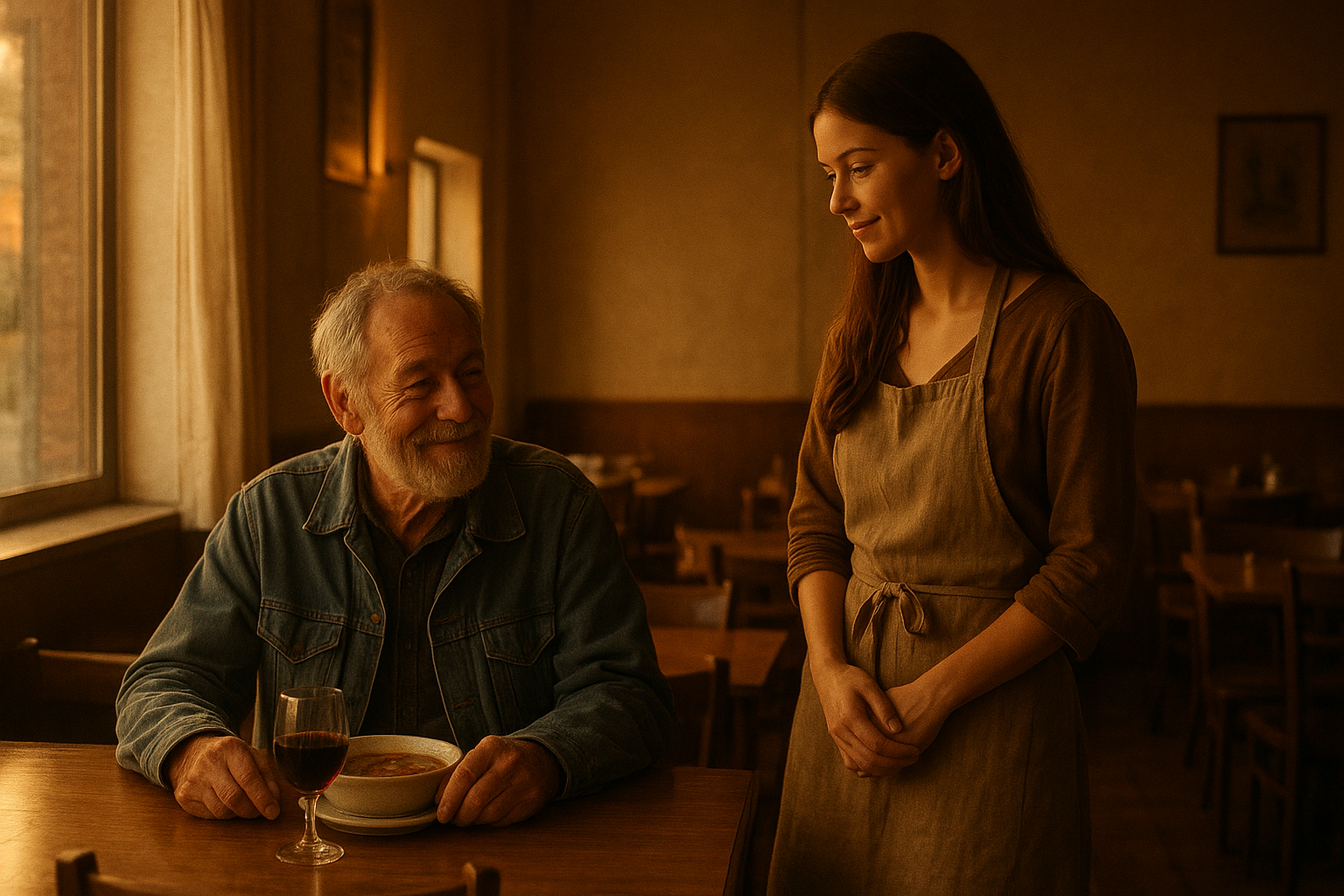
He was seventy years old. His beard was the colour of winter fog, his jacket a faded blue that had once been brighter, and the leather satchel slung across his chest had been repaired so many times that the stitching looked like a map of small journeys. He came here every Tuesday. He always ordered the same thing: the soup of the day, a basket of bread, and one glass of the house red, which he drank slowly, as though each sip were a sentence in a story he was in no hurry to finish.
The waitress who brought it to him was named Emma Okafor. She was twenty-five, with long chestnut hair pulled back loosely, a white button-down shirt, and a black skirt that swished when she walked. She had worked at La Maison Verte for eleven months, and in that time she had learned that the customers who tipped the least were often the ones who said thank you the most.
She set the bowl down with both hands, the way her grandmother had taught her. Steam curled up between them like a small ghost of comfort.
“Here you are, sir,” Emma said, smiling. “Please enjoy.”
Henrik looked up at her, and something in his face softened — the gratitude of a man who had eaten alone for a long time. “Thank you, Emma,” he said, quietly, as if her name were a gift he wanted to hold carefully.
She was still holding her notepad and pen, still smiling, when the footsteps came.
They were hard, deliberate footsteps, the kind that announced themselves before their owner did. Emma didn’t have to turn around to know who it was. She could tell from the way the other waiters suddenly found urgent things to do at the far end of the room.
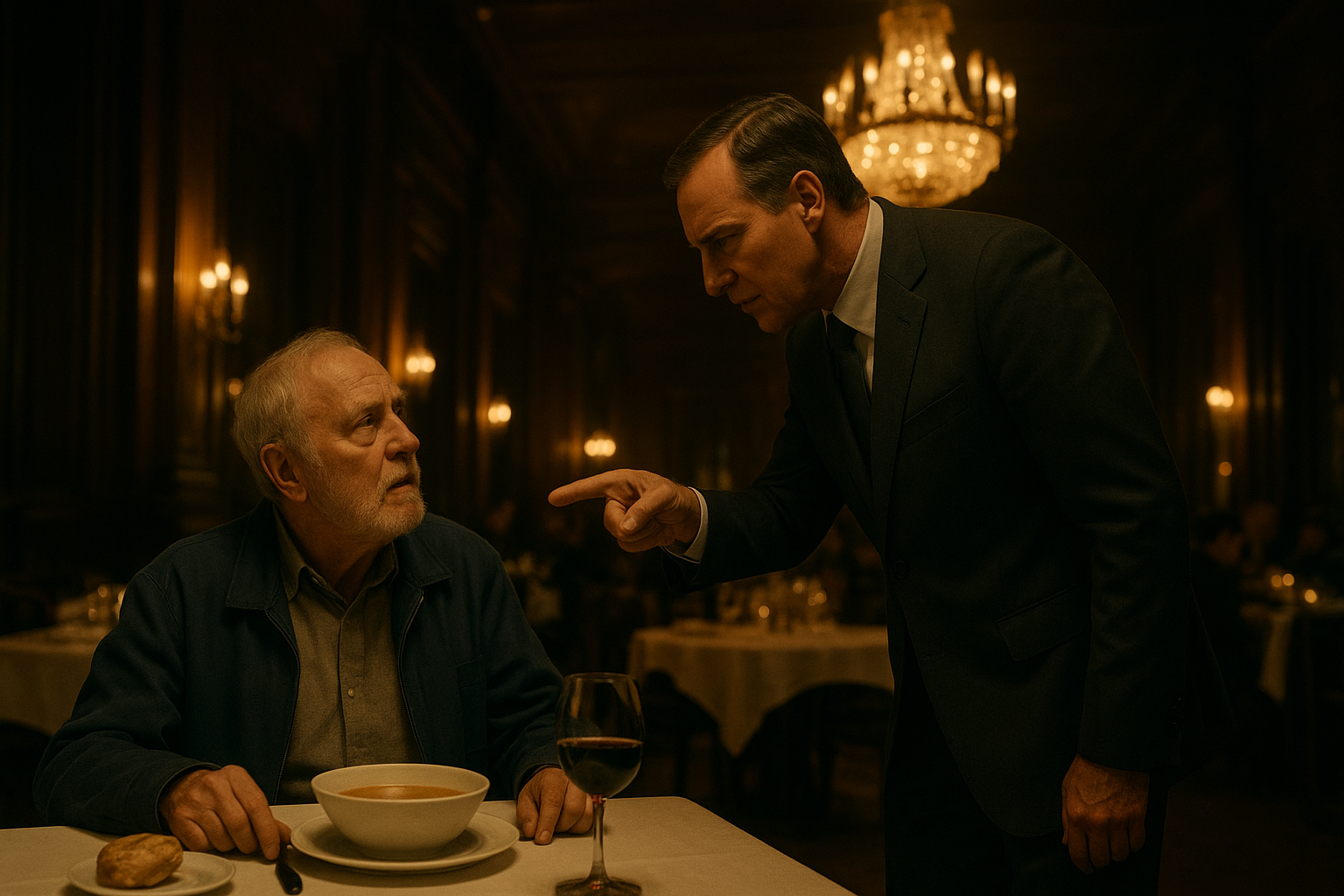
Mr. Calloway. The manager. Forty-five years old, with short grey hair and a dark grey suit that fit him like a verdict. He stopped at table fourteen and leaned in, one finger extended like a small, blunt weapon, pointing directly at Henrik.
“Are you finished yet?” he said.
The dining room did not go silent. That was the cruelest part. The clink of forks continued, the murmur of conversations rolled on, and yet at table fourteen the world had narrowed to the width of that pointing finger.
Henrik set down his spoon. He looked up, and his grey eyes were not angry. They were confused, the way a man is confused when the ground he has been standing on for years suddenly turns out to be ice.
“I’m sorry?” he said.
“We have paying customers waiting for tables,” Calloway said. His voice was stern, demanding, and pitched just loud enough for the couple at table twelve to hear. “You’ve been here forty minutes. One soup. One glass of wine. On a Friday night.”
Emma felt her face go hot. Her hands tightened around the notepad. “Mr. Calloway,” she said, keeping her voice low and polite, “Mr. Bauer is a regular. He—”
“He’s a regular who orders soup,” Calloway cut her off, not even looking at her. He was still looking at Henrik, still pointing, as though the old man were a stain on the tablecloth that needed naming. “Emma, I’d like a word. In the back. After you clear this table.”
Henrik’s hands rested on either side of his bowl. He did not raise his voice. He had spent enough of his life around men like Calloway to know that raising your voice was how you lost. He simply reached for his napkin, folded it with careful, deliberate movements, and placed it beside the plate.
“I understand,” he said softly. “I’ll go.”
And that was when Emma did something she would think about for the rest of her life.
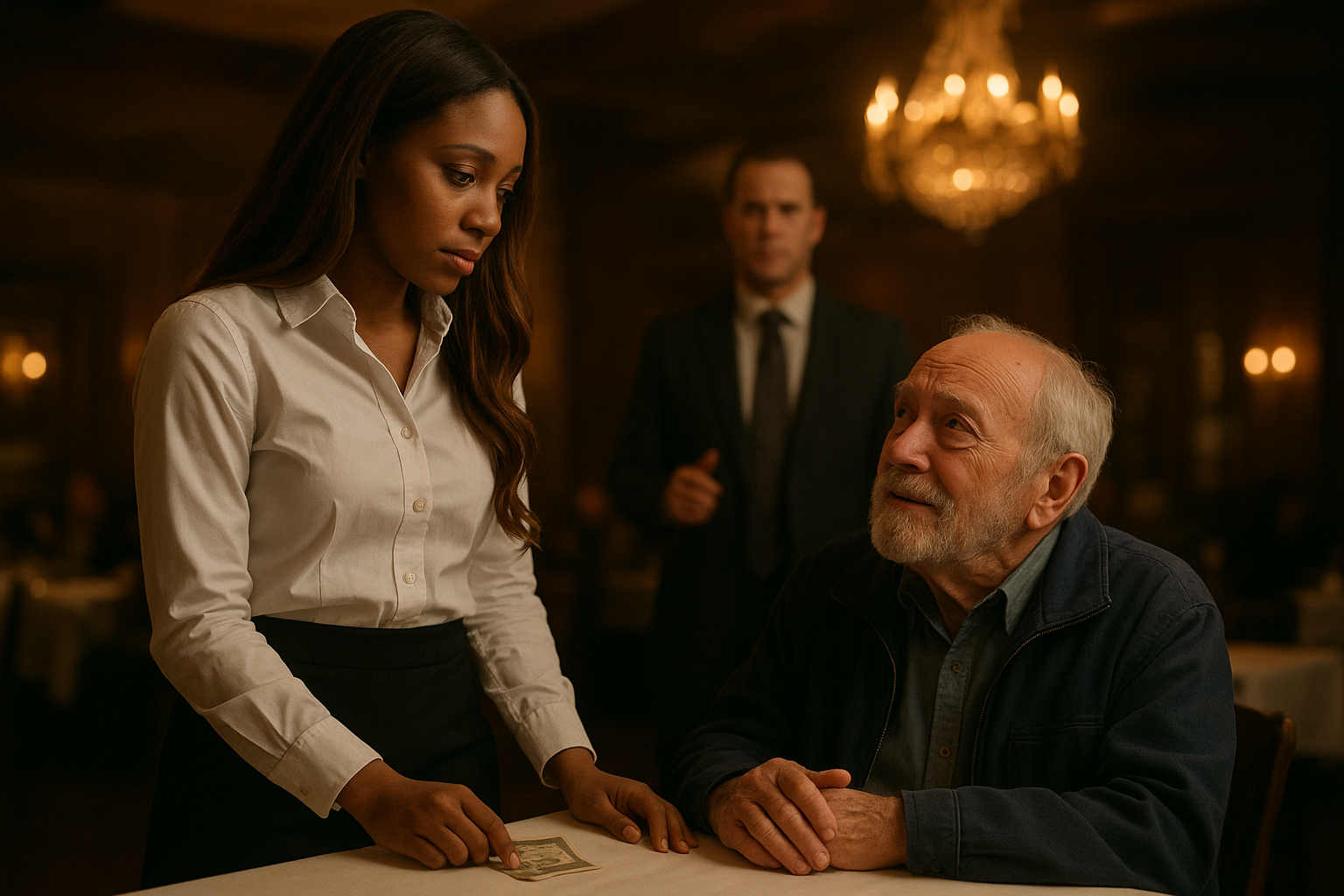
She put her notepad down on the table. She reached into the pocket of her black skirt and pulled out her wallet — a cheap thing, cracked at the corners, held together with a hair tie. She opened it and laid three twenty-dollar bills on the white linen, right next to Henrik’s bowl of soup.
“For the table,” she said. “For the rest of the evening. He can stay.”
Calloway blinked. “Excuse me?”
“You said paying customers,” Emma said. Her voice was shaking, but it did not break. “I’m paying. He’s my customer. He’s been my customer every Tuesday for eleven months. He taught me how to fold a napkin into a swan when I was new and I couldn’t stop crying in the back because a man yelled at me. He didn’t yell. He just showed me. So yes, Mr. Calloway. I’m paying.”
For a long moment, the manager said nothing. His finger had dropped to his side, as if it had forgotten what it was doing. At table twelve, the woman had stopped pretending not to listen. At table sixteen, a man in a grey wool coat slowly set down his fork.
Henrik looked at the money on the table. Then he looked at Emma, and his eyes were wet, and he did not try to hide it.
“Emma,” he said. “You don’t have to do that.”
“I know,” she said. “That’s why I’m doing it.”
Calloway took a breath. He looked around the room — really looked, for the first time that evening — and saw that the room was looking back. Not with anger. With something worse. With memory. Every person in that dining room had, at some point, been the old man at the table. Every one of them had felt the finger.
“Fine,” Calloway said, and the word came out smaller than he intended. “Fine. Clear the table when he’s done, Emma.” He turned and walked back toward the host stand, and his footsteps, this time, were not hard at all.
Emma sat down in the empty chair across from Henrik. Just for a moment. Just long enough to breathe.
“You didn’t have to,” Henrik said again.
“You gave me a swan,” Emma said. “I owed you.”
Henrik laughed — a real laugh, the kind that comes from somewhere deep and rusty. He picked up his spoon and tasted the soup. It had gone a little cold. He ate it anyway, every drop, and when he finished, he folded his napkin into a small white swan and left it on the table beside the three twenty-dollar bills.
Emma kept that swan. She kept it in the pocket of her apron for the rest of the shift, and then in a drawer at home, and then, years later, on a shelf in the restaurant she opened herself, a small place with twelve tables and no chandeliers, where the soup was always hot and nobody was ever asked to leave.
She called it The Swan. And every Tuesday, at table four, near the window, an old man with a grey beard and a blue jacket came in and ordered the soup of the day, and a basket of bread, and one glass of the house red, which he drank slowly, as though each sip were a sentence in a story he was in no hurry to finish.