
The dining hall sat in semi-darkness, its dark-brown walls swallowing most of the light that managed to filter through the tall windows. Round wooden tables stood in quiet rows across the polished floor. Outside, a grey sky pressed low over an asphalt road that stretched empty in both directions. Inside, the air carried the muted clink of cutlery and the heavier sound of boots that did not belong to ordinary customers.
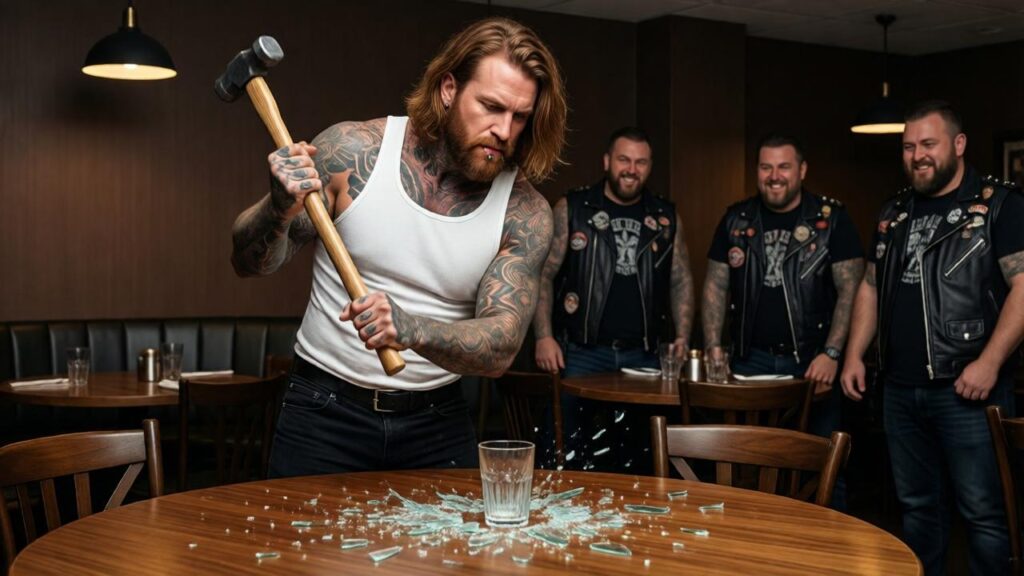
Vance “Sledge” Kane stood at one of the central tables like a living threat. Thirty years old, European, chestnut hair falling to his shoulders, heavily muscled, every visible centimetre of skin from wrists to neck and across his face covered in dense black tattoos. A white tank top clung to his chest, black loose jeans tucked into heavy boots, tunnels stretching his earlobes, a silver ring through his lower lip. In both hands he gripped a short wooden sledgehammer. With a wide, malicious grin he raised it high and brought it down on an empty glass that stood on the table. The glass exploded. Shards sprayed across the wood and skittered onto the floor.
Behind him four large men watched with open amusement. Dutch Malone, forty, bald, thick beard, black leather vest covered in old club patches over a black T-shirt. Cobra Raines, thirty-eight, short dark hair, heavy neck tattoos, the same black vest and jeans. Brick Vargas, forty-two, massive shoulders, grey-streaked beard. Snake Delaney, thirty-four, leaner, restless eyes, constant half-smile. All of them looked like they had ridden in from somewhere the law preferred not to follow.
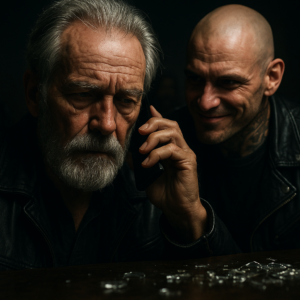
At a nearby table sat Julian Thorne. Eighty years old, European, silver-grey hair combed neatly back, long white beard carefully trimmed, black suit, white shirt, no tie. In front of him rested a plate of untouched food and two clear water glasses. He did not flinch when the glass shattered. He simply reached into the inside pocket of his jacket, drew out a matte-black smartphone, and pressed it to his ear with the calm precision of a man checking the time.
“It’s me,” he said, voice low and resolute. “Bring them.”
He ended the call and set the phone face-down beside his plate. Shards of glass glittered near his water glass. His gaze remained steady, focused on nothing in particular.
Sledge Kane turned, still holding the wooden hammer loosely at his side, and looked at the old man with open mockery.
“What, old man? Calling for help?” The smile on his tattooed face was wide and confident. “You think anyone’s coming to save your lunch?”
The four men behind him laughed. Dutch slapped the table. Cobra shook his head as if the whole scene were a private joke.
Julian Thorne did not answer. He simply waited.
Outside, under the low grey sky, the empty asphalt road was no longer empty.
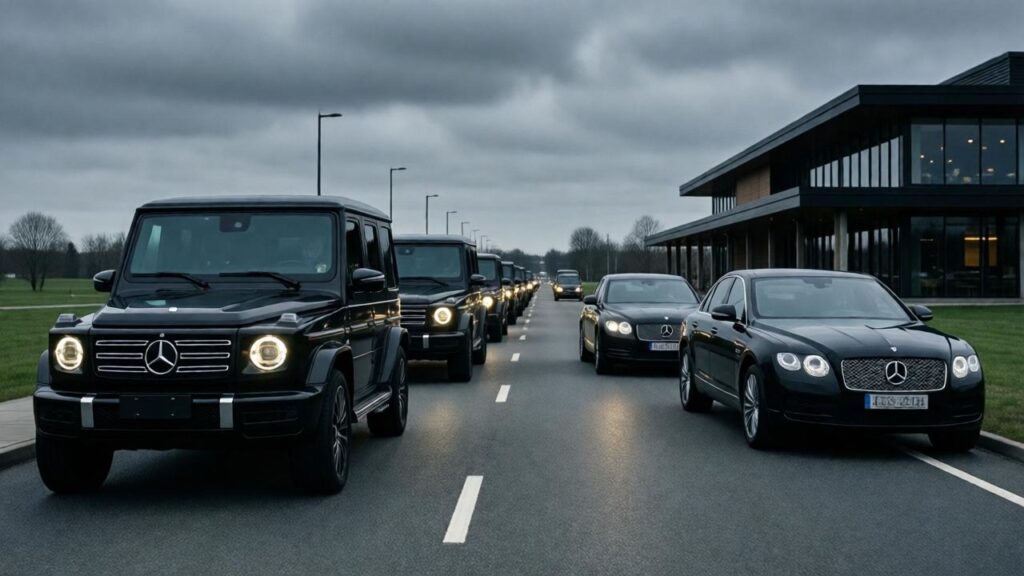
A column of black vehicles appeared in the distance and grew larger with every second. Mercedes-Benz G-Wagens, heavy and square, followed by two long black Bentleys. Their headlights cut pale tunnels through the dull afternoon light. They did not hurry. They simply advanced with the steady certainty of something that had already decided the outcome.
Sledge’s smile faltered for the first time when the lead G-Wagen turned into the parking area in front of the dining hall and stopped. Then another. Then another. Within less than a minute eight black vehicles stood in a precise line, engines idling, dark windows reflecting the cloudy sky.
The bikers behind Sledge stopped laughing. Dutch’s hand drifted toward the inside of his vest. Brick’s shoulders tensed. Snake’s restless eyes flicked from the windows to the old man and back again.
Doors opened in near silence.
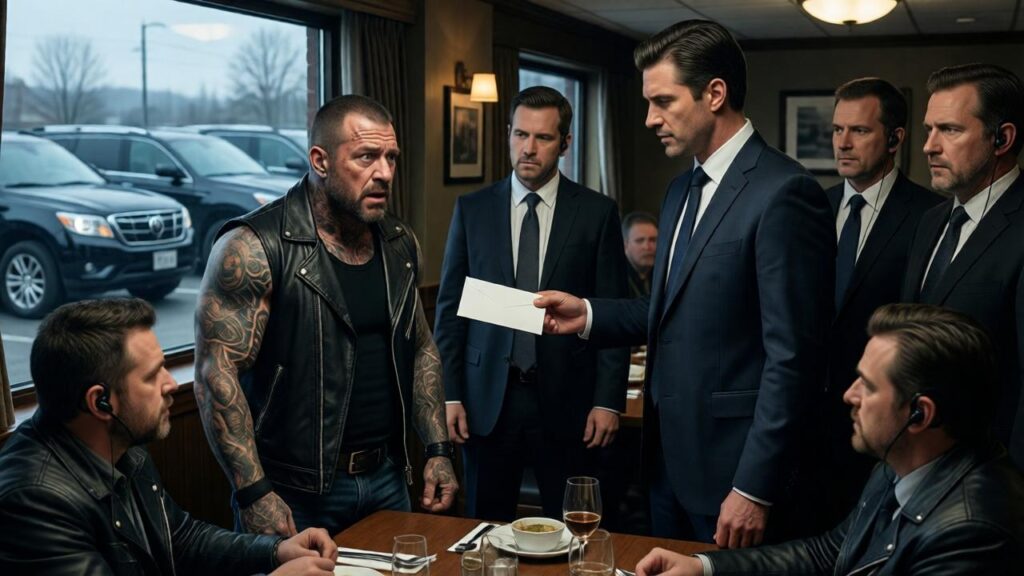
Men in dark suits stepped out. White shirts, conservative ties, polished shoes, discreet earpieces. They moved without haste and without conversation. Twelve of them in total. The first through the glass doors of the dining hall was a tall man in his early fifties with silver at the temples and an expression that suggested he had never once raised his voice in anger. His name was Marcus Hale. Beside him walked Lena Voss, mid-forties, short silver-streaked hair, black coat over a tailored suit. Behind them came Callum Reed, Darius Cole, and eight others whose faces carried the same controlled emptiness.
They did not draw weapons. They did not speak to the bikers. They simply walked the length of the room until they stood in a loose semicircle around the table where Julian Thorne still sat.
Marcus Hale stopped in front of Sledge Kane and looked at him the way a man looks at a piece of furniture that has been placed in the wrong room. Then he reached into the inner pocket of his jacket and produced a plain white envelope, sealed, unmarked.
He held it out.
Sledge stared at the envelope as if it might bite. His tattooed face had lost its earlier arrogance; what remained was a mixture of shock and slow-forming disbelief. The four men behind him looked equally unsettled. The wooden sledgehammer hung forgotten in Sledge’s right hand.
Marcus’s voice was quiet and almost polite.
“Mr. Kane. This is for you.”
Sledge did not take it at first. Julian Thorne spoke without raising his eyes from the table.
“Take the envelope, Mr. Kane. Read what is inside. Then decide how the rest of your afternoon will go.”
Sledge’s jaw worked. Pride fought curiosity and lost. He set the wooden hammer on the nearest empty chair, wiped his palm on his jeans, and accepted the envelope. The paper felt heavier than it should have. He tore it open with one thick thumb.
Inside was a single sheet of heavy paper and three small photographs.
The paper carried a short typed message and a signature that Sledge recognised from certain stories that circulated in the darker corners of the city—stories most people preferred to treat as legend. The photographs showed three locations Sledge knew intimately: a warehouse on the east docks, a private garage where the crew stored weapons, and the modest house where his younger sister lived with her two children. Each photograph was recent. Each was timestamped. Each carried a small red circle around a detail that made the implication unmistakable.
Sledge’s face went pale beneath the tattoos. The mocking confidence drained out of him in a single slow breath. Behind him Dutch muttered a curse. Cobra took an involuntary step backward. Brick’s massive hands opened and closed once.
Julian Thorne finally looked up. His pale eyes were calm, almost kind.
“You broke a glass that did not belong to you. You raised a hammer in a room where children sometimes eat. You asked me if I was calling for help.” He paused. “I was not calling for help. I was calling for delivery.”
Marcus Hale spoke again, still quiet. “The envelope contains everything you need to understand the new arrangement. Your crew will leave this building. You will not return. You will not approach Mr. Thorne again. You will not approach anyone who sits at his table. In return, the photographs remain photographs. The locations remain undisturbed. The people in them remain untouched.”
Sledge’s voice, when it came, was rough. “You’re bluffing.”
Julian’s reply was soft. “I am eighty years old, Mr. Kane. I no longer waste time on bluffs.”
Silence stretched across the dark-brown room. Outside, the black G-Wagens and Bentleys continued to idle, their presence a low mechanical reminder that the conversation was not theoretical.
Sledge looked once more at the photographs, then at the old man in the black suit, then at the twelve men who had entered without raising their voices. Something in his posture changed. The wooden sledgehammer stayed on the chair. He folded the paper and the photographs carefully, slid them back into the envelope, and held the envelope as if it were suddenly fragile.
“We’re leaving,” he said to the others. The words sounded foreign in his mouth.
Dutch started to protest. One look from Sledge silenced him. The four men turned and walked toward the glass doors. Sledge followed last. At the threshold he stopped and looked back.
“This isn’t over,” he said, but the words lacked conviction.
Julian Thorne answered without standing. “It was over the moment you chose the wrong glass.”
The bikers stepped out into the grey afternoon. Engines from their own motorcycles—parked farther down the road—started one by one. They rode away without looking back. The black SUVs and Bentleys remained for another three minutes, then departed in the same precise order in which they had arrived, leaving the asphalt road empty once more.
Inside the dining hall the semi-darkness returned. The suited men waited until the last engine note faded, then Marcus Hale gave a small nod. They filed out as quietly as they had entered. Only Julian Thorne remained at his table, the plate of food still untouched, one water glass unbroken, shards of the destroyed glass still glittering near his shoes.
He picked up the remaining glass, took a slow sip of water, and set it down again.
The waitress—young, pale, and carefully invisible until now—approached with a dustpan and brush. Julian stopped her with a raised hand.
“Leave it,” he said gently. “Someone will clean it later.”
She retreated.
For a long time the only sound was the soft hum of the ventilation and the distant murmur of traffic that had nothing to do with the events of the last twenty minutes. Julian Thorne finished his water, folded his napkin, and rose. At eighty he still moved with the unhurried economy of a man who had never needed to hurry.
Outside, the grey sky had begun to darken toward evening. The asphalt road remained empty. Somewhere across the city Vance “Sledge” Kane would open the envelope again, study the photographs under better light, and begin the slow, necessary work of explaining to the rest of his crew why certain tables, certain glassware, and certain old men in black suits were no longer to be tested.
Julian Thorne already knew how that conversation would end.
He walked to the glass doors, paused once to look back at the round tables and the dark-brown walls, then stepped out into the fading light. A single black Bentley waited at the curb, rear door already open. Marcus Hale stood beside it.
“Any further instructions, sir?”
Julian considered the question for a moment.
“Tomorrow is Tuesday,” he said. “I will be here at the usual time. The usual table. Make sure the glassware is intact.”
Marcus inclined his head. “Of course.”
Julian lowered himself into the rear seat. The door closed with a soft, expensive sound. The Bentley pulled away from the dining hall and disappeared down the asphalt road, leaving only the grey sky and the quiet certainty that some lessons, once delivered in a sealed envelope, did not need to be repeated.
In the days that followed, word travelled quietly through the places where men like Sledge Kane gathered. The story changed with each telling—sometimes the old man had been a retired judge, sometimes a former intelligence officer, sometimes something older and less official—but the core remained the same: a wooden sledgehammer, a shattered glass, one calm phone call, and a white envelope that contained photographs no one wanted to see twice.
The Reaper Crew—Sledge’s loosely organised circle—did not dissolve. They simply adjusted their geography. Certain roads became closed. Certain dining halls became invisible. Certain names were spoken only in lowered voices, if they were spoken at all.
Julian Thorne continued to appear every Tuesday at the same round table in the same semi-dark room. The plate of food remained mostly untouched. The water glass stayed whole. No one ever raised a sledgehammer in his presence again.
And on the rare occasions when a new face entered the dining hall with too much swagger and too little history, the waitress would glance once toward the old man in the black suit. Julian would meet her eyes for half a second, then return to his water. That was usually enough.
The envelope, after all, had already done its work.