
The morning was obscenely beautiful.
That was the first thing Daniel Mercer noticed when he stepped out of the black limousine — how the sun kept shining as though nothing had happened. The sky over Greenwood Cemetery stretched wide and impossibly blue, a washed-out September blue that made the white headstones glow like teeth against the green lawns. Somewhere in the distance a lawnmower hummed. Birds sang. The world, apparently, had not received the news.
Daniel adjusted the cuff of his black shirt and felt the familiar weight of his watch against his wrist — a gift from his wife, back when there had still been a wife, back when there had still been a family. He was forty-six years old, and he had already buried his mother, his father, and his marriage. Today he would bury his daughter.
Emily.
He could not say the name out loud. He had not said it in four days, not since the hospital, not since the doctor had come into that terrible little room with the terrible little sofa and told him, in a voice so gentle it was obscene, that there had been nothing anyone could do. Viral myocarditis, he would later write on forms and repeat to relatives. A virus that had slipped into his daughter’s chest like a thief through an open window and stolen the thing that kept her alive.
She was nine years old. She had loved strawberry ice cream and books about dragons and the color yellow. She had a gap between her front teeth that he had secretly hoped would never close.
Now she lay in a white coffin at the edge of the gravesite, dressed in white, a crown of white flowers on her head, her long chestnut hair arranged carefully over her shoulders by a funeral director who had never met her and would never know that she hated having her hair brushed.
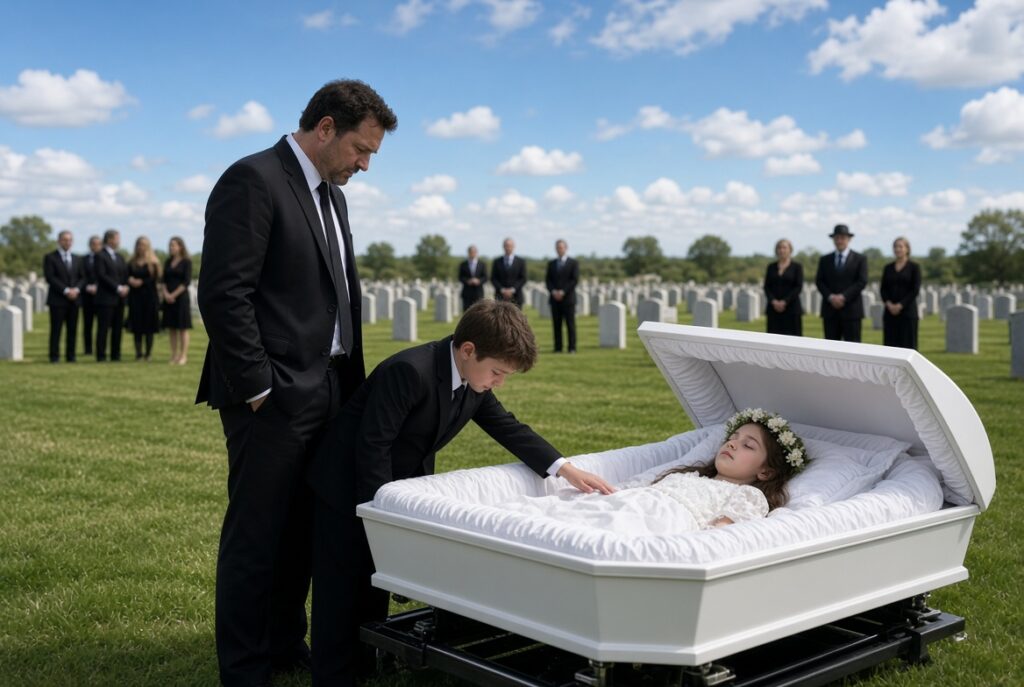
The mourners had gathered in a loose semicircle — colleagues, neighbors, a few of Emily’s teachers, his sister Margaret in a black dress that looked expensive and uncomfortable. They stood with their hands folded, their faces arranged into expressions of appropriate sorrow, and Daniel hated every one of them for the simple crime of being alive.
The priest had begun the committal. “Earth to earth, ashes to ashes…”
And that was when the boy moved.
He came out of nowhere — or rather, out of the crowd, small and fast, a boy of maybe eleven with wild curly chestnut hair and a black suit that was a size too large for him, the sleeves swallowing his hands. He ducked under the arm of a man who tried to stop him and darted straight to the coffin.
“Wait,” he said. “Please. Wait.”
He leaned over the white coffin, both hands gripping the edge, and stared down at Emily’s face. Then he looked up, searching the crowd, and his eyes locked onto Daniel.
“She’s not dead,” the boy said. His voice cracked. “Your daughter is still alive.”
The cemetery went very quiet.
Daniel felt something cold slide down the back of his neck. “Get him out of here,” he said. His voice came out low and hard, a stranger’s voice. “This is a funeral. You’re lying.”
Two men in dark coats moved toward the boy, but he twisted away from them, still clinging to the coffin, and now he was pointing — pointing at Emily’s left arm, which lay pale and still against the white satin lining.
“I’m not lying,” the boy said. “Her name is Emily. She has a scar on her wrist shaped like a half moon.”
Daniel’s mouth went dry.
The scar was real. It was small, a pale crescent just below her wrist bone, from the summer she was six and had fallen off her bicycle onto a piece of broken flowerpot. He had been the one to carry her inside, the one to hold her hand while his wife cleaned the cut, the one who had kissed the bandage and promised her that scars were just stories your skin remembered. No one at this funeral knew about that scar. The mortician had covered it with makeup. Even Daniel himself had forgotten it until this moment.
“I saw her two days ago,” the boy said. “I saw her two days ago, at the old water tower on Ashfield Road. She was sitting on the fence. She was eating a strawberry ice cream.”
Someone in the crowd gasped. Margaret stepped forward, her hand pressed to her chest. “Daniel,” she said, “who is this child?”
Daniel didn’t answer. He was staring at the boy, and the boy was staring back at him, and somewhere beneath the numb gray fog that had wrapped itself around Daniel’s heart for four days, something stirred. Something that felt dangerously like hope.
“What’s your name?” Daniel asked.
“Theo,” the boy said. “Theo Vance.”
“And how,” Daniel said slowly, “do you know my daughter?”
Theo’s chin trembled, but he did not look away. “Because she’s my friend,” he said. “And because she asked me to come here and tell you.”
The funeral director wanted to call the police. Margaret wanted to call a doctor. The priest, to his credit, suggested they all take a moment, and the moment stretched into an hour, and by the end of it Daniel Mercer was sitting on a folding chair beside an open grave, holding a paper cup of terrible coffee, listening to an eleven-year-old boy tell him a story that could not possibly be true.
Theo Vance lived three streets over from the Mercer house. He had met Emily in June, at the public library’s summer reading program, where they had both signed up for the dragon book club and had both been disappointed to discover that the club was mostly about reading and only slightly about dragons. They had become friends the way children do — quickly, completely, without paperwork. They had ridden bikes along the creek path. They had traded books. They had once spent an entire Saturday building a fort out of cardboard boxes in Theo’s backyard and defending it against an imaginary army.
Daniel had known none of this. He had been working, that summer. He was always working. He had noticed, vaguely, that Emily seemed happier — that she hummed while she drew at the kitchen table, that she asked to go to the library more often — and he had been glad, and he had not asked questions, because asking questions took time and time was the one thing he never seemed to have.
“She got sick on a Tuesday,” Theo said. “She didn’t come to the library. I waited for her and she didn’t come. And then my mom said she heard from Mrs. Delgado that Emily was in the hospital.”
“She was in the hospital,” Daniel said. “For three days. And then she died.”
“I know that’s what they told you.” Theo set his jaw. “But that’s not what happened.”
According to Theo, he had gone to the hospital on the second day, with his mother, to deliver a get-well card that the dragon book club had all signed. They had been turned away at the ICU — no children under twelve, hospital policy — so Theo had waited in the lobby while his mother went up. And while he waited, he had seen something.
“I saw them wheel her out,” he said. “On a bed. With a mask on her face. And there was a man walking next to the bed, and he wasn’t a doctor.”
“How do you know he wasn’t a doctor?”
“Because he was wearing a suit, and he had a briefcase, and he was talking on a phone, and he was saying — ” Theo stopped, and for the first time, he looked afraid. “He was saying, ‘The transfer is complete. The family has been informed.'”
Daniel stared at him. “That doesn’t mean anything. That could have been — “
“And then I saw her two days ago,” Theo said. “At the water tower. She was sitting on the fence, and she had a bruise on her arm, and she was crying. She said she couldn’t go home. She said the people who took her told her that you thought she was dead.”
“Theo.” Daniel’s voice was barely a whisper. “Do you understand what you’re saying?”
“I’m saying she’s alive,” Theo said. “And I’m saying she asked me to tell you. She said you would believe the scar.”
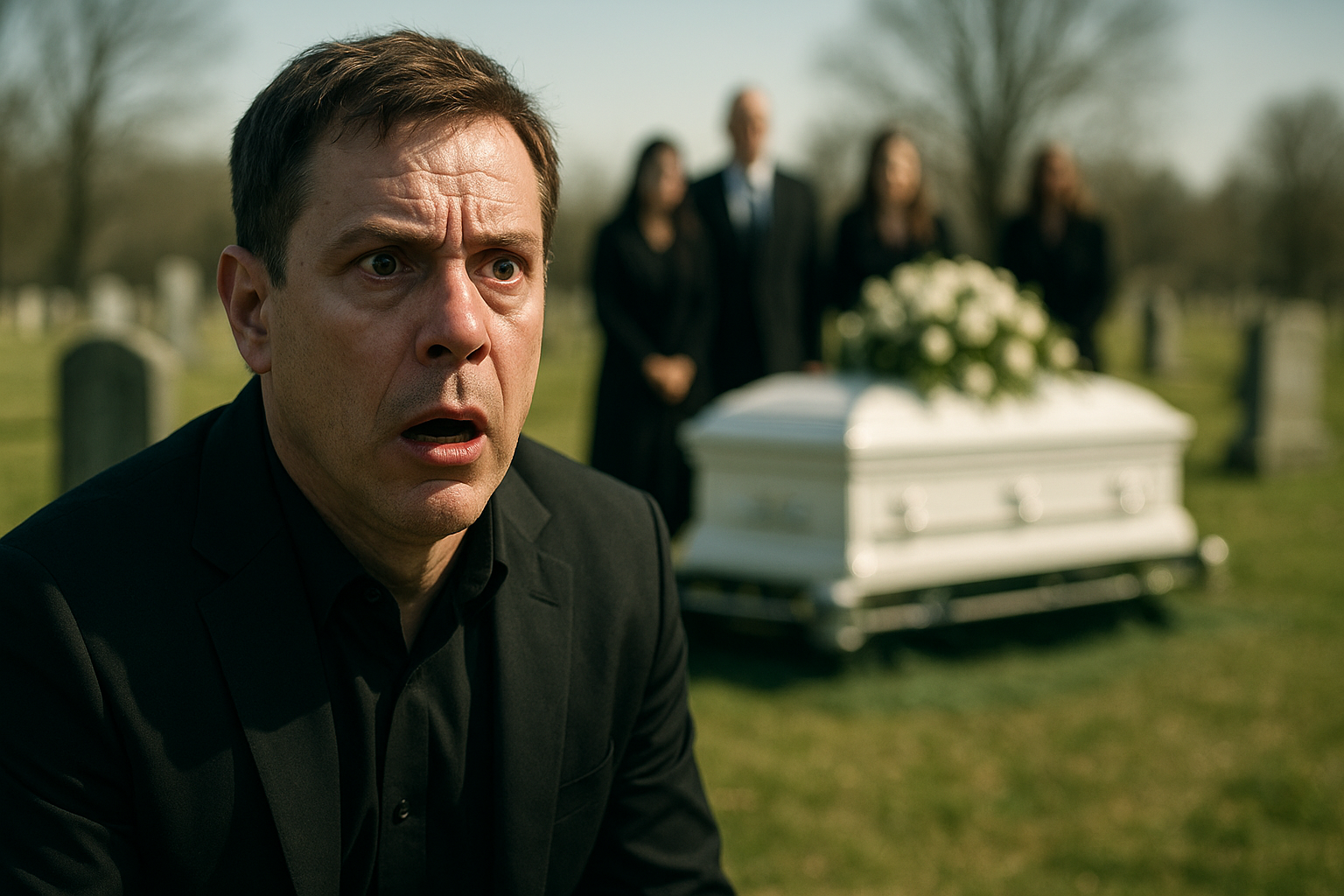
The next morning, Daniel Mercer did something he had never done in his life.
He lied to his sister, told her he needed to be alone, and then he drove to the Ashfield Road water tower, where he parked his car on the gravel shoulder and sat for a long time, watching the fence.
He had brought the scar with him — not literally, but in his mind, the memory of it, the way Emily had laughed through her tears when he’d told her that scars were stories. He had brought other things too. The way she said “Daddy” when she wanted something. The way she folded her socks into little balls. The way she had looked at him, on the last night before the hospital, when he had kissed her forehead and told her he’d see her in the morning.
He had seen her in the morning. She had been asleep, or what he had believed was asleep. And then she had been gone.
At noon, a girl appeared on the fence.
She was wearing a yellow T-shirt that Daniel had never seen before and jeans that were too big for her, and her hair was pulled back in a messy ponytail, and she was eating a strawberry ice cream cone. She was smaller than he remembered. Thinner. There was a bandage on her forearm.
Daniel did not move. He could not move. He sat in his car and watched his daughter — his dead daughter — swing her legs against the fence and lick her ice cream, and he felt the world tilt around him like a ship in a storm.
Then Emily looked up. She looked directly at the car. And she raised one hand and waved.
He was out of the car before he knew he was moving. He crossed the gravel, crossed the grass, and stopped ten feet away from her, because he was suddenly afraid — afraid that if he came closer she would dissolve, that she was a hallucination, that grief had finally broken his mind.
“Emily,” he said.
She looked at him with eyes that were older than nine. “Hi, Daddy.”
He fell to his knees in the grass. He was crying, and he didn’t care. “You’re alive,” he said. “You’re alive, you’re alive, you’re — “
“I’m sorry,” she said. Her voice was small and steady, the voice of a child who had been forced to grow up too fast. “I didn’t know how to tell you. They said if I told anyone, they would hurt you.”
“Who?” Daniel’s voice cracked. “Who said that?”
Emily looked past him, toward the road, and her face changed. “They’re here,” she whispered.
Daniel turned.
A black sedan had pulled onto the gravel shoulder behind his car. Two men in dark suits got out. One of them was holding a phone. The other was holding something Daniel could not quite see.
“Mr. Mercer,” the first man called out, in a voice as smooth as polished stone. “We need to talk about your daughter.”
What followed was not a rescue. It was a negotiation, and then a confession, and then a slow, terrible unraveling of a story that Daniel would spend the next year trying to understand.
The men were not police. They were not doctors. They were, as far as Daniel could piece together, contractors — men who worked for a company that ran clinical trials for a rare pediatric heart condition, a condition that Emily had been diagnosed with six months before her “death,” a diagnosis that Daniel had never been told about because the diagnosis had been made by a specialist he had never met, during a routine checkup that had been quietly arranged by a school nurse who had been paid to notice things.
The trial was experimental. The drug was unproven. The company needed children who would not be missed — or rather, children whose parents could be convinced that they had died, so that the children could be moved to a private facility and monitored without interference from ethics committees or grieving families or the press.
Emily had been one of eleven children taken in this way over the past three years. She was the first to escape.
She had escaped because Theo had kept coming to the water tower. He had come every day after the funeral, because he had promised her he would, and because he was eleven years old and believed — with the fierce, uncomplicated faith of a child — that promises were things you kept. He had brought her food. He had brought her books. He had brought her, eventually, the thing she needed most: a witness.
Daniel did not go to the police. Not at first. The men in the black sedan had made it very clear what would happen if he did — not to him, but to Emily, who would be moved somewhere he would never find her, and to Theo, who had already seen too much. So Daniel did what any father would do. He played along. He pretended to believe their story — that Emily had been in a coma, that she had woken up, that there had been a terrible mistake. He signed papers. He shook hands. He smiled.
And then, three weeks later, when Emily was back in her own bed and the men had stopped watching quite so closely, he called a journalist he had gone to college with, a woman named Priya who wrote for a national magazine and who had a reputation for never letting go of a story once she had her teeth in it.
The story broke in November. The company collapsed in December. The men in the black sedan were arrested in January, along with the specialist, the school nurse, and a hospital administrator who had signed eleven death certificates for eleven living children.
Ten of those children were found. One was not.
Emily was the one who had gotten away. She was also the one who had to live with the knowledge that she had been chosen, in part, because her father worked too much and her mother had left and no one, in the end, had been paying close enough attention to notice that she was gone.
On a bright Saturday in April, Daniel Mercer stood in his backyard and watched his daughter teach Theo Vance how to do a cartwheel.
She was not very good at it. She kept falling over, and Theo kept laughing, and the two of them kept getting up and trying again, and Daniel stood by the grill with a spatula in his hand and felt something he had not felt in a long time: the ordinary, unbearable sweetness of a normal afternoon.
He had quit his job. He had sold the house and bought a smaller one, closer to the library, closer to Theo’s family, closer to the water tower where his daughter had waited for him to believe the impossible. He had learned to cook, badly. He had learned to listen, slowly. He had learned that the most important thing a father can do is not to provide, but to pay attention.
Emily still had nightmares. She still flinched at black sedans. She still sometimes asked him, in a small voice, whether the men were really gone. And he always answered the same way: “They’re gone. And I’m here. And I’m not going anywhere.”
Theo came over every Saturday. He had become, in the strange arithmetic of grief and survival, something between a brother and a hero — the boy who had refused to mourn, the boy who had stood at a funeral and told a room full of adults that they were wrong.
“Dad,” Emily called, from the middle of the lawn. “Watch this.”
She ran, she jumped, she turned — and for one perfect second, she was upside down in the air, her hair flying, her face split by a grin, her body a small bright star against the blue.
Then she landed on her feet, wobbled, and fell over laughing.
Daniel set down the spatula. He walked across the grass, knelt beside his daughter, and helped her up.
“Again?” she asked.
“Again,” he said.
And she did.

Epilogue: Two Years Later
The letter arrived on a Tuesday, in a plain white envelope with no return address.
Daniel opened it at the kitchen table while Emily ate breakfast. Inside was a single sheet of paper, folded in thirds, and a photograph — a photograph of a girl, about seven years old, with dark hair and a serious expression, standing in front of a building Daniel did not recognize.
On the back of the photograph, in neat handwriting, was a single sentence:
My name is Sofia. I am the one they never found. Please help me.
Daniel looked at the photograph for a long time. Then he looked at his daughter, who was watching him with the calm, knowing eyes of a child who had seen too much and understood too well.
“Dad?” Emily said.
“Yeah, sweetheart?”
“We have to help her.”
Daniel folded the letter. He put it in his pocket. He picked up his phone.
“I know,” he said. “I’m calling Priya.”
And somewhere, in a building Daniel could not yet name, a girl with dark hair and a serious expression waited for someone to believe her.