
Sometimes the smallest moments carry the greatest weight. A hand reaching out. A plate of warm food. A single sentence spoken at the right time. These are the things that change lives — not grand gestures, not fortunes, but the quiet kindness of one person who sees another and chooses to act.
This is the story of a boy who stood at a dumpster with a metal plate in his hands, and the old man who took it from him and threw it away. And then — impossibly — gave him something better.
The Dumpster and the Diner
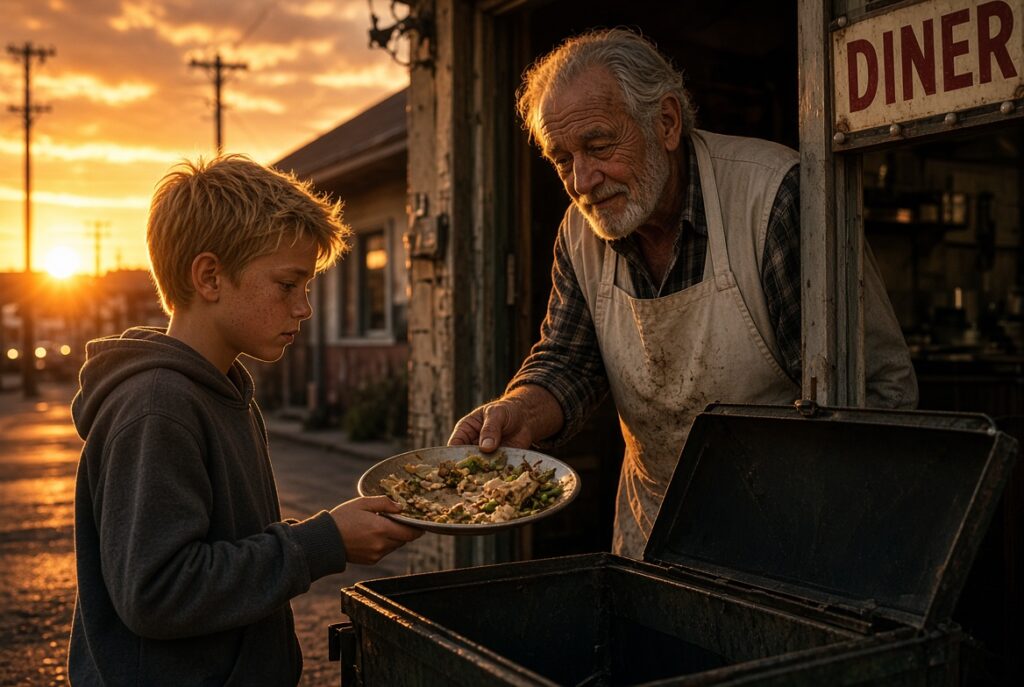
The sun was setting over the small German town, painting the sky in shades of amber and rose. The boy — ten years old, with short blond hair that hadn’t seen a comb in days and a constellation of freckles across his nose — stood in front of a large plastic garbage container behind a modest diner. He held a metal plate in his trembling hands. On it were the remnants of someone else’s meal: a few cold potatoes, a scrap of meat, a piece of bread that had gone hard at the edges.
He was hungry. The kind of hungry that makes your stomach feel like it’s eating itself. The kind of hungry that makes you swallow your pride and dig through other people’s trash.
The back door of the diner creaked open. An old man stepped out — seventy-five years old, with short gray hair, a dark gray short-sleeved shirt, and a white apron stained with years of grease and sauce. He looked at the boy. The boy looked back, frozen, caught in the act.
The old man walked over slowly. He didn’t yell. He didn’t scold. He simply reached out and took the metal plate from the boy’s hands.
“You can forget that,” he said, his voice calm and gentle. “That’s not for people like you.”
The boy’s shoulders slumped. Of course. He should have known. People like him didn’t get to eat. People like him didn’t get to hope. He turned to leave, his worn sneakers scuffing against the asphalt.
“Wait,” the old man said.
The boy stopped.
“Come with me.”
The boy hesitated. Was this a trick? Was the old man going to call the police? But something in the old man’s eyes — something warm, something familiar — made him follow.
They walked through the back door, through the narrow kitchen with its hissing grill and bubbling pots, and into the diner itself. The old man gestured to a red vinyl booth in the corner. The boy sat down, confused, his heart hammering in his chest.
Minutes later, the old man returned. In his hands was a plate — not a metal plate with scraps, but a proper ceramic plate. On it was a fresh steak, still sizzling, alongside a mound of creamy mashed potatoes and glazed carrots that glistened under the diner’s warm lights.
“Here is your food,” the old man said, setting the plate down. “You can start.”
The boy stared at the plate. Then at the old man. Then back at the plate. Tears welled up in his eyes and spilled down his freckled cheeks. He picked up the fork with shaking hands.
“Thank you,” he whispered. “Thank you.”
“Eat,” the old man said simply. “Eat, my boy.”
The boy ate. He ate like someone who hadn’t eaten in days — because he hadn’t. He ate like someone who had forgotten what warm food tasted like — because he had. And with every bite, the tears kept falling, silent and steady, dripping onto the table.
“Your deed will remain in my memory forever,” he said between bites, his voice breaking. “I will never forget this. Never.”
The old man watched from behind the counter. He didn’t say anything. He just nodded, a small smile playing at the corners of his weathered lips, and turned back to wiping down the grill.
What the boy didn’t notice — what he couldn’t have noticed — was the man who had been sitting at the far end of the counter the entire time. A man in his mid-thirties, with short blond hair, a dark blue suit, a crisp white shirt, and a silk tie. He had been nursing a cup of coffee, watching the scene unfold. And when he stood up to leave, he placed something on the wooden counter: a set of car keys and a plain white card.
He walked out without a word.
The old man picked up the card. On it was a single sentence in neat handwriting: “Thank you for everything. I’ll be back.”
The First Step
Years passed. The boy at the dumpster grew up. The old man at the diner grew older. And the man in the blue suit? He came back — again and again — until the day the old man finally hung up his apron for good.
But this story isn’t about endings. It’s about beginnings.
On a crisp early morning, on a street corner near a small German town, a young man stood beside a small red hot dog cart. He was eighteen years old, with short blond hair and a lean build, wearing a simple green jacket and faded jeans. His name was Lukas, and he had spent the last eight years saving every penny he could — working odd jobs, skipping meals, sleeping on friends’ couches — to buy this cart.
It wasn’t much. A red metal box on wheels, a small grill, a cooler for the sausages, a window that flipped open. But to Lukas, it was everything.
He tied on his apron — the same style the old man had worn, white and practical — and opened the little window for the first time.
A voice spoke, warm and nostalgic, as if from somewhere far away:
“Sometimes a great story begins with a small step.”
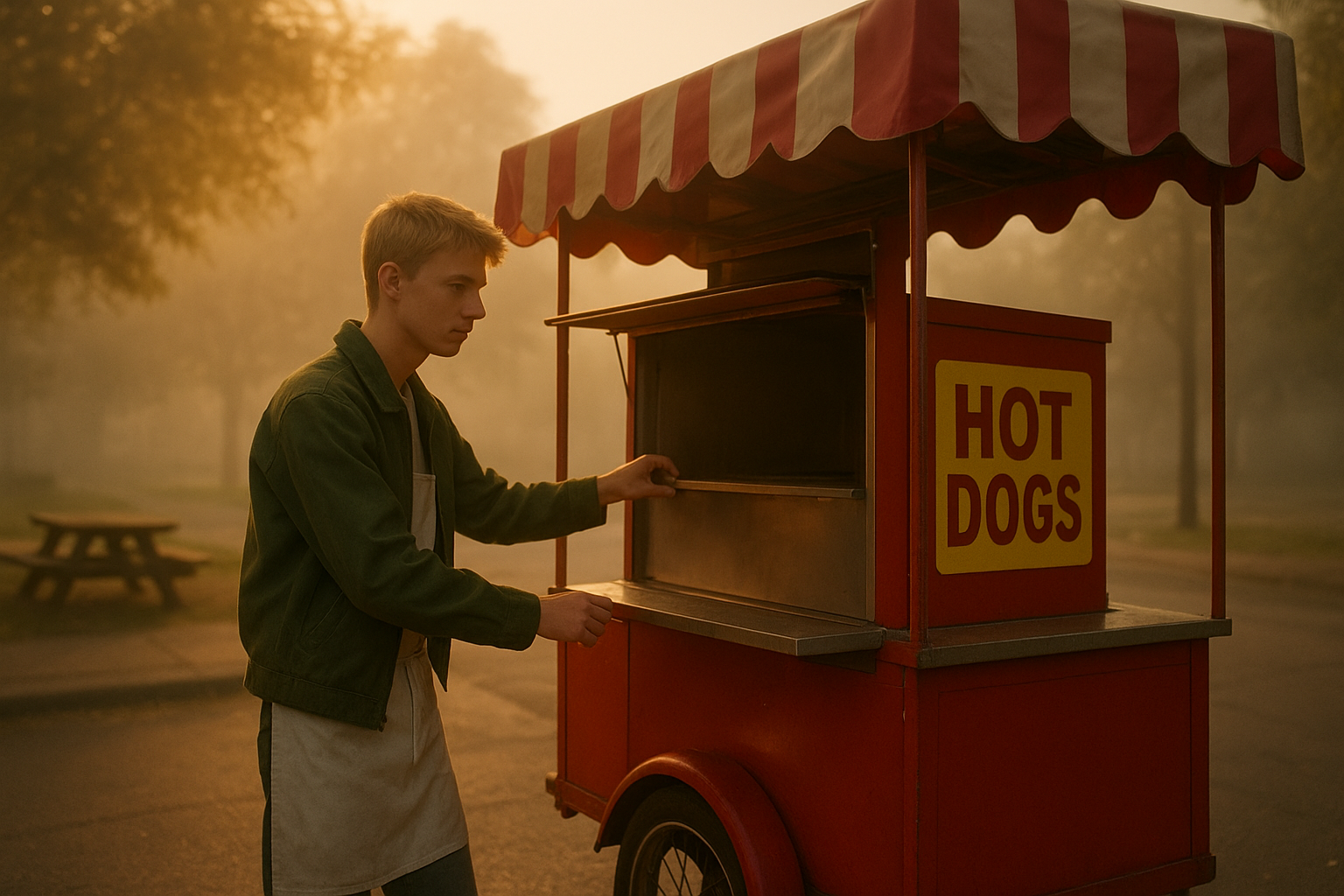
Lukas didn’t know it yet, but that small red cart would become the foundation of something extraordinary. Not because of luck. Not because of money. But because of a lesson he had learned long ago, standing in front of a dumpster with a metal plate in his hands: that kindness, once given, never truly disappears. It plants a seed. And seeds, if tended with patience and love, grow into forests.
The Cart That Became a Dream
The first day, Lukas sold three hot dogs. The second day, five. The third day, a man in a business suit bought two and told him they were the best he’d had in years.
By the end of the first month, there was a line.
Lukas worked eighteen-hour days. He woke before dawn to buy fresh sausages from a local butcher. He experimented with toppings — caramelized onions, spicy mustard, a secret sauce he’d perfected after dozens of failed attempts. He learned his customers’ names. He remembered their orders. He asked about their kids, their jobs, their lives.
And he never forgot where he came from.
Every evening, after closing, he would take whatever food was left over and walk to the edge of town — to the dumpsters behind the old diner, to the alleys where the forgotten people lived — and he would hand out free meals. No questions asked. No judgment. Just food, warm and plentiful, offered with a smile.
“Here you go,” he would say. “Enjoy your meal.”
One day, a young man named Felix walked up to the cart. He was twenty-five, with short blond hair, a white shirt, dark trousers, and a black apron. He had been working at a chain restaurant for years, miserable and unfulfilled, and he had heard rumors about the hot dog cart on the corner — the one with the line around the block, the one where the owner treated every customer like family.
“Do you need help?” Felix asked.
Lukas looked at him. Really looked at him. And in Felix’s eyes, he saw something familiar — a hunger that had nothing to do with food.
“Yes,” Lukas said. “Yes, I need help.”
Felix started the next day. He learned quickly — how to grill the sausages just right, how to wrap them so the bun stayed warm, how to greet customers with genuine warmth. And he watched Lukas. Watched how he treated the homeless man who came by every morning. Watched how he gave free meals to the single mother who couldn’t afford lunch for her kids. Watched how he never, ever looked down on anyone.
“Why do you do this?” Felix asked one evening, as they were cleaning up.
Lukas paused. He reached into his pocket and pulled out a photograph — old, creased, faded. In it, a ten-year-old boy with freckles and messy blond hair was smiling in front of a small diner. Beside him stood an old man in a dirty white apron, holding a plate of steak and mashed potatoes.
“Because someone helped me,” Lukas said quietly. “When I was nobody. When I had nothing. He gave me food. He gave me dignity. And I promised I would pass it on.”
Felix didn’t say anything. But something shifted in his chest. Something that felt a lot like purpose.
“From a small cart became a dream,” the narrator’s voice said, proud and emotional, “that grew bigger every day.”
The Restaurant of Second Chances
Ten years later, in the heart of the city, a restaurant opened its doors. It was called The First Step, and it was unlike any restaurant anyone had ever seen.
The space was vast and beautiful, with large windows that let in streams of natural light, warm wooden tables polished to a soft glow, and an open kitchen where chefs worked with quiet precision. The walls were decorated with photographs — not of celebrities or landscapes, but of ordinary people: a homeless man holding a hot dog, a single mother smiling as she fed her children, a young boy with freckles standing in front of a dumpster.
And in the center of the main dining room, mounted on the wall in a place of honor, was a large golden plaque. On it was an engraved portrait of an old man — short gray hair, dark gray shirt, white apron — holding a plate of steak and mashed potatoes.
Lukas — now thirty-five, with short blond hair and a dark blue suit — walked through the dining room, checking on the staff, greeting guests, making sure everything was perfect. He stopped in front of the plaque and stood there for a long moment.
“I will never forget who helped me,” he said softly.
“His past always remained a part of his success,” the narrator said, warm and knowing.
Lukas reached into his pocket and pulled out his phone. On the screen was a message from an unknown number — a black-and-white security camera photograph, grainy and striped with interference. In it, a small boy stood beside a garbage container, holding a metal plate.
Lukas stared at the image. His heart clenched.
He knew that boy. He had been that boy.
He walked outside. The street was busy, filled with the noise of traffic and the chatter of pedestrians. And there, beside a large plastic garbage container with its lid flipped open, was a boy — ten years old, with messy dark hair, an old gray hoodie, and dirty jeans. He was digging through the trash, searching for food.
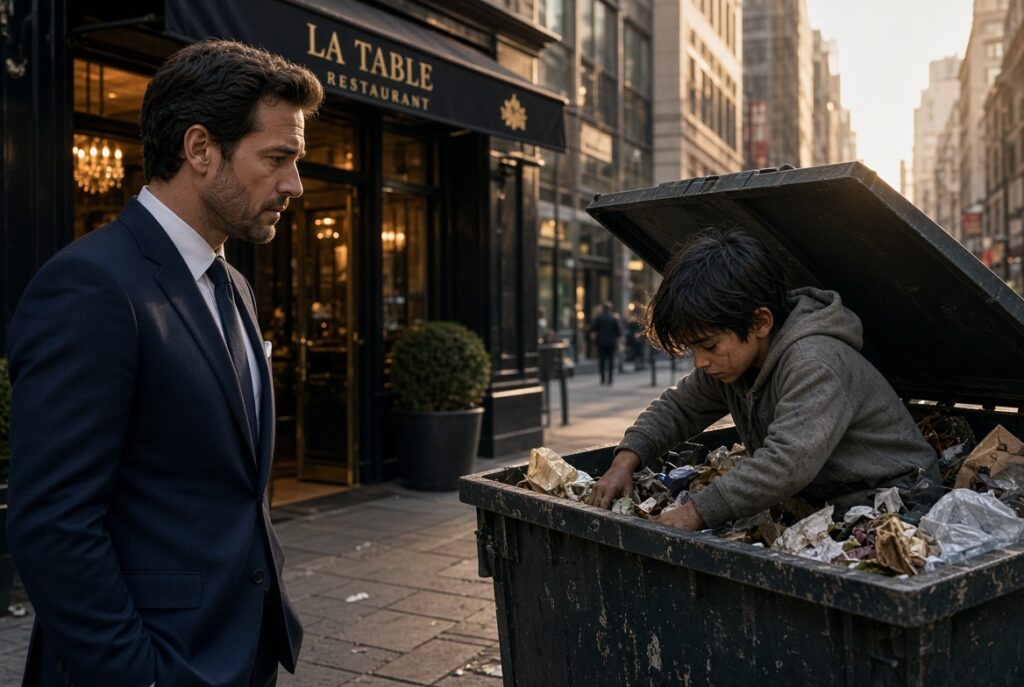
Lukas felt the world tilt. For a moment, he was ten again, standing at a different dumpster, in a different town, with a metal plate in his hands and despair in his heart.
He walked over slowly. The boy looked up, startled, ready to run.
“Hey, little man,” Lukas said, his voice gentle and concerned. “Come with me.”
The boy hesitated. Lukas held out his hand. And after a long, trembling moment, the boy took it.
Robert
Inside the restaurant, the boy sat in a booth by the window. He looked small and out of place against the elegant wooden table and the soft leather seats. His eyes darted around, taking in the golden plaque, the photographs on the walls, the well-dressed customers who glanced at him with curiosity and then looked away.
Lukas appeared with a plate — not a metal plate with scraps, but a proper ceramic plate. On it was a fresh steak, still sizzling, alongside a mound of creamy mashed potatoes and glazed carrots that glistened under the restaurant’s warm lights.
He set it down in front of the boy.
“Eat,” he said, kind and calm. “You deserve it.”
The boy stared at the plate. Then at Lukas. Then back at the plate. Tears welled up in his eyes and spilled down his cheeks.
He picked up the fork with shaking hands and began to eat. And with every bite, the tears kept falling, silent and steady, dripping onto the table.
Lukas sat down across from him. He didn’t say anything. He just waited. When the boy had finished — every last bite, every last crumb — Lukas spoke.
“What’s your name?”
The boy looked down. “My name is Robert,” he said shyly.
Lukas smiled. “Nice to meet you, Robert. Do you need help, maybe?”
Robert stared at the table. His fingers traced the grain of the wood. “I’m still too young,” he said sadly. “Nobody gives me a job.”
Lukas leaned forward. “You know, Robert… I was once exactly like you.”
He pulled out his phone and showed Robert the old photograph — the one of the ten-year-old boy with freckles standing in front of a diner, beside an old man in a white apron.
“That’s me,” Lukas said. “Twenty-five years ago. I stood in front of a dumpster, just like you. And an old man gave me food. He gave me a chance. And that chance changed everything.”
Robert looked at the photograph. Then at Lukas. “Really?”
“Really,” Lukas said. “And now I’m passing that chance on to you.”
He stood up and gestured toward the kitchen. “You can help our cook. Everyone has to start somewhere.”
Robert’s eyes widened. The surprise on his face slowly melted into a smile — a real smile, the first one in a long, long time.
“Really?” he asked again. “I’ll do it. I’ll do it!”
The Golden Plaque
That evening, Lukas and Robert stood outside the restaurant. The city lights were coming on, one by one, like stars falling to earth. Lukas looked at the old photograph on his phone one more time — the boy with freckles, the old man with the plate — and then he looked at Robert.
“You know, Robert… I was once exactly like you,” he said again, his voice quiet and emotional.
“Sometimes one person helps another,” the narrator said, “because he recognizes himself in him.”
Robert looked up at Lukas. “Will I be like you someday?”
Lukas knelt down so he was eye level with the boy. “You’ll be better than me,” he said. “I promise you.”
And in that moment, something passed between them — something invisible, something unbreakable. A promise. A legacy. A chain of kindness that stretched back twenty-five years, to a dumpster behind a diner, to an old man who had seen a hungry boy and decided to feed him.
The Chain Continues
Years passed. Robert grew up. He worked in the kitchen of The First Step, learning everything he could from the chefs, from Lukas, from the customers who came and went. He learned to cook. He learned to serve. But most importantly, he learned to see — to see the people others overlooked, to see the hunger behind the eyes, to see the stories that no one else bothered to read.
And when he was twenty-five — with short dark hair, a white shirt, and a black apron — Robert became the head chef of The First Step.
The restaurant had grown. It now had locations in three cities. On every wall, in every location, hung a golden plaque with the portrait of the old man — the one who had started it all. And on every table, in every restaurant, stood a small sign: “Every tenth lunch is free for those in need.”
Robert stood in the main dining room, looking up at the golden plaque. He thought about the old man he had never met — the one who had given Lukas a plate of steak and mashed potatoes, who had said “That’s not for people like you” and then proved himself wrong. He thought about Lukas, who had found him at a dumpster and given him a chance. He thought about all the people who had walked through these doors — hungry, broken, forgotten — and left with full stomachs and full hearts.
“A good deed never ends,” the narrator said, proud and emotional. “It lives on as long as someone passes it on.”
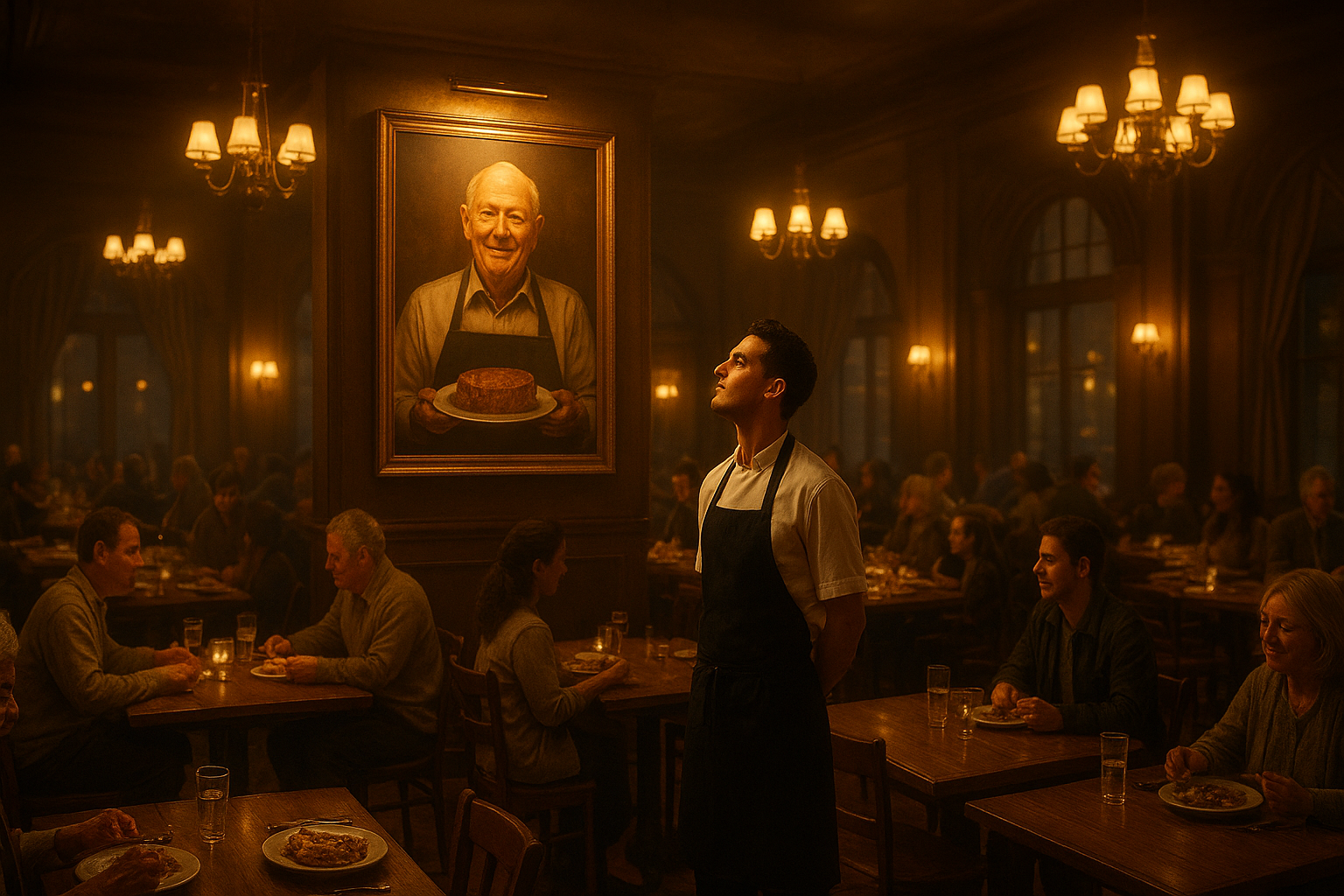
The camera panned slowly across the restaurant. At one table, a homeless man was eating a hot meal, tears streaming down his face. At another, a single mother was feeding her children, smiling for the first time in weeks. At another, a young couple was celebrating an anniversary — and had quietly paid for the meals of everyone in the room.
And at the center of it all, the golden plaque gleamed. The old man in the portrait seemed to be watching, his weathered face frozen in a gentle smile, his hands holding a plate of steak and mashed potatoes.
He had no idea, when he threw away that boy’s metal plate and replaced it with a proper meal, that he was starting something that would outlive him. He had no idea that his small act of kindness would ripple outward, touching hundreds, thousands, tens of thousands of lives.
But that’s the thing about kindness. You never know where it will end. You never know how far it will travel. You never know whose life it will change — or how many times it will be passed on, hand to hand, heart to heart, until it becomes something so vast and beautiful that it’s impossible to trace back to its source.
All because one old man, on one ordinary evening, looked at a hungry boy and decided to feed him.
Epilogue: The Boy at the Dumpster
In a small German town, behind a diner that had long since closed, there was still a large plastic garbage container. It was old and weathered, covered in graffiti and rust. No one paid it any attention.
But sometimes, late at night, if you looked closely, you might see a figure standing there. An old man — or perhaps just the ghost of one — with short gray hair, a dark gray shirt, and a white apron. He would stand beside the dumpster, holding a plate of steak and mashed potatoes, waiting.
Waiting for the next hungry boy. The next forgotten girl. The next person who needed to be seen.
And when they came — and they always came — he would hand them the plate and say, in a voice warm and gentle:
“Here is your food. You can start.”
And somewhere, in a restaurant in the city, a golden plaque gleamed. And a young chef in a black apron looked up at it and smiled. And a chain of kindness, forged in a single moment of compassion, continued to grow — one plate, one meal, one life at a time.
Because a good deed never ends.
It lives on.
Forever.