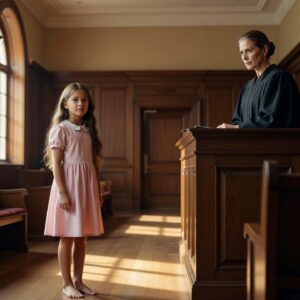

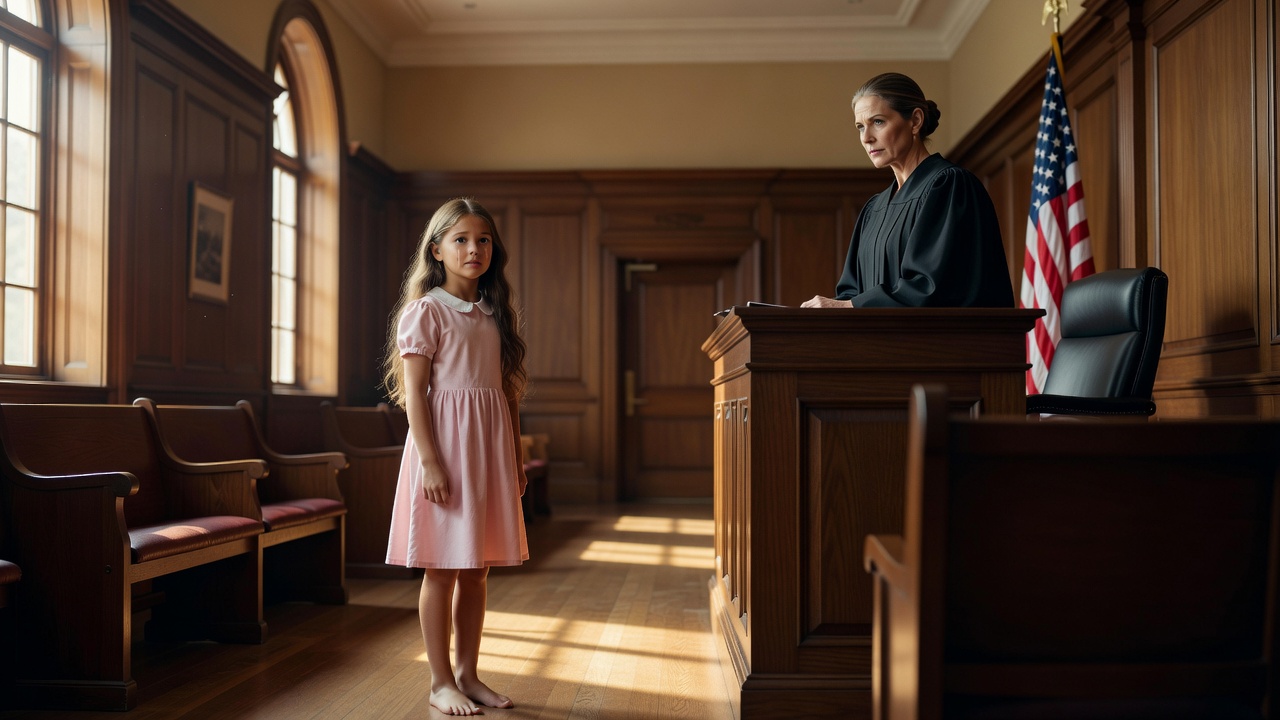
The heavy oak doors of the county courthouse groaned open, and a small figure burst through. Bare feet slapped against the cold marble floor as a girl of no more than seven ran down the corridor, her long, wavy light-brown hair flying behind her like a banner. She wore a pale pink dress with short sleeves and a white collar—the kind of dress a mother might iron carefully for a Sunday service. But this was no Sunday. This was a Tuesday morning in the middle of a murder trial, and the child was screaming.
“My daddy didn’t kill her father!”
The words echoed off the vaulted ceiling and slipped under the double doors of Courtroom 4B, where the jury had just been seated and the prosecution was preparing to call its first witness. Inside, a man in a gray suit—forty-eight years old, with short brown hair and a dark tie—turned his head toward the commotion. His name was David Mercer, and he was the defendant. Beside him sat his ex-wife, Elaine, a woman of forty-five with wavy dark brown hair and a navy blue dress. Her face, already pale from three days of testimony, went slack with confusion.
“Who is that child?” David whispered, but no one answered.
The bailiff, a broad-shouldered man named Harris, stepped into the aisle to intercept the girl, but she was too quick. She dodged his outstretched arm and ran straight toward the judge’s bench, where Judge Margaret Holloway—a seventy-year-old woman with short gray hair and a black robe—sat with her gavel half-raised. The judge’s eyes widened. In thirty years on the bench, she had seen outbursts, threats, and even a fainting juror, but never a barefoot child in a pink dress.
“She’s lying!” Elaine shouted, rising from her seat and pointing a trembling finger at the girl. “Get her out of here! This is a circus!”
The girl stopped at the edge of the bench and turned to face the judge. Her cheeks were wet, her chin trembled, but her voice—when it came—was steady. “I saw what happened,” she said. “I saw everything.”
Judge Holloway leaned forward, her gavel forgotten. “What did you see?”
The courtroom went silent. Even the court reporter’s fingers hovered over her keyboard. The girl swallowed hard, and then she began to speak.
Her name was Sophie. She was six years old—almost seven, she would insist—and she lived with her mother in a small apartment above a bakery on Elm Street. Her father, David, had moved out two years ago after the divorce, but he still picked her up every Saturday for pancakes at the diner and a walk in the park. Sophie loved those Saturdays. She loved the way her father laughed at her jokes and the way he always let her press the button on the crosswalk even when the light was already green.
But three months ago, the Saturdays had stopped. David had been arrested and charged with the murder of a man named Richard Calloway—Elaine’s father. The prosecution claimed that David had gone to Richard’s house on the night of March 12th, angry over a custody dispute, and had struck the old man with a fireplace poker. There was no eyewitness. There was no murder weapon. There was only circumstantial evidence: David’s fingerprints on the front door, a neighbor who heard shouting, and a motive that the district attorney painted in broad, ugly strokes.
What the court didn’t know—what no one knew—was that Sophie had been there that night. She had been in the back seat of her mother’s car, parked across the street, waiting while Elaine ran into her father’s house to pick up a check. Sophie had seen a man walk up the front steps. She had seen him through the window. And that man was not her father.
“I was in the car,” Sophie told the judge, her small hands gripping the edge of the bench. “Mommy said stay put. I stayed put. But I saw a man. He had a hat. A blue hat. And he went inside, and then I heard a loud noise, and then he ran out.”
“Objection!” The district attorney, a sharp-nosed man named Coleman, shot to his feet. “Your Honor, this is highly irregular. The child was not on the witness list. She has not been sworn in. This is—”
“Sit down, Mr. Coleman,” Judge Holloway said quietly. She looked at Sophie. “Sweetheart, do you know what it means to tell the truth?”
Sophie nodded. “It means you say what really happened, even if it makes your tummy hurt.”
A ripple of soft laughter went through the gallery, but it died quickly when the judge raised her hand. “Bailiff, please swear in the child.”
Harris approached with the Bible, but Sophie shook her head. “I don’t need the book,” she said. “I already promised God.”
Elaine was on her feet again, her face flushed. “This is absurd! She’s a child! She doesn’t know what she saw! She’s been coached—”
“Mrs. Mercer,” the judge said, her voice like a blade wrapped in velvet, “if you speak out of turn again, I will have you removed from this courtroom. Do you understand?”
Elaine sat down, but her eyes burned with fury. David, meanwhile, had gone very still. He was staring at his daughter as if she were a ghost. He had no idea she had been there that night. He had no idea she had seen anything at all.
“Go on, Sophie,” the judge said. “Tell us what you saw.”
And Sophie did. She described the man with the blue hat—a man she had seen before, she said, at her mother’s office. A man named Victor. He had been wearing a dark coat and gloves, even though it was a warm night. He had walked up the steps, let himself in with a key, and come out seven minutes later, breathing hard. Sophie had ducked down in the back seat when he passed the car. She had been so scared she had wet her pants. When her mother came back, Sophie had been crying too hard to tell her what had happened.
“I tried to tell Mommy later,” Sophie said, “but she said I was dreaming. She said I had a big imagination.”
“And who is Victor?” the judge asked.
Sophie pointed at a man sitting in the third row of the gallery—a man in a gray suit who had been taking photographs of the proceedings. His name was Victor Hale, and he was a private investigator hired by Elaine’s attorney. He had been in the courtroom every day, snapping pictures, taking notes, and no one had thought twice about it.
Now, every head in the room turned to look at him. Victor Hale’s face went white. He stood up, knocking his camera to the floor with a clatter, and bolted for the exit.
“Bailiff!” Judge Holloway shouted. “Seal the doors!”
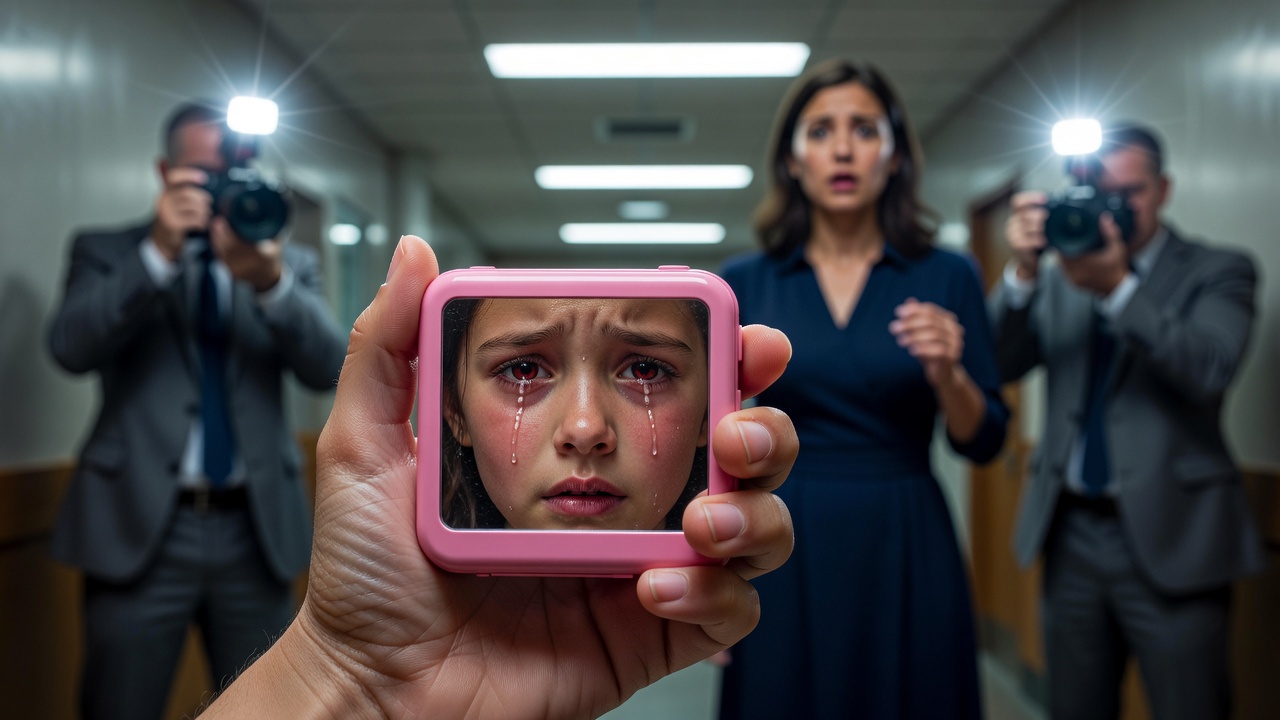
But Harris was already moving. He caught Victor Hale by the arm just as he reached the back of the courtroom, and the two men went down in a heap of flailing limbs and scattered papers. A flash went off—one of the other photographers, Character 5, had instinctively snapped a picture—and then the room erupted.
“Order!” The judge pounded her gavel. “Order in the court!”
It took nearly ten minutes to restore calm. By then, Victor Hale was in handcuffs, and the district attorney was staring at his own shoes as if he wished the floor would swallow him. Elaine was weeping—not with anger now, but with something that looked like despair. And David Mercer was holding his daughter in his arms, his face buried in her hair, whispering words that no one else could hear.
“I’m sorry, Daddy,” Sophie said. “I should have told sooner.”
“No, baby,” he said. “You told right when it mattered.”
The trial was suspended. Within a week, Victor Hale was charged with the murder of Richard Calloway, and the case against David Mercer collapsed like a house of cards. It turned out that Victor had been embezzling money from Richard’s estate for years, and Richard had finally caught him. Elaine had known nothing about it—she had been a pawn in a game she didn’t even know was being played. The blue hat was found in Victor’s apartment, along with a key to Richard’s house and a pair of gloves with traces of the old man’s blood.
But the story didn’t end there. Not really.
Sophie became something of a local celebrity. The newspapers called her “the barefoot heroine” and “the little girl who stopped a trial.” Her picture was on the front page of the county paper, and for a few weeks, strangers stopped her on the street to shake her hand. She didn’t like the attention. She didn’t like the way people looked at her, as if she were a curiosity, a freak of nature. She just wanted to go back to being a normal kid who ate pancakes on Saturdays and pressed the crosswalk button.
But normal was hard to find after that morning in Courtroom 4B. Sophie started having nightmares. She dreamed of the man with the blue hat, of the loud noise, of the way her mother had screamed when she heard the news. She woke up crying, and her mother would come running, and for a few minutes, everything would be okay. But then the sun would come up, and Sophie would remember that her father had almost gone to prison for something he didn’t do.
“Why did Victor do it?” she asked her father one afternoon, sitting on a park bench while the pigeons pecked at crumbs by their feet.
David sighed. “Some people do bad things because they’re scared, Sophie. Scared of getting caught. Scared of losing what they have. Victor was scared, and he made a terrible choice.”
“But that doesn’t make it right.”
“No,” David said. “It doesn’t. But it helps to understand. Understanding doesn’t mean forgiving. It just means you don’t have to carry the anger around like a rock in your pocket.”
Sophie thought about that for a long time. She thought about it when she saw Elaine at the grocery store, looking thin and tired and old. She thought about it when she saw Victor Hale’s face on the evening news, his eyes blank and hollow. She thought about it when she lay in bed at night, listening to the wind rattle the windowpanes.
And slowly, the nightmares began to fade.
Six months after the trial, Sophie’s mother got a new job in a different city. It was a chance to start over, she said. A chance to leave the whispers behind. Sophie didn’t want to go. She didn’t want to leave her father, who had moved into a small apartment on the other side of town and was slowly rebuilding his life. She didn’t want to leave her school, her friends, her Saturday pancakes. But her mother was adamant. “We need this,” she said. “You need this.”
So they packed up their things and drove three hundred miles to a town called Riverton, where the streets were lined with maple trees and nobody knew Sophie’s name. It was strange, at first. Strange to be anonymous. Strange to walk into a classroom and not have anyone stare. Strange to be just a girl again.
But it was also a relief.
Sophie made new friends. She joined the school choir. She learned to ride a bike without training wheels. She even got a pet hamster, which she named Gavel, in honor of the judge who had listened to her when no one else would. And every Saturday, she called her father on the phone, and they talked for an hour about everything and nothing.
“I miss you, Daddy,” she said one night, curled up under her covers with the phone pressed to her ear.
“I miss you too, baby,” he said. “But I’m proud of you. You know that, right?”
“I know.”
“You were braver than anyone I’ve ever met. Braver than me. Braver than the judge. Braver than the whole damn courtroom.”
Sophie giggled. “You said a bad word.”
“I know,” he said. “Don’t tell your mother.”
And for a moment, everything was okay.
But life has a way of circling back. Two years later, when Sophie was eight, she received a letter in the mail. It was from Judge Holloway. The judge had retired from the bench and moved to a small house by the ocean, where she spent her days gardening and reading mystery novels. She had thought about Sophie often, she wrote. She had wondered how the girl was doing, whether she had managed to put the trial behind her. And she had something she wanted to give her.
Enclosed in the envelope was a small, silver key.
“This is the key to my old chambers,” the judge wrote. “I want you to have it. Not because it opens a door, but because it reminds you that you have the power to open doors that others say are locked. You did that for your father. You can do it for yourself, too.”
Sophie kept the key on a chain around her neck. She wore it every day, even when she went swimming, even when she slept. It was a small thing, a piece of metal, but it meant everything. It meant that she had been seen. It meant that she had been heard. It meant that she mattered.
When Sophie was twelve, her father moved to Riverton to be closer to her. He got a job at a hardware store and rented a little house with a porch and a swing. On weekends, Sophie would ride her bike over and they would sit on the porch and talk about books and music and the future. David had started dating a woman named Carla, a kind-eyed nurse with a laugh that sounded like wind chimes. Sophie liked her. She liked the way Carla didn’t treat her like a fragile thing, like a child who might break if you said the wrong word.
“You know, your dad talks about you all the time,” Carla said one afternoon, handing Sophie a glass of lemonade. “He says you’re the bravest person he’s ever known.”
Sophie shrugged. “I was just in the right place at the right time.”
“No,” Carla said. “You were in the wrong place at the wrong time, and you still did the right thing. That’s different. That’s braver.”
Sophie thought about that for a long time. She thought about it when she saw a news story about a wrongful conviction, or a child who had spoken up about something bad, or a person who had stood up for what was right even when it was hard. She thought about it when she looked at the silver key around her neck and remembered the judge’s words.
You have the power to open doors that others say are locked.
When Sophie was eighteen, she applied to law school. She didn’t tell anyone at first—not her mother, not her father, not even Carla. She wanted to be sure. She wanted to know that it was what she really wanted, not just a reaction to what had happened when she was six. So she volunteered at a legal aid clinic, answering phones and filing papers, and she watched the lawyers work. She watched them fight for people who had no one else to fight for them. She watched them stand up in court and speak the truth, even when it was unpopular, even when it was dangerous.
And she knew.
On her first day of law school, Sophie stood in front of the mirror in her tiny apartment and looked at herself. She was tall now, with long wavy hair that she wore in a ponytail. She was wearing a gray suit—her first real suit—and a pair of sensible shoes. Around her neck, the silver key glinted in the morning light.
“You can do this,” she said to her reflection. “You’ve done harder things.”
She thought about the courtroom, about the way her bare feet had slapped against the marble floor, about the way her voice had trembled but held. She thought about her father’s face when he realized she had saved him. She thought about the judge’s steady eyes, and the way she had asked, “What did you see?”
And she smiled.
Years later, when Sophie was a public defender in a busy city courthouse, she found herself in a familiar position: standing in front of a judge, arguing for someone who had been written off by everyone else. The case was tough. The evidence was stacked against her client. The prosecutor was sharp and relentless, and the jury looked skeptical.
But Sophie didn’t back down. She cross-examined witnesses with precision. She presented evidence that the police had overlooked. She spoke with a quiet, unshakeable conviction that made the courtroom sit up and listen.
And when the verdict came back—not guilty—she didn’t celebrate. She just nodded, and thanked the jury, and walked out into the hallway, where her father was waiting.
“You did it,” David said, his eyes shining.
“We did it,” Sophie said. “You taught me that the truth matters. Even when it’s hard. Even when no one wants to hear it.”
David hugged her, and for a moment, they were back in that courtroom, a barefoot girl and a frightened father, holding onto each other like a lifeline.
“I’m proud of you,” he said.
“I know,” Sophie said. “You always were.”
And somewhere, in a small house by the ocean, an old judge smiled and turned the page of her mystery novel, thinking of a little girl in a pink dress who had changed everything.