
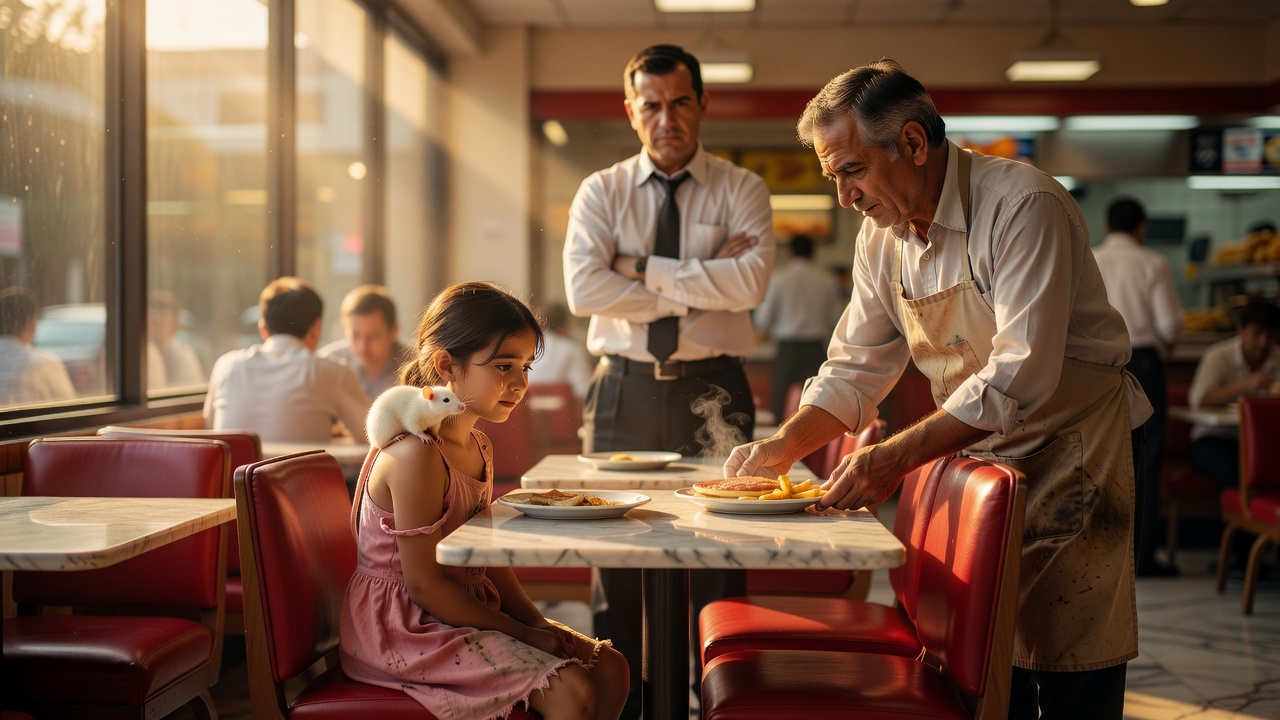
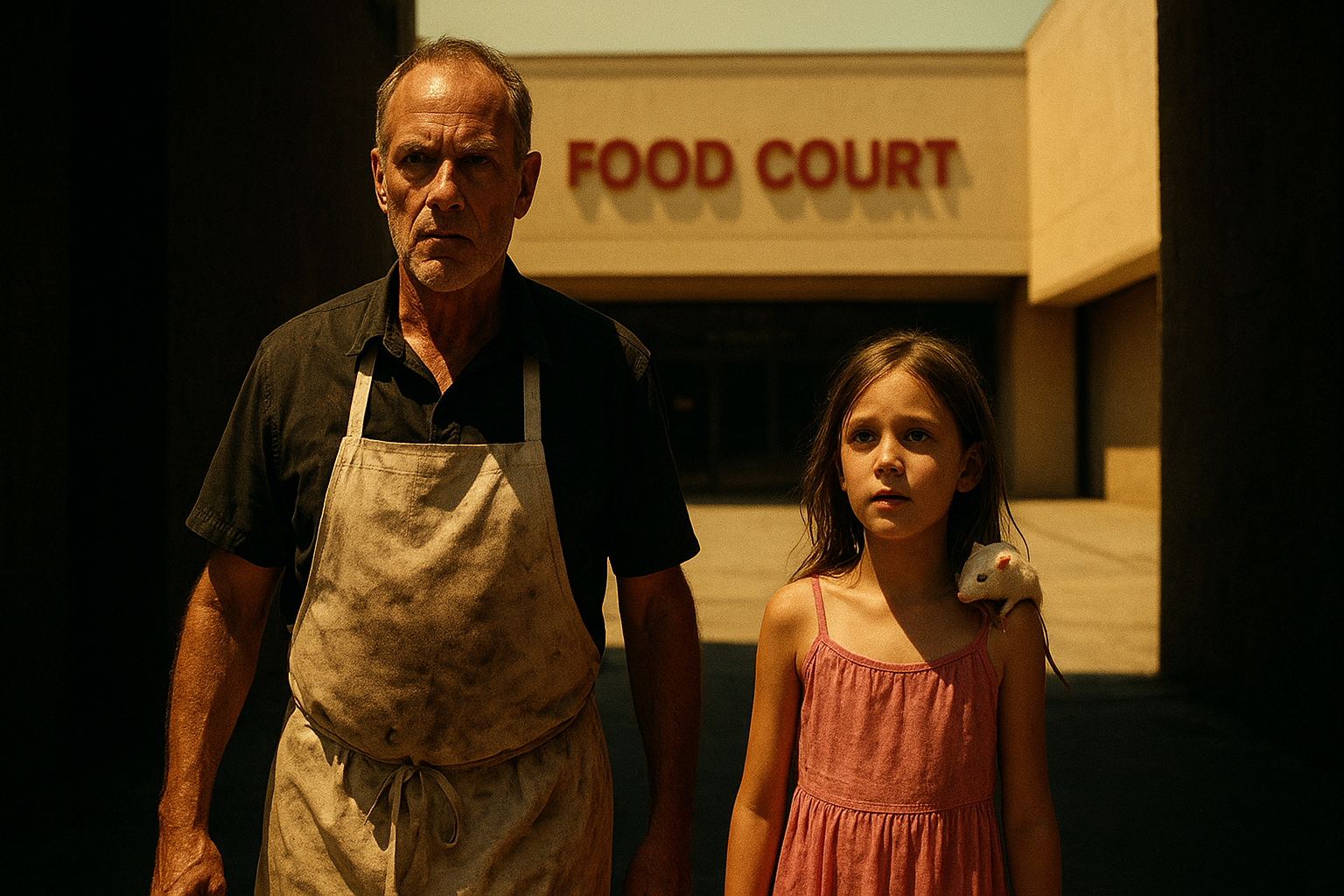
The food court hummed with the ordinary music of midday—trays clattering, cash registers chiming, the low murmur of shoppers and office workers grabbing a quick bite. Sunlight poured through the tall windows of the bustling diner, slanting across marble tables and spilling over the red vinyl seats like warm honey. Nobody noticed the small, filthy figure hunched at a corner table. Nobody except the man in the stained apron.
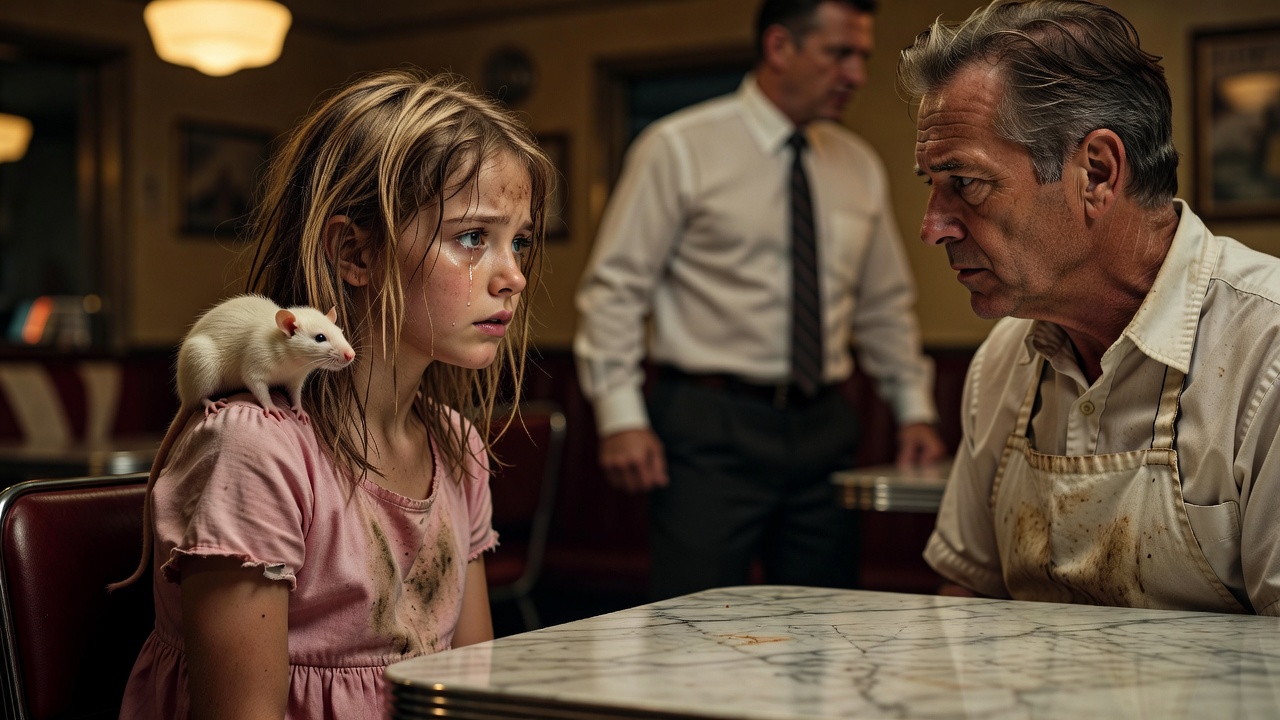
She was sixteen years old, maybe younger—it was hard to tell beneath the grime. Her golden hair, once bright, hung in tangled ropes around a face streaked with tears and dirt. Her pink sundress had long ago surrendered to mud and grease. And on her right shoulder, perched like a tiny sentinel, sat a white rat, its pink nose twitching as it watched the world with unsettling calm.
The girl picked at the plate in front of her, though her hands trembled. She looked up at the older man standing beside her—short, dark hair salted with gray, a dirty black short-sleeved shirt under a white apron that had seen better days. He was watching her with something she hadn’t seen in a long time. Kindness.
“Why are you helping me?” she asked, her voice barely a whisper, soft and sad.
He set down another plate, this one piled with scrambled eggs and toast, and gave her a small, tired smile. “Just eat, sweetheart.”
She nodded, a fresh tear sliding down her cheek. “Thank you.”
Behind them, a third figure stood with arms crossed over a crisp white shirt and dark tie. His hair was neat, his badge read Manager, and his face was a mask of cold disapproval. He had been watching the whole exchange, his jaw tight, his eyes flicking between the girl and the apron-clad man like a hawk calculating the cost of mercy.
“That meal comes out of your paycheck,” the manager said, his voice stern and firm, cutting through the diner’s noise like a blade.
The older man—his name was Frank, though nobody had asked—straightened up and turned, his expression flickering between concern and barely concealed contempt. “Okay! Gosh,” he said, keeping his voice low, as if trying not to scare the girl. “It’s just eggs, Martin. She’s a kid.”
“She’s a health code violation,” Martin replied, his eyes dropping to the rat on her shoulder. “And you’re enabling her. I’ve told you before—no loitering, no handouts. This isn’t a charity.”
The girl kept her eyes on her plate, but her shoulders stiffened. The rat, sensing her tension, crawled down her arm and nestled in the crook of her elbow, its tiny claws gripping the fabric of her dress. She took another bite, chewing slowly, deliberately. Then she looked up at Frank, and something in her eyes shifted—a flicker of something far older than twelve.
“I wish I could tell you who I am,” she said, her voice sad but determined, each word measured.
Frank frowned, leaning closer. “What did you say?”
She opened her mouth to repeat herself, but Martin stepped forward, his shadow falling across the table. “I said—”
“I heard you,” Frank cut him off, not taking his eyes off the girl. “What do you mean, who you are? You’re a kid who needs a meal. That’s who you are.”
The girl shook her head slowly. The rat climbed back up to her shoulder, its whiskers brushing her cheek. She glanced at Martin, then back at Frank, and her voice dropped to a whisper so quiet that Frank had to lean in until his ear was almost touching her hair.
“Tomorrow at 8pm,” she said, “be aware of white BMW near entry.”
Frank froze. The words didn’t belong in a diner, didn’t belong in the mouth of a twelve-year-old. They sounded like a warning, a code, a piece of a puzzle he hadn’t known he was solving. He pulled back, searching her face for a joke, a prank, anything. But her eyes were dead serious, and the rat on her shoulder stared at him with an intelligence that made his skin prickle.
Behind them, Martin had heard enough. He uncrossed his arms, his face twisting with anger. Without a word, he turned sharply on his heel and stalked away, his polished shoes clicking against the tile floor. The girl watched him go, then looked back at Frank.
“You shouldn’t have done that,” Frank murmured. “He’s going to call security. Or worse.”
“He’s already called someone,” the girl said. “He just doesn’t know it yet.”
Before Frank could ask what she meant, a new sound cut through the diner—a chair scraping back, hard. A man had risen from a table near the entrance, a man Frank hadn’t noticed before. He was older, sixty-five perhaps, with neat black hair slicked back with brilliantine, a black suit that looked expensive, and a face like a clenched fist. Unshaven, angry, silent—until now.
“Stop!” the man shouted, his voice ringing across the food court. “Don’t tell him!”
He was smiling as he said it, a thin, terrible smile, and as he spoke he reached inside his jacket, his hand disappearing into the inner pocket. The girl gasped. The rat hissed. Frank’s blood turned to ice.
Everything happened at once. Frank lunged forward, his hand reaching for the girl, but she was already moving—sliding off her chair, the rat clinging to her collar, her bare feet slapping against the tile. The man in the black suit pulled his hand from his jacket, and for a heartbeat Frank expected a gun. Instead, the man produced a small black device—a phone, or something like it—and pressed it to his ear.
“Abort,” he said into it, his eyes fixed on the girl. “She’s talking. Move to secondary.”
Then he turned and walked out of the diner, calm as a man leaving a church service. The glass doors swung shut behind him, and the food court swallowed him whole.
Frank stood frozen, his heart hammering. The girl had stopped at the edge of the seating area, her chest heaving. She looked back at him, and for the first time, he saw fear in her eyes—real fear, the kind that belonged to hunted things.
“You have to go,” she said. “He’ll come back. They always come back.”
“Who?” Frank demanded. “Who is he? Who are you?”
She hesitated. The rat climbed down from her shoulder and into her cupped hands, and she held it like a talisman. “My name is Elara,” she said. “And I’m not supposed to exist.”
Frank took a step toward her. “What does that mean?”
“It means,” she said, backing away, “that if you help me, they’ll kill you. And if you don’t, they’ll kill me. So maybe you should just forget you ever saw me.”
She turned and ran. Frank watched her go, her small figure weaving between shoppers and strollers, the white rat a bright spot against her dirty dress. He should have let her go. Every rational part of his brain screamed at him to turn around, go back to his grill, and pretend the last ten minutes had never happened.
But Frank had spent twenty years flipping burgers and serving strangers, and in all that time, no one had ever asked him why are you helping me? No one had ever looked at him like he was the last safe thing in the world.
He untied his apron and let it fall to the floor.
—
The alley behind the food court smelled of grease and rain. Frank found her crouched behind a dumpster, the rat sitting on her knee, both of them watching the street. She didn’t seem surprised to see him.
“You’re stubborn,” she said.
“I’m stupid,” Frank corrected. “There’s a difference.” He crouched beside her, his knees popping. “Start talking, Elara. Who’s the man in the black suit?”
She was quiet for a long moment. Then she said, “His name is Silas Vane. He works for a company called Meridian. They… make people. Or they used to. I was one of their projects.”
“Projects.”
“I was born in a lab,” she said, matter-of-factly. “Not like a test tube baby. I mean—I was made. Designed. They wanted a child who could… do things. Remember things. Things that haven’t happened yet.”
Frank stared at her. “You’re telling me you can see the future.”
“Not exactly.” She stroked the rat’s back. “I can see patterns. Probabilities. They trained me to predict what people will do next. It’s not magic. It’s math. But it works.”
“And the white BMW?”
“That’s how they’re coming for me,” she said. “Tomorrow at eight. I saw it. A white BMW pulls up to the entry, and two men get out, and they take me back. Unless someone stops them.”
Frank rubbed his face. “Why me? Why not the police?”
“Because the police work for Meridian,” she said. “Everyone works for Meridian. Except you.” She looked at him, and for a moment she seemed impossibly old. “You gave me eggs. You didn’t ask for anything. That’s… rare.”
Frank let out a long breath. “Okay,” he said. “Okay. What do we do?”
The rat climbed up to Elara’s shoulder and sat there, whiskers twitching. Elara smiled—the first real smile Frank had seen from her—and said, “First, we need to get my brother.”
“Your brother?”
“He’s still inside,” she said. “They’re holding him on the fourth floor. He’s the one they really want. I’m just the key.”
Frank looked up at the food court, at the bright windows and the ordinary people eating ordinary lunches. Somewhere above them, in a building he’d worked in for two decades, a boy was waiting. And a man named Silas Vane was already making calls.
“Then let’s go get him,” Frank said.
Elara stood, brushing dirt from her dress. The rat chittered softly in her ear, and she nodded as if it had spoken. “You know,” she said, “I predicted you’d say that. But it’s different when it actually happens.”
“Different how?”
“Better,” she said. “It’s better.”
They walked out of the alley together, a tired old man and a girl with a white rat, heading toward a building that held more secrets than either of them could count. The sun was still shining, the food court was still humming, and somewhere a white BMW was already on its way.
Part II: The Fourth Floor
The Meridian building was not supposed to exist. It had no logo, no reception desk, no directory in the lobby. It was simply a floor—the fourth—in an office tower that also housed a dentist, a travel agency, and a call center for a mattress company. Frank had walked past it a thousand times without ever knowing it was there.
Elara led him through a service entrance and up a stairwell that smelled of bleach and old carpet. The rat rode on her shoulder, its nose working constantly, as if it could smell the danger ahead.
“How do you know where he is?” Frank whispered.
“I saw it,” she said. “In a dream. Or a memory. Sometimes they’re the same thing.”
They stopped at a door marked Authorized Personnel Only. Elara pressed her palm against the lock, and it clicked open. Frank raised an eyebrow.
“They made me,” she said. “They didn’t think to change the locks.”
Inside, the fourth floor was a maze of white corridors and glass-walled rooms. Monitors lined the walls, showing feeds from cameras all over the city. In one room, Frank saw a familiar face—Martin, the manager, sitting at a desk, talking on a phone, his expression nervous.
“He’s one of them,” Elara said. “Not important. Just a watcher.”
They moved deeper into the floor, past rooms filled with equipment Frank couldn’t name, until they reached a door at the end of the hall. Elara stopped.
“He’s in there,” she said. “My brother. They call him Twelve.”
“What do they call you?”
“Thirteen,” she said. “Lucky number.”
Frank pushed the door open. The room was small and white, with a single bed and a boy sitting on it. He was younger than Elara, maybe eight, with the same golden hair and the same too-old eyes. When he saw her, he didn’t smile. He just stood up and walked into her arms.
“You came,” he said.
“I told you I would,” she said.
Frank watched them, and something in his chest tightened. He had never had children. He had never wanted them. But standing there, in a room that smelled of antiseptic and fear, he understood something he hadn’t before: some things were worth losing everything for.
“We need to go,” he said. “Now.”
They made it to the stairwell before the alarms went off. Red lights flashed, and a voice—Silas Vane’s voice—came over the intercom.
“Thirteen,” he said, calm and cold. “You disappoint me. I thought you understood the rules.”
Elara grabbed Frank’s hand. “Don’t listen to him. He’s just trying to scare you.”
“He’s succeeding,” Frank said.
They ran. Down the stairs, through the service entrance, out into the street. The white BMW was already there, parked at the entry, just as Elara had predicted. Two men in black suits stood beside it, scanning the crowd.
“This way,” Elara said, pulling Frank toward a side street. The rat clung to her shoulder, its eyes bright and wild. They ducked into a narrow alley, then another, until the sound of pursuit faded.
When they finally stopped, Frank was gasping for breath. Elara and her brother weren’t even winded.
“What now?” Frank asked.
Elara looked at her brother, then at Frank. “Now we disappear,” she said. “But first, I need to tell you something.”
“What?”
“You’re going to die tomorrow,” she said. “If you stay with us. I saw it. That’s why I didn’t want to tell you who I was. I didn’t want you to get hurt.”
Frank stared at her. The rat stared back. The city hummed around them, indifferent.
“Well,” he said finally, “I’ve been dying for twenty years. A day early doesn’t make much difference.”
Elara smiled again, and this time it reached her eyes. “You’re weird,” she said.
“I know,” Frank said. “Now let’s go find a place to hide.”
They walked on, three figures and a rat, into a city that was full of eyes. Behind them, the white BMW pulled away from the curb, heading back to Meridian. Silas Vane would be angry. But he would also be patient. He had been patient for twelve years.
He could afford to wait a little longer.
—
To be continued…