
The snow fell in thick, relentless sheets over the city, blanketing the parking lot of St. Mary’s Medical Center in a pristine white that hid the grime of the asphalt beneath. It was the kind of cold that bit through layers, that made breath visible and fingers numb. And in the middle of that frozen expanse, a ten-year-old boy named Malik worked with a determination that belied his years.
He was small for his age, with close-cropped black curls and skin the color of rich earth. His gray hoodie was pulled up over his head, the strings drawn tight, and his blue puffer jacket—a size too large, a hand-me-down from a cousin—hung loose on his thin frame. His black jeans were faded at the knees, his black boots scuffed and worn, and his gray backpack, heavy with the weight of textbooks and worry, sagged against his shoulders. In his gloved hands, he gripped an ice scraper like a weapon, attacking the windshield of a black SUV with methodical precision.
He had been at it for twenty minutes. The wind howled across the lot, whipping snow into his face, but Malik didn’t stop. He couldn’t afford to. Every car he cleaned meant another five dollars, another small step toward the impossible mountain of his mother’s hospital bills. The numbers haunted him at night—thousands of dollars, an amount so large it felt like a cruel joke. But his mother had always told him that small steps still moved you forward. So he scraped, and he scraped, and he tried not to think about the cold.
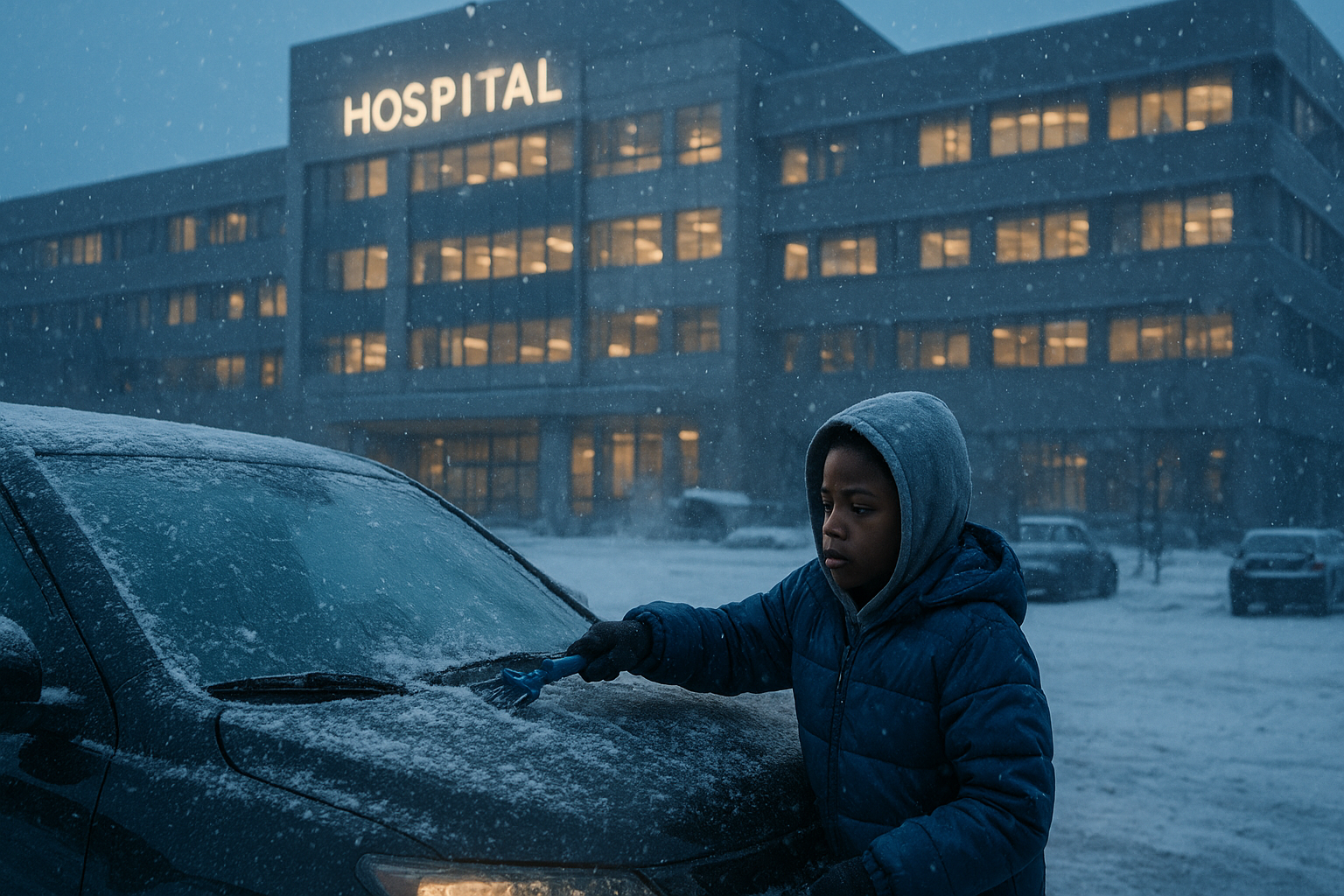
He was so focused on his task that he didn’t hear the footsteps crunching through the snow behind him. He didn’t notice the tall figure approaching until a sharp, angry voice cut through the winter air.
“Hey, get away from my car!”
Malik spun around, his heart hammering in his chest. The man standing before him was everything Malik was not—tall, imposing, dressed in a black wool coat that probably cost more than Malik’s family made in a month. He was around fifty, with short silver hair and sharp blue eyes that held suspicion and irritation. A black suit, white shirt, and blue tie peeked out from beneath his coat. He looked like someone important, someone who had never had to scrape ice off a windshield for five dollars.
“I was just removing the ice, sir,” Malik said, his voice calm despite the fear fluttering in his stomach. He had learned long ago that politeness was armor. “I didn’t mean any harm.”
The man’s eyes narrowed. “Are you trying to scratch my paint?”
Malik shook his head quickly. “No, sir. Five dollars and I’ll make it clean. I do a good job. I promise.”
The man—Mr. Harrison, though Malik didn’t know his name yet—studied the boy with a mixture of suspicion and curiosity. He had seen kids like this before, hustling in parking lots, offering to clean windshields or carry groceries. Usually, he ignored them, brushed them off with a wave of his hand and a muttered dismissal. But there was something different about this one. Something in the boy’s eyes that made him pause.
“Why are you out here in this cold?” Mr. Harrison asked, his tone shifting from angry to curious. “Where are your parents?”
Malik hesitated. The truth was painful, a wound he didn’t like to expose. But his mother had taught him to be honest, even when it hurt. Especially when it hurt.
“My mother is inside,” he said quietly, his eyes dropping to the snow at his feet. “She’s sick. I’m helping with her hospital bills.”
The words hung in the air between them, heavy and raw. Mr. Harrison felt something shift in his chest—a crack in the wall he had built around himself over years of board meetings and bottom lines and carefully cultivated indifference.
He looked at the windshield. It was spotless, gleaming despite the gray sky. The boy had done a better job than the professionals Mr. Harrison usually hired. He reached into his pocket and pulled out his wallet.
“You did a better job than most adults,” he said, his voice softer now. He pulled out a hundred-dollar bill and held it out to Malik. “Here. Take this.”
Malik’s eyes went wide. He had never seen a hundred-dollar bill in his life, not up close. It was more money than he could imagine. But something made him hesitate.
“Sir,” he said, his voice barely above a whisper, “the charge is only five dollars.”
Mr. Harrison smiled—a rare, genuine smile that softened the hard lines of his face. “For your mother,” he said. “Use it for her.”
Malik felt tears prick at his eyes, but he blinked them back. Crying in front of strangers was not something he allowed himself. He took the bill with trembling hands.
“God bless you, sir,” he said, his voice thick with emotion.
Mr. Harrison nodded once, then turned and climbed into his SUV. The engine rumbled to life, and the car pulled away, tires crunching through the fresh snow. Malik watched it go, clutching the hundred-dollar bill like it was made of gold. For a moment, he allowed himself to hope. Maybe this was the answer. Maybe this was the miracle his mother had been praying for.
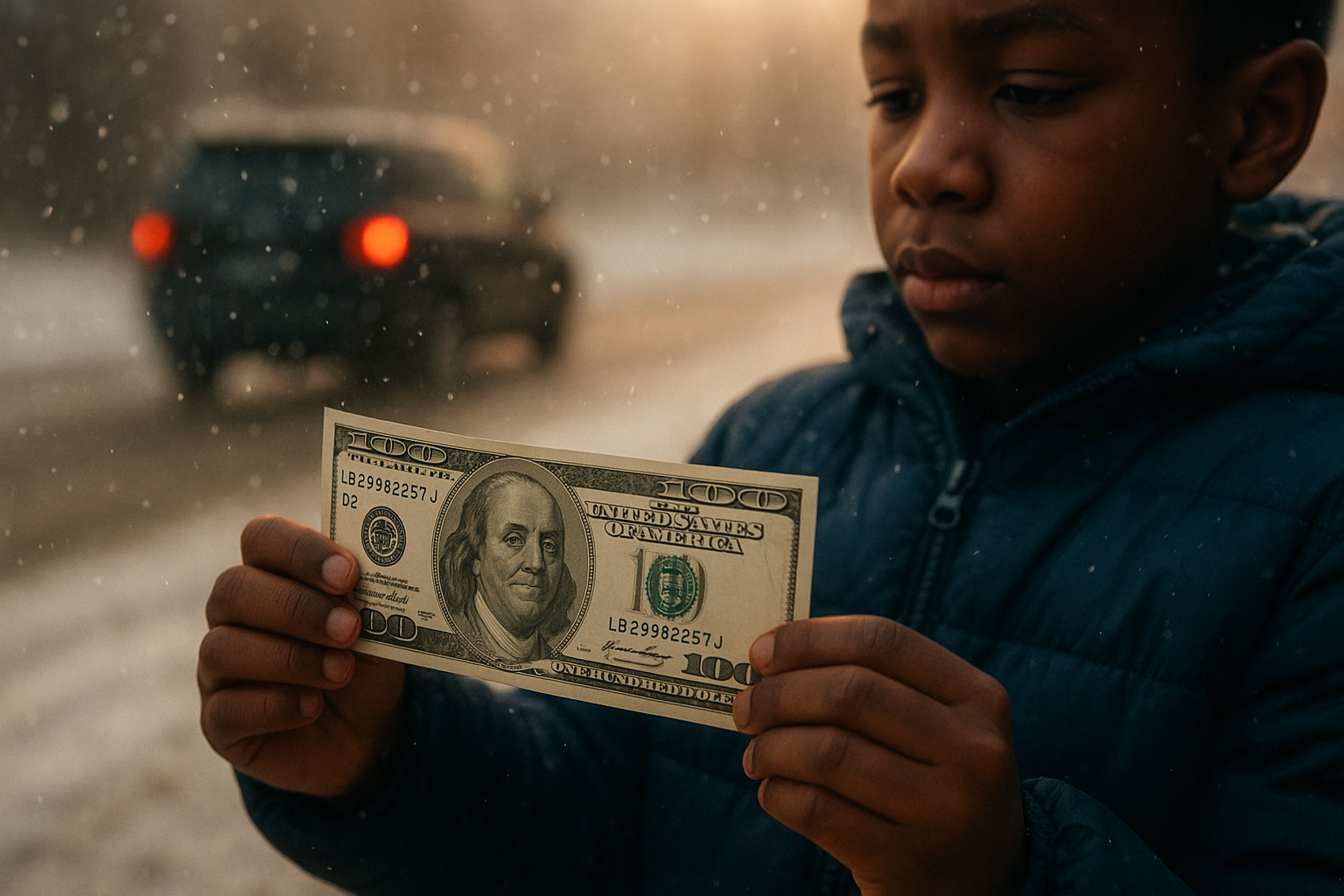
But then he saw it.
A small purple box, half-buried in the snow where the SUV had been parked. It must have fallen out of the man’s pocket when he pulled out his wallet. Malik bent down and picked it up, brushing the snow off its velvet surface. It was a jewelry box, the kind you saw in movies. His fingers trembled as he opened it.
Inside was a ring. A diamond ring, the stone catching the gray winter light and throwing it back in a dazzling spray of color. It was the most beautiful thing Malik had ever seen, and probably the most expensive. He didn’t know much about jewelry, but he knew enough to understand that this was not something you found every day.
His first thought was of his mother. This ring could pay her hospital bills. It could pay for her treatments, for her medicine, for the surgery the doctors said she needed. It could save her life. The thought was so powerful, so seductive, that for a moment, Malik allowed himself to imagine it. He imagined walking into the hospital, handing the ring to the billing office, watching their faces as they realized the debt was paid. He imagined his mother’s smile, the relief in her eyes.
But then he heard her voice in his head, clear as if she were standing beside him.
Malik, never let fear make you dishonest.
He closed the box. His hands were shaking, but not from the cold. He knew what he had to do. The ring wasn’t his. It belonged to the man in the black coat, the man who had been generous, who had given him a hundred dollars without hesitation. To keep it would be to steal, to betray the trust that had been offered. And Malik’s mother had taught him better than that.
He ran.
He ran after the SUV, his boots slipping on the icy pavement, his lungs burning with the cold air. He waved his arms, shouting at the top of his lungs.
“Sir! Sir, you dropped something! Sir, wait!”
But the car didn’t stop. It turned out of the parking lot and disappeared down the street, its taillights fading into the gray winter afternoon. Malik stood there, breathless and defeated, the purple box clutched in his hand.
“He didn’t hear me,” he whispered to the empty parking lot. “He didn’t hear me.”
For a long moment, he stood there, staring at the place where the car had vanished. The snow continued to fall, soft and indifferent, covering his footprints as if he had never been there at all. He looked down at the box in his hand.
What was he supposed to do now?
He thought about his mother, lying in her hospital bed, her face pale and drawn with pain. He thought about the bills piling up on the kitchen table, the red “PAST DUE” stamps that seemed to multiply like weeds. He thought about the way the doctors looked at him with pity, the way the nurses whispered when they thought he couldn’t hear.
And he thought about the ring.
It would be so easy. So terribly, terribly easy. He could take it to a pawn shop, sell it for a fraction of its worth, and use the money to pay the bills. His mother would never know. No one would ever know. The man in the black coat was rich—he probably had a dozen rings like this one. What was one lost ring to someone like him?
But even as he thought it, Malik knew he couldn’t do it. He couldn’t betray the trust of a stranger, couldn’t repay kindness with theft. His mother would be ashamed of him. And more than anything, he didn’t want to be the kind of person who took what wasn’t his.
He opened the box again and looked at the ring. It sparkled in the dim light, beautiful and terrible. He thought about his mother’s words, the ones she had repeated to him so many times over the years.
What if honesty costs too much? Then pay it anyway.
Malik closed the box and slipped it into his pocket. He would find the man. He would give the ring back. Somehow, someway, he would do the right thing.
But first, he had to see his mother.
The hospital was warm, almost oppressively so after the biting cold outside. Malik made his way through the maze of corridors, past the nurses’ station, past the waiting rooms filled with anxious families, until he reached Room 312. His mother’s room.
She was sitting up in bed when he walked in, her face lighting up with a smile that made everything else fade away. She was beautiful, his mother. Even sick, even tired, even with the dark circles under her eyes and the thinness of her frame, she was the most beautiful person Malik had ever known.
“Malik,” she said, reaching out her hand. “Come here, baby.”
He crossed the room and took her hand, feeling the warmth of her fingers despite the cold that seemed to have settled into her bones. He sat on the edge of the bed, and for a moment, neither of them spoke. They didn’t need to. The silence was enough.
But then Dr. Reynolds appeared in the doorway, his expression grave. He was a tall man in his late forties, with short silver hair and a white coat that seemed to carry the weight of every difficult conversation he had ever had. He held a clipboard in his hands, and Malik knew, even before the doctor spoke, that the news was not good.
“Mrs. Johnson,” Dr. Reynolds said, his voice professional but not unkind, “I need to talk to you about the payment. The amount needs to be paid by tomorrow.”
Malik felt his mother’s hand tighten around his. “Please, sir,” he said, his voice small but steady, “I’m trying. I’m doing everything I can.”
Dr. Reynolds looked at the boy, and something in his eyes softened. “I understand,” he said, “but the hospital has rules. I wish it were different.”
“Doctor,” his mother said, her voice pleading, “he’s just a child.”
“I know,” Dr. Reynolds said. “But the rules apply to everyone.”
Malik looked at his mother, then at the doctor, then back at his mother. “I’ll find more money,” he said, his voice fierce with determination. “I promise. I’ll find it.”
His mother pulled him close, wrapping her arms around him. He could feel her trembling, could feel the fear she was trying so hard to hide. And in that moment, Malik made a decision. He would do whatever it took to save her. Whatever it took.
Later, when the doctor had gone and the room was quiet, his mother took his face in her hands and looked into his eyes. Her gaze was intense, searching, as if she could see right through him to the secrets he was keeping.
“Malik,” she said, “look at me.”
He looked.
“I’m scared, Mama,” he admitted, his voice breaking. “I’m so scared.”
“I know, baby,” she said. “I’m scared too. But listen to me. Never let fear make you dishonest. Do you understand?”
He nodded, but his eyes flickered to the purple box hidden in his pocket. She saw it. She always saw everything.
“What do you have there?” she asked.
Malik hesitated. He could lie. He could say it was nothing, just a rock he had picked up outside. But his mother had taught him better than that.
He pulled out the box and opened it, showing her the ring. Her eyes widened, then softened with understanding.
“Where did you get that?” she asked.
“A man dropped it,” Malik said. “In the parking lot. He gave me a hundred dollars for cleaning his car, and then he dropped this. I tried to give it back, but he drove away before I could catch him.”
His mother was silent for a long moment. Then she asked the question Malik had been dreading.
“What were you planning to do with it?”
Malik looked down at his hands. “I thought… I thought maybe I could sell it. Pay for your bills.”
His mother closed her eyes, and Malik saw a tear slip down her cheek. When she opened them again, there was something fierce and proud in her gaze.
“What if honesty costs too much?” she asked softly.
Malik knew the answer. He had known it all along, even when he tried to convince himself otherwise. “Then pay it anyway,” he whispered.
His mother nodded. “That’s my boy,” she said. “That’s my good, honest boy.”
Malik closed the box and put it back in his pocket. He would find the man. He would give the ring back. And somehow, someway, they would find another way to pay the bills.
But as he sat there, holding his mother’s hand, watching the snow fall outside the window, he couldn’t help but wonder if honesty would be enough. If doing the right thing would save them, or if it would only make everything worse.
He didn’t know the answer. But he knew what his mother would want him to do. And that was enough.
For now.
The next morning, Malik woke before dawn. The hospital room was quiet, his mother sleeping peacefully for the first time in days. He slipped out of bed, careful not to wake her, and pulled on his boots and jacket. The purple box was still in his pocket, a constant reminder of the choice he had made.
He had to find the man. But how? He didn’t know his name, didn’t know where he lived, didn’t know anything about him except that he drove a black SUV and had been at the hospital the day before. It wasn’t much to go on, but it was all he had.
He started with the parking lot.
The snow had stopped falling overnight, but the ground was still covered in a fresh layer of white. Malik retraced his steps, looking for any clue that might tell him who the man was. He checked the spot where the SUV had been parked, but there was nothing there—no footprints, no tire tracks, nothing.
He asked the parking attendant if he remembered a black SUV, but the man just shrugged and shook his head. “Lots of black SUVs come through here,” he said. “Can’t keep track of them all.”
Malik was about to give up when he remembered something. The man had been visiting the hospital. That meant he knew someone who was sick, someone who was being treated here. Maybe he was a regular visitor. Maybe someone at the hospital would know him.
He went back inside and approached the reception desk. The woman behind it was kind, with warm eyes and a gentle smile. Her name tag said “Nurse Patricia.”
“Excuse me,” Malik said, his voice polite but urgent. “I’m looking for a man. He was here yesterday, visiting someone. He has silver hair and drives a black SUV.”
Nurse Patricia looked at him with curiosity. “That’s not much to go on, sweetheart. Do you know who he was visiting?”
Malik shook his head. “No. But he dropped something, and I need to give it back to him.”
Nurse Patricia’s expression softened. “That’s very honest of you,” she said. “Let me see what I can do.”
She typed something into her computer, her fingers moving quickly over the keyboard. After a moment, she looked up.
“There was a man matching that description here yesterday,” she said. “He was visiting his wife. She’s in the long-term care wing, Room 415. His name is Mr. Harrison.”
Malik felt his heart leap. “Thank you,” he said. “Thank you so much.”
He hurried to the elevator, his boots squeaking on the polished floor. Room 415. He repeated the number in his head like a prayer. Room 415. Room 415.
When he reached the fourth floor, he stepped out of the elevator and looked around. The long-term care wing was quieter than the rest of the hospital, the lights dimmer, the air heavier with the weight of long illnesses and longer goodbyes. He walked down the corridor, checking the room numbers until he found it.
Room 415.
The door was slightly ajar. Malik hesitated, his hand hovering over the doorknob. What if the man was angry? What if he didn’t believe Malik’s story? What if he accused him of stealing the ring?
But then he thought of his mother, of her words, of the look in her eyes when she told him to do the right thing. He pushed open the door.
The room was small but comfortable, filled with flowers and get-well cards. In the bed lay a woman, pale and thin, her eyes closed in sleep. And beside her, in a chair pulled close to the bed, sat Mr. Harrison.
He looked up when Malik entered, his expression shifting from surprise to recognition to something else—something that looked almost like hope.
“You,” he said. “The boy from the parking lot.”
Malik nodded. “I found something,” he said. “You dropped it.”
He pulled the purple box from his pocket and held it out. Mr. Harrison stared at it for a long moment, his face unreadable. Then he took the box and opened it, and when he saw the ring inside, his eyes filled with tears.
“This was my mother’s ring,” he said, his voice thick with emotion. “I was going to give it to my wife for our anniversary. I thought I had lost it.”
He looked up at Malik, and there was something new in his eyes—respect, gratitude, and something deeper, something that looked almost like love.
“You could have kept this,” he said. “You could have sold it. No one would have known.”
Malik shook his head. “It wasn’t mine,” he said simply. “My mother taught me to be honest.”
Mr. Harrison was silent for a long moment. Then he reached into his pocket and pulled out his checkbook.
“What’s your mother’s name?” he asked.
“Sarah Johnson,” Malik said. “She’s in Room 312.”
Mr. Harrison wrote something on a check and handed it to Malik. Malik looked at it and gasped. It was enough to pay for his mother’s entire treatment, with money left over.
“I can’t accept this,” he said, his voice trembling.
“You can,” Mr. Harrison said. “And you will. Consider it a reward for your honesty. And a thank you for returning something that means more to me than you can possibly know.”
Malik looked at the check, then at Mr. Harrison, then at the woman sleeping in the bed. He thought of his mother, of her words, of the long nights and the fear and the hope that had carried him through.
“Thank you,” he whispered. “Thank you so much.”
Mr. Harrison smiled. “You’re a good boy, Malik,” he said. “Your mother raised you well.”
Malik nodded, tears streaming down his face. He turned and ran from the room, down the corridor, back to the elevator. He had to tell his mother. He had to tell her the news.
When he burst into Room 312, his mother was awake, sitting up in bed with a worried expression on her face. But when she saw the check in his hand, her expression changed to one of disbelief.
“Malik,” she said, “what is that?”
He climbed onto the bed and wrapped his arms around her, burying his face in her shoulder. “I gave the ring back,” he said. “And the man—Mr. Harrison—he gave me this. It’s enough, Mama. It’s enough to pay for everything.”
His mother was silent for a long moment. Then she began to cry, holding him tight, her tears falling into his hair.
“My boy,” she whispered. “My good, honest boy.”
They sat there for a long time, holding each other, crying and laughing and thanking God for the miracle that had come in the form of a purple box and a choice to do the right thing.
And as the snow continued to fall outside the window, blanketing the world in white, Malik knew that his mother was right. Honesty was always worth it. No matter the cost.
The next chapter of their story began that day.
Three months later, Sarah Johnson walked out of St. Mary’s Medical Center on her own two feet. The surgery had been successful, the treatments had worked, and the cancer that had threatened to take her life was in remission. Malik stood beside her, holding her hand, his heart so full it felt like it might burst.
Mr. Harrison was there too, waiting by his black SUV. He had visited Sarah several times during her recovery, bringing flowers and books and, on one memorable occasion, a box of chocolates that Malik had eaten almost entirely by himself. They had become friends, unlikely as it seemed—the wealthy businessman and the struggling single mother, bound together by a boy’s honesty and a purple box.
“Ready to go home?” Mr. Harrison asked, opening the car door.
Sarah nodded, her eyes shining with tears. “I don’t know how to thank you,” she said.
“You already have,” Mr. Harrison said. “You raised a son who reminded me what matters in life.”
Malik climbed into the back seat, and as the car pulled away from the hospital, he looked out the window at the parking lot where it had all begun. The snow was gone now, replaced by the green shoots of spring, but he would never forget that cold winter day, the ice scraper in his hands, the hundred-dollar bill, the purple box.
He would never forget the choice he had made.
And he would never forget his mother’s words, the ones that had guided him through the darkest moment of his life.
What if honesty costs too much? Then pay it anyway.
It was a lesson he would carry with him forever. A lesson he would one day pass on to his own children. A lesson that had saved his mother’s life and changed his own in ways he could never have imagined.
Because sometimes, the smallest choices—the choice to do the right thing, to be honest, to trust in the goodness of others—can lead to the greatest rewards.
And that, Malik knew, was the truest thing of all.