
Tales

The Soup, the Manager, and the Man Who Waited

The chandeliers of The Gilded Ox threw warm pools of light across the mahogany tables, and the clink of silverware rose and fell like distant music. Emma had worked the evening shift for three years, and she still loved the hush that settled over the dining room just before the dinner rush. Tonight, however, the hush had teeth.

At table nine sat Mr. Arthur Bellweather, a retired clockmaker with a snow-white beard and a brown leather satchel slung across his shoulder. He came in every Tuesday, ordered the same soup, and tipped exactly fifteen percent, no matter what. Emma liked him. He always asked about her mother’s garden.

“Here you are, sir. Please enjoy,” she said, setting the bowl of minestrone and the basket of warm sourdough in front of him. Her smile was real, and so was his.

“Thank you, Emma,” Arthur said, his voice soft as worn velvet. He unfolded his napkin with the careful reverence of a man who had eaten alone for too many years.

Then the air changed. Mr. Vance, the floor manager, crossed the room in four long strides, his dark grey tie swinging like a metronome. He stopped at table nine and pointed a finger at Arthur as if the old man were a stain on the carpet.

“Are you finished yet?” Vance demanded.

Arthur looked up, spoon hovering. “I’m sorry?”

“We have paying customers waiting for tables.”
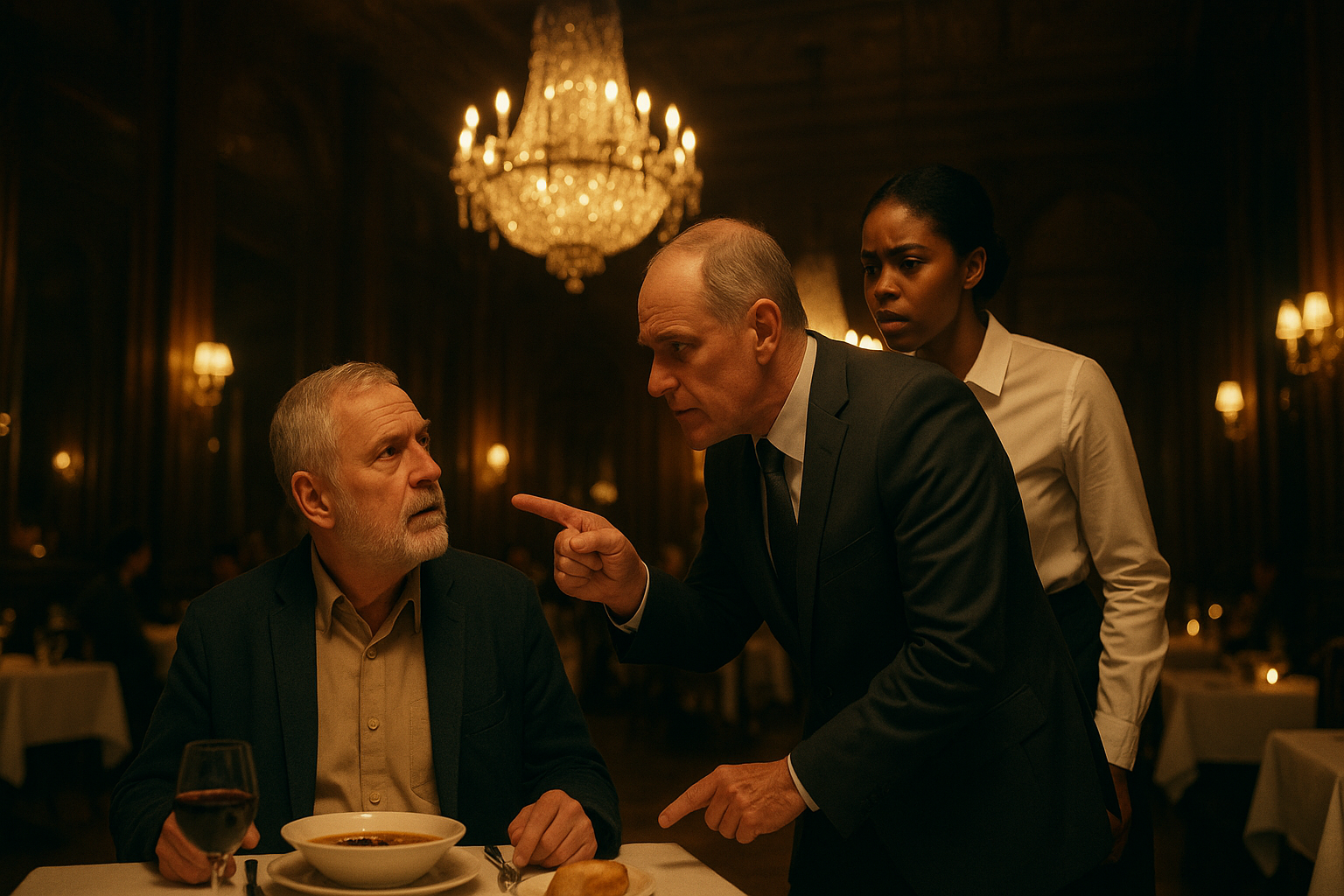
Cinematic wide shot of a luxurious restaurant with soaring ceilings, ornate crystal chandeliers and dark wood panelling. An elderly European man, 70, grey beard and short grey hair, in a blue jacket and beige shirt, sits alone at a table with soup, bread and a glass of red wine, looking up in confusion. A stern manager in a dark grey suit leans over the table pointing a finger, while a young African American waitress in a white shirt and black skirt stands behind him, her face tense with worry. Warm golden lighting, shallow depth of field, realistic film still, muted amber and deep brown palette.

Emma’s hand tightened around her notepad. “Mr. Vance, he’s still eating.”

“He’s been eating for forty minutes, Emma. That’s a table for two, and there are people at the bar who’ve been waiting since six.” Vance straightened and smoothed his lapel. “Mr. Bellweather, I’m going to have to ask you to settle your check.”

Arthur set down his spoon. He did not argue. He had spent sixty years learning when not to. He reached into his satchel and pulled out a worn leather wallet, counting bills with fingers that trembled just slightly. Emma watched the colour rise in his cheeks and felt something hot and tight behind her ribs.

“I’ll walk you out,” she said quietly.

Outside, the November wind smelled of rain and roasted chestnuts. Arthur buttoned his jacket and smiled at her, but the smile didn’t reach his eyes. “It’s all right, Emma. He’s right. A restaurant is a business.”

“That doesn’t make it kind,” she said.

He chuckled, a dry, papery sound. “No. It doesn’t.” He hesitated, then pressed something into her palm — a small brass key, warm from his pocket. “My shop. 14 Lantern Row. I close at five, but if you ever want to see how a clock works, the door is open.”

Emma turned the key over in her hand. “Why me?”

“Because you asked about my soup,” he said. “And because you looked at me like I was a person, not a table.”

She watched him walk down the wet pavement until the fog swallowed him whole. Then she went back inside, where Vance was already seating a young couple at table nine, beaming as if he had done something heroic.
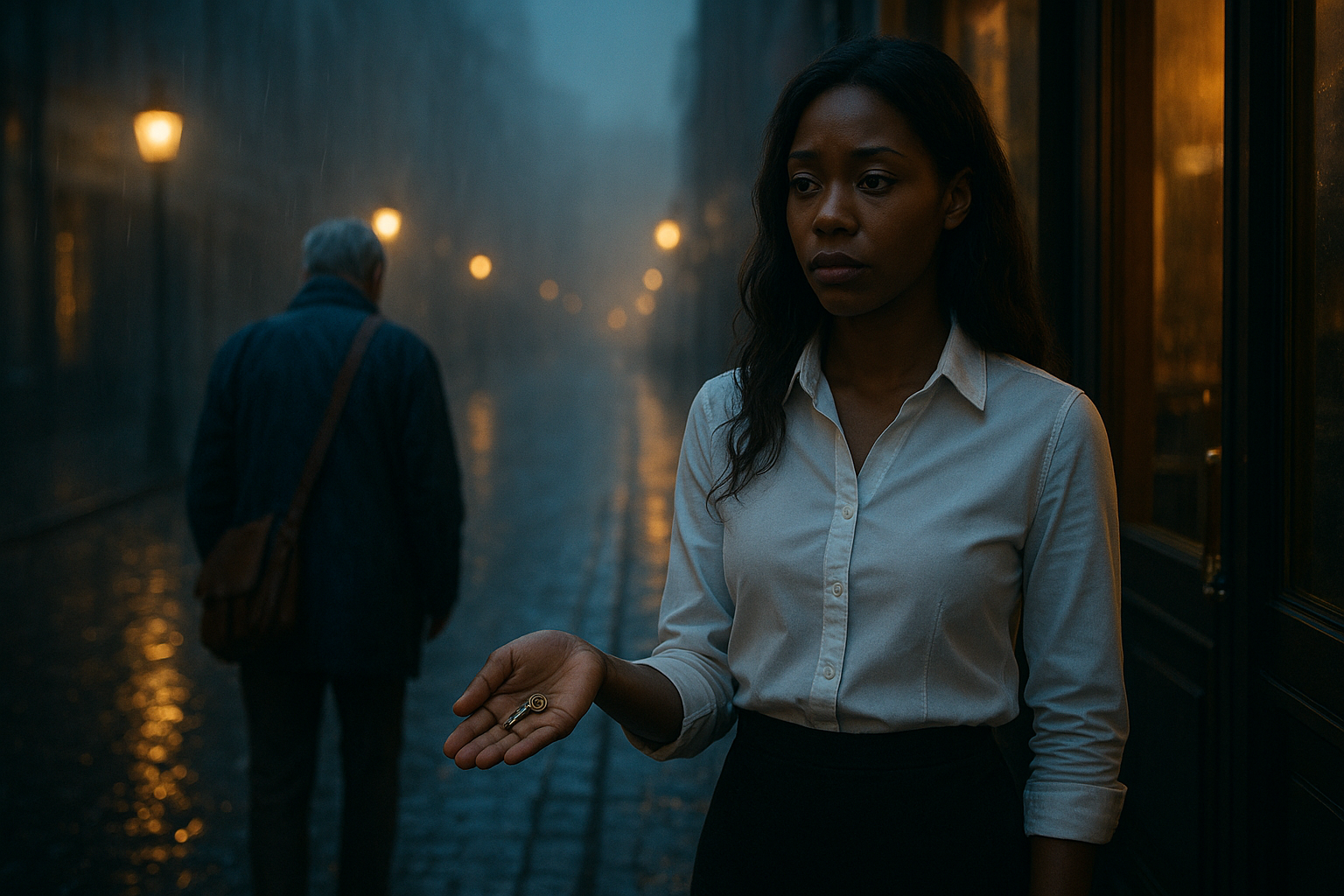
Cinematic medium shot on a rainy city street at night. An elderly European man with a grey beard and blue jacket walks away into the fog, shoulders slightly hunched, a brown leather satchel across his chest. In the foreground, a young African American waitress with long chestnut hair, white button-up shirt and black skirt stands outside the restaurant door, holding a small brass key in her open palm, her expression a mix of sadness and quiet resolve. Wet cobblestones reflect amber streetlamps, shallow depth of field, moody blue and gold tones, realistic film still.

The next Tuesday, Arthur did not come. Nor the Tuesday after. Emma served soup to strangers and smiled at Vance when he praised her, and each time she did, she felt the brass key growing heavier in her apron pocket.

On the third Tuesday, she took the bus to Lantern Row. Number 14 was a narrow shop wedged between a bakery and a shuttered laundromat, its window crowded with clocks — cuckoo clocks, mantel clocks, a grandfather clock whose pendulum swung like a slow heartbeat. The door was unlocked.

Arthur was at his workbench, a jeweller’s loupe screwed into one eye, a tiny screwdriver in his hand. He didn’t look surprised to see her. He simply set down his tools and poured two cups of tea from a chipped enamel pot.

“You came,” he said.

“I came,” Emma said. “I quit the restaurant.”

Arthur raised his eyebrows. “Because of me?”

“Because of me,” she said. “I want to learn something that lasts longer than a dinner rush.”

He laughed then, a real laugh, the kind that crinkled the corners of his eyes. He handed her a small brass gear and a pair of tweezers. “Then we’ll start with the escapement,” he said. “It’s the part that keeps the clock from running too fast. Funny thing — a good restaurant needs one too.”
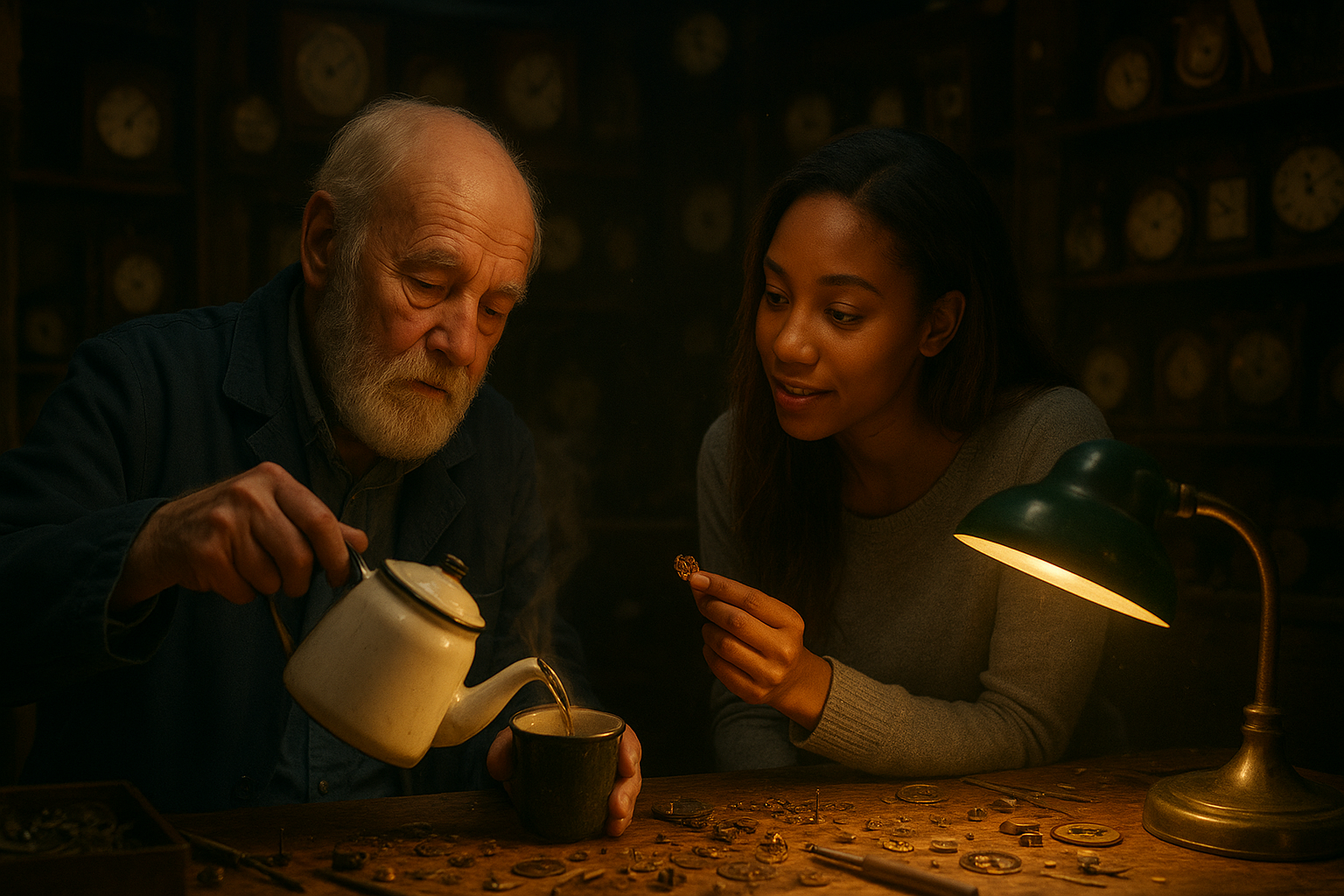
Cinematic interior shot of a small, cluttered clockmaker's shop at dusk. An elderly European man with a white beard and blue jacket sits at a wooden workbench covered with tiny gears, tools and a jeweller's loupe, pouring tea from an enamel pot. Beside him, a young African American woman with long chestnut hair, now wearing a simple grey sweater, leans in with curiosity, holding a small brass gear in her fingers. Warm tungsten light from a green banker's lamp, shelves of ticking clocks in soft focus behind them, dust motes in the air, realistic film still, intimate and hopeful mood.

By spring, Emma could disassemble a movement and put it back together blindfolded. By summer, she had repaired the grandfather clock in the town hall and been paid more than a month of waitressing. By autumn, she had a small sign above the door of 14 Lantern Row that read Bellweather & Emma — Fine Horology.

And every Tuesday, at exactly noon, they closed the shop, walked three blocks to a small bistro with checkered tablecloths, and ordered soup. No one ever asked them to leave. The owner, a round woman named Marta, always brought an extra basket of bread and said the same thing every time: “Take your time, gentlemen. And lady.”

Arthur would smile at that, and Emma would smile back, and somewhere in the shop behind them, a hundred small clocks kept ticking, patient and precise, measuring out the hours they had been given — and the ones they had chosen to give each other.
Related Posts

The Stall Boy’s Warning: A Helicopter, a Bomb, and the Truth That Wouldn’t Stay Buried

The sun hung high over the von Auerbach estate, pouring gold across the manicured lawn that stretched like a green carpet toward the great house. It was the…

The Man Who Waited: A Story of Max, Walter, and the Dog Who Came Home

The 7:42 train to Alexanderplatz was always half-empty on Tuesday mornings. The fluorescent lights hummed their sterile white hymn, bleaching the orange seats and the tired faces of…

A young girl with long wavy light-brown hair, barefoot, wearing a pale pink dress with a white collar, stands facing a stern female judge in a black robe inside a wood-paneled courtroom. The girl's face is tear-streaked but determined. Behind the judge, an American flag hangs softly lit. Warm afternoon light filters through tall windows, casting long shadows across the wooden benches. The atmosphere is tense yet hopeful, with muted browns, golds, and the soft pink of the girl's dress dominating the composition. Camera angle is slightly low, emphasizing the child's courage.

The Little Girl Who Stopped a Trial: A Courtroom Drama Unfolds

The heavy oak doors of the county courthouse groaned open, and a small figure burst through. Bare feet slapped against the cold marble floor as a girl of…

A dramatic sunset over a marina, wooden pier stretching into calm water, a large white yacht gleaming under orange and gold sky, palm trees silhouetted in the background, an elderly man in a gray jacket and brown leather bag standing alone, a young man in a beige polo walking away with his head down, cinematic lighting, warm tones, emotional atmosphere, wide shot

The Sunset Key A Yacht, a Stranger, and the Secret That Changed Everything

The sun hung low over the marina, bleeding orange and gold across the water. The wooden pier creaked gently underfoot as an elderly man walked slowly toward the…

Cinematic shot of a rainy city street with towering skyscrapers, cold and wet. Emma, a 20-year-old European woman with chestnut hair in a ponytail, wears a light blue waitress uniform with a white apron under a black leather jacket, black leggings, and white sneakers. She stands behind a red hot dog cart with steam rising under a green fabric awning. Close-up on her hands passing a hot dog over the cart to the hands of Walter, a 70-year-old European man with gray hair, in a brown cap with a yellow logo, brown jacket, and plaid shirt. The background is blurred, focus on the exchange. Mood is cold yet warm, lighting is dim with rain reflections.

Rain Over the City: The Hot Dog Cart Encounter

The rain fell in sheets over the city, turning the streets into mirrors that reflected the cold, indifferent glow of skyscrapers. Emma pulled her black leather jacket tighter…

A snowy farmyard at dawn, a tall bearded man in a dark grey coat carries a lantern toward a weathered wooden barn while soft blue morning light spreads across the fields, inside the cabin window a young woman with chestnut hair in a bun watches him go, her expression thoughtful and moved, warm golden light spilling from the window onto the snow, painterly historical style, mood of quiet hope and new beginnings, palette of deep blues, warm ambers, and soft whites

No Child Sleeps in My Barn: The Unexpected Mercy of Jesse Brand

The lantern sputtered against the log walls, throwing long, restless shadows across the cabin. Mary Campbell set the last empty plate down on the rough timber table with…