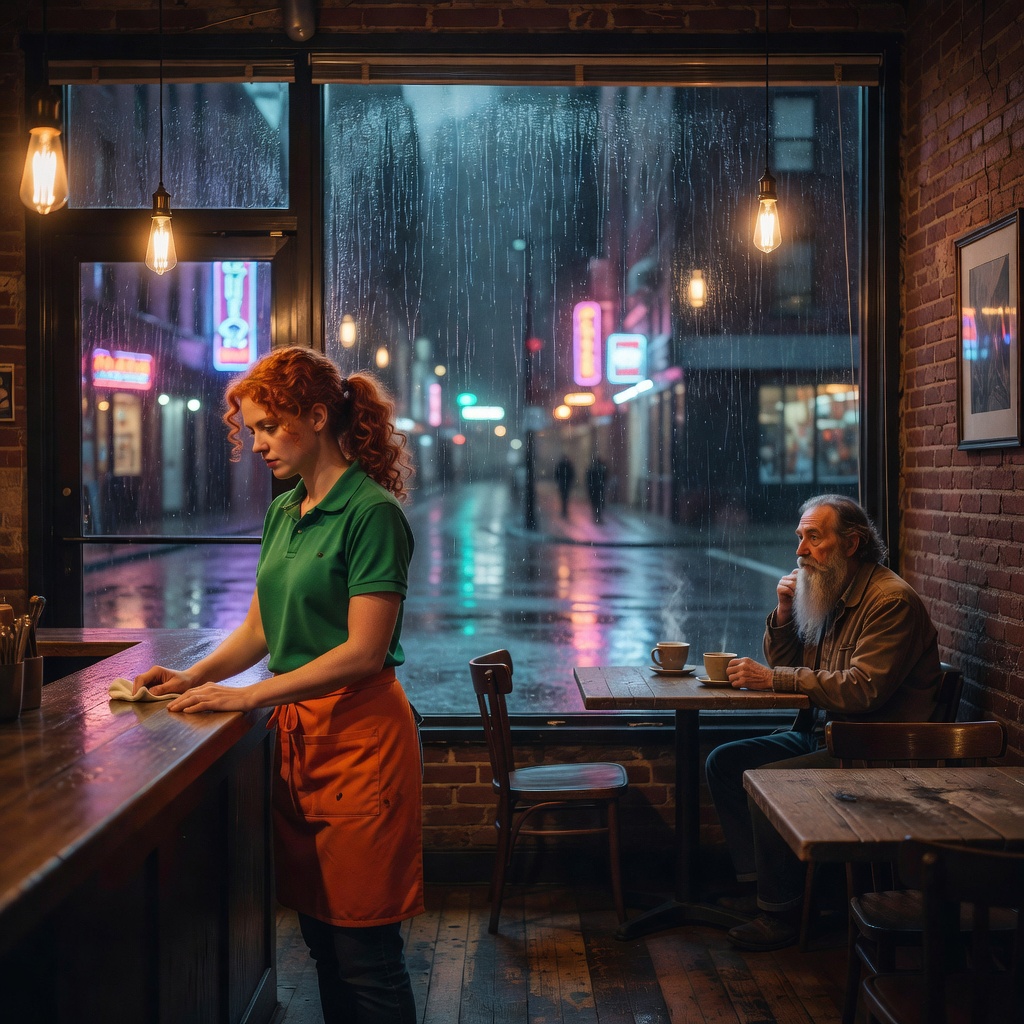
The rain hammered against the café windows, turning the city lights outside into streaks of liquid gold. Inside, the warm glow of the pendant lamps fought against the gloom, casting long shadows across the checkered floor. Maya, a twenty-year-old with a fiery ponytail and a bright orange apron, wiped down the pastry counter for the fifth time that evening. It was one of those nights when time moved slowly, and the silence was broken only by the hiss of the espresso machine and the drumming of the downpour.
She glanced at the old man by the window. He was a fixture now, a ghost in a brown jacket, his long gray beard and unkempt hair making him look like a weary prophet. He sat on the wooden bench, staring out at the wet street, his eyes hollow with a sadness that seemed as deep as the puddles reflecting the neon signs. Maya had seen him there for the past three nights, never ordering, just watching.
Something in his posture broke her heart. She grabbed a sandwich from the display case, wrapped it in a paper napkin, and placed it on a small plate. She walked over to him, her white sneakers squeaking softly on the floor.
“Here,” she said softly, setting the plate in front of him.
He looked up, startled. His eyes, watery and tired, met hers. He picked up the sandwich with trembling hands but didn’t take a bite. “I’m sorry, I can’t pay,” he said, his voice a low rumble, barely audible.
“You don’t have to,” Maya replied, her voice calm and warm.
He blinked, confusion flickering across his weathered face. “Why are you helping me?”
She didn’t have to think. “Because you’re hungry.”
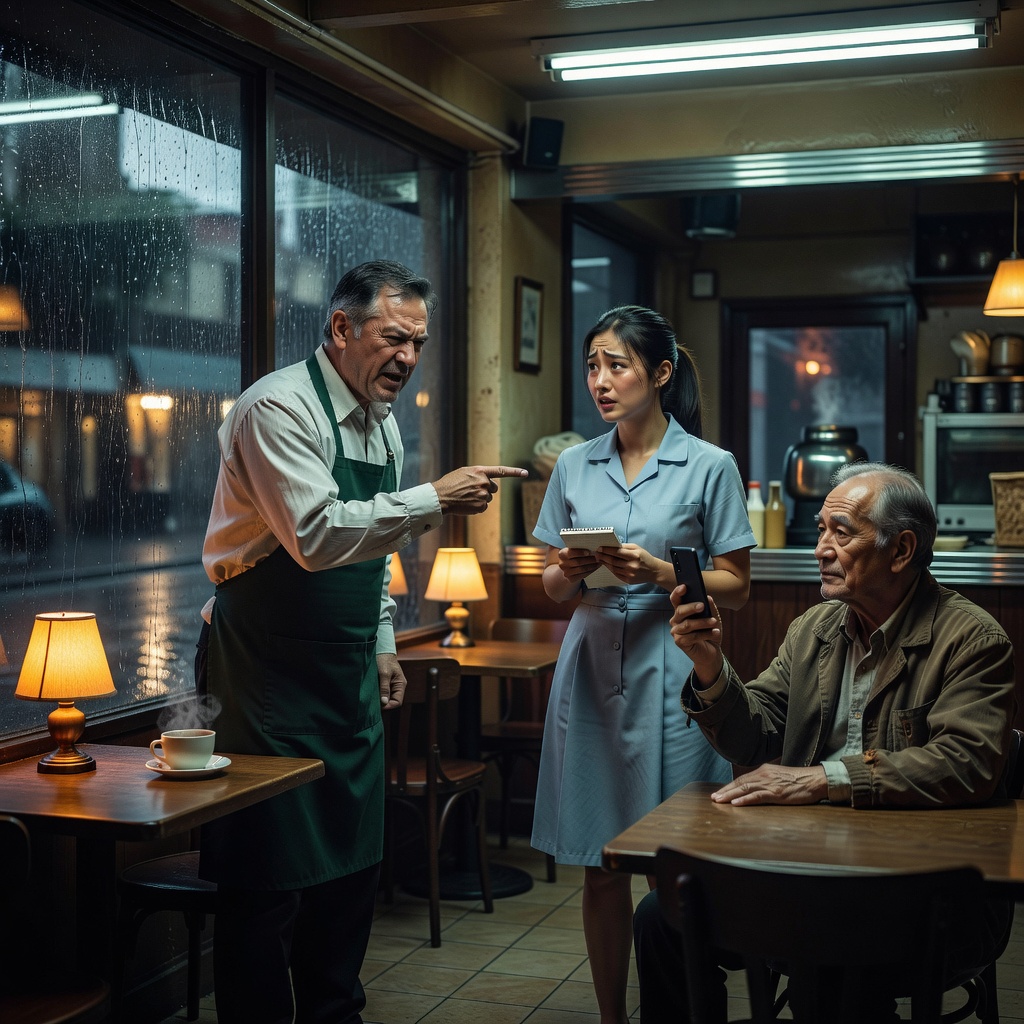
He stared at her for a long moment, then took a bite. The tension in his shoulders eased slightly. Maya was about to turn away when the kitchen door swung open, and Marco, the middle-aged manager with a stern face and a dark green apron, stormed out. His eyes locked onto the sandwich in the old man’s hands, then onto Maya.
“That wasn’t yours to give away,” he said, his voice sharp as broken glass.
Maya stood her ground. “He was hungry.”
“You’re fired,” Marco spat, his face reddening.
Before Maya could respond, the old man set down his sandwich and pulled a black smartphone from his coat pocket. He held it up, his voice suddenly firm and authoritative. “Don’t announce anything yet.”
Marco froze, his mouth open. There was something in the old man’s tone that commanded attention. The old man dialed a number, his fingers moving with surprising dexterity for someone his age. He put the phone to his ear, his gaze never leaving Marco’s.
A few seconds of silence stretched like a rubber band. Then the old man spoke, his voice clear and resolute. “I found the person I came here to find.”
Maya’s heart hammered in her chest. She looked at the old man, then at Marco, whose face had gone pale. The old man lowered the phone, a faint smile touching his lips. He looked at Maya, and for the first time, his eyes held a spark of life.
“My name is Arthur,” he said. “And I’ve been looking for you for a long time.”
Maya’s brow furrowed. “For me?”
Arthur nodded slowly. “Your grandmother, Eleanor… she used to work here, didn’t she?”
Maya felt the floor tilt. “How do you know that?”
“Because I was in love with her,” Arthur said, his voice cracking. “And before she passed, she told me about you. She said you’d be here one night, in the rain, wearing an orange apron. She made me promise to find you.”
Marco took a step back, his anger replaced by confusion. “What is this?”
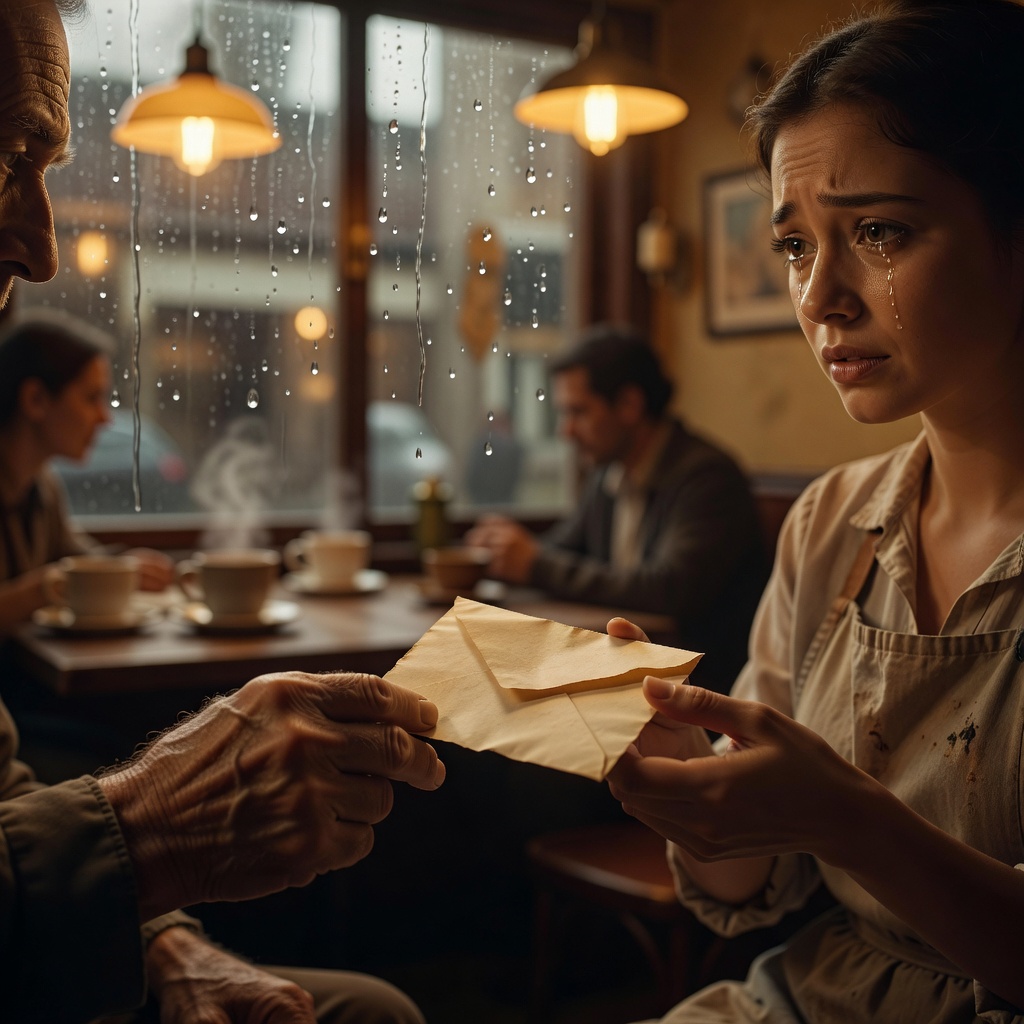
Arthur ignored him, reaching into his coat pocket again. He pulled out a worn, yellowed envelope. “She asked me to give this to you. It’s a letter, and a key.”
Maya’s hands trembled as she took the envelope. “A key to what?”
“To the little bakery she always dreamed of opening,” Arthur said. “She saved every penny. And she wanted you to have it.”
Tears welled in Maya’s eyes. She had only vague memories of her grandmother, but they were warm ones, full of flour dust and laughter. She looked at Arthur, this ragged man who had come in from the rain, and understood now why he had been sitting there for three nights, waiting.
“Why didn’t you just come in and tell me?” she asked.
Arthur smiled, a weary, honest smile. “I needed to see you first. To see if you had her heart. And you do.”
Marco cleared his throat, looking uncomfortable. “I… I didn’t know.”
Arthur turned to him. “You were right to protect your business. But you were wrong to fire her. She’s the kind of person any business would be lucky to have.”
Marco looked at Maya, then at the empty plate. He sighed. “Consider yourself not fired. And… I’m sorry.”
Maya nodded, her mind still reeling. She opened the envelope, slipping out a letter written in elegant, faded ink. She read a few lines, and a sob escaped her. Arthur reached out and placed a hand on her shoulder.
“She said you’d know what to do,” he said softly.
Maya looked up at him, her vision blurred. “Will you stay? Have some coffee?”
Arthur nodded, and for the first time that night, he smiled broadly. “I’d like that.”
They sat together at the window, watching the rain fall, the city lights shimmering like stars on the pavement. Maya felt a warmth spread through her, a sense of purpose she had never known. The night had started with a simple act of kindness, and it had led her to a legacy she never knew existed.
Outside, the rain began to slow, and the first hint of dawn crept over the horizon. In the quiet café, two strangers became family, bound by love, rain, and a sandwich that changed everything.
The marble floors of the villa gleamed under the soft glow of the crystal chandelier, casting dancing shadows across the high ceilings. In this palace of opulence, secrets…
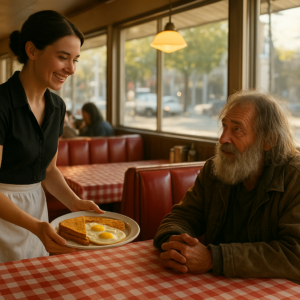
The morning sun streamed through the windows of Rosie’s Diner, casting a warm glow over the red-and-white checkered tablecloths and the gleaming chrome of the counter. The air…
The midday sun beat down on the cracked pavement outside Rosie’s Diner, where the smell of grilled onions and stale coffee mingled with the exhaust of passing cars….
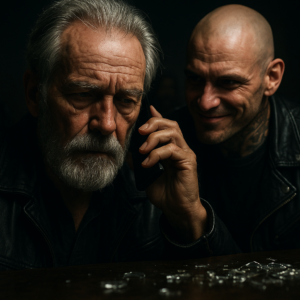
The kitchen smelled of stale bread and fresh violence. Viktor, sixty-eight, sat motionless at the oak table, a half-eaten sandwich on the plate before him. His black leather…
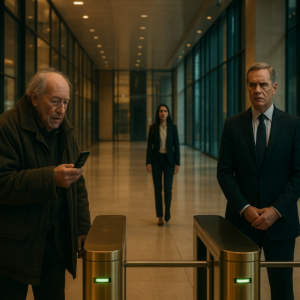
The lobby of Meridian Tower was a cathedral of glass and polished stone, a monument to corporate success. Sunlight streamed through the vast windows, catching the golden turnstiles…
The air in the modern canteen was thick with tension, a stark contrast to its minimalist design of grey concrete walls and warm wooden floors. Dim lighting cast…
Adblocker detected!
We see that you are using an ad blocker. The advertising on our site helps us to further develop the project, improve content, and offer everything to you free of charge.
If you would like to support our service, please disable your ad blocker for this page.

 NotATabooo
August 30, 2026
NotATabooo
August 30, 2026