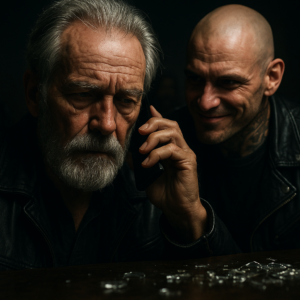

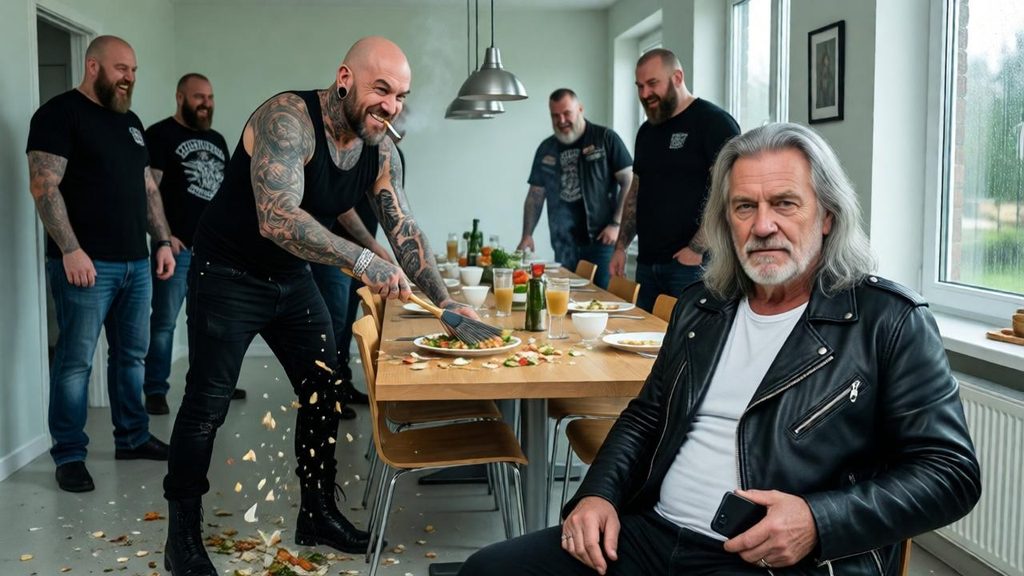
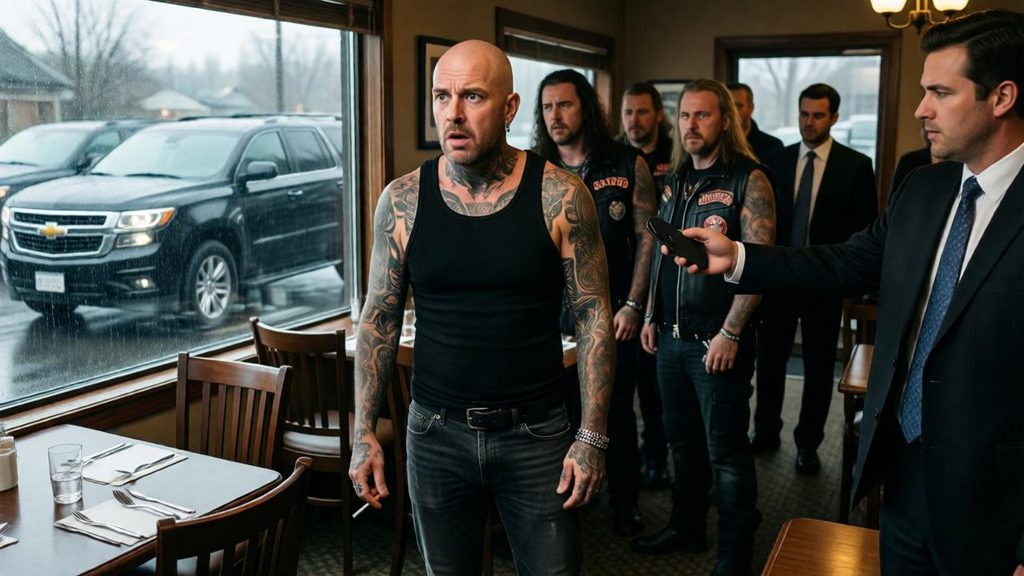
ain hammered the wide windows of the bright, modern dining room. Pale walls, long wooden tables, the smell of coffee and wet asphalt drifting in every time the door opened. Rogan stood at the head of the table, cigarette clamped between his teeth, bald head gleaming under the overhead lights. Tattoos crawled up his neck and across his face like living ink. The black tank top clung to his chest; silver tunnels flashed in his ears. With a wide, malicious grin he swept his arm across the table. A plate of food exploded against the floor in a spray of porcelain and gravy.
The men behind him—thick-necked, bearded, black T-shirts and jeans—laughed. One of them clapped Rogan on the shoulder.
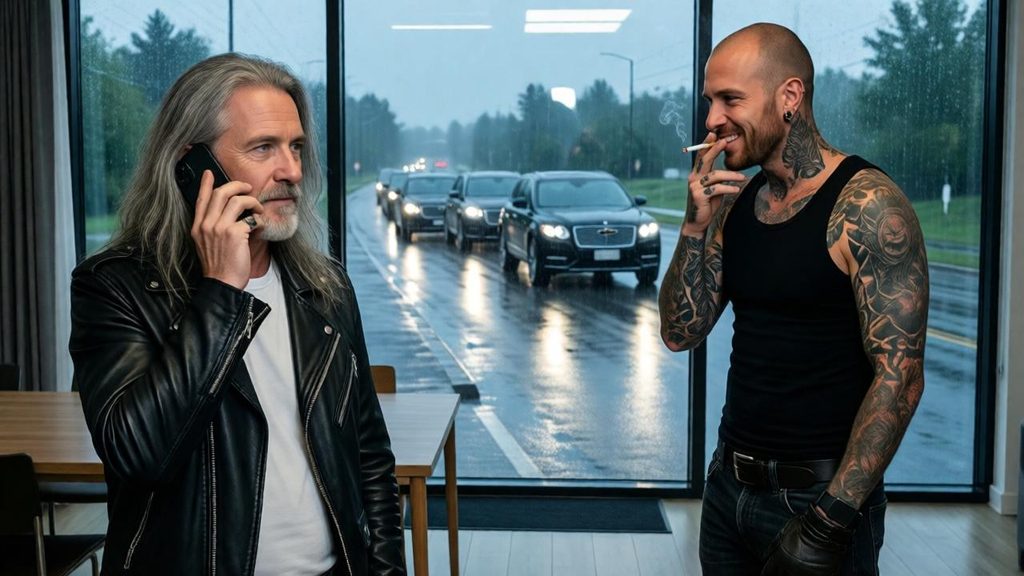
At the far end of the table Silas sat perfectly still. Seventy years old, long grey hair falling past his shoulders, black leather jacket over a plain white T-shirt. He reached into his pocket, took out a black smartphone, and raised it to his ear as if the chaos around him did not exist.
“It’s me,” he said, voice calm and resolute. “Bring them.”
Rogan exhaled a stream of smoke and leaned forward, still smiling.
“What, old man? Calling for help?”
Silas did not answer. He simply kept the phone to his ear, eyes steady.
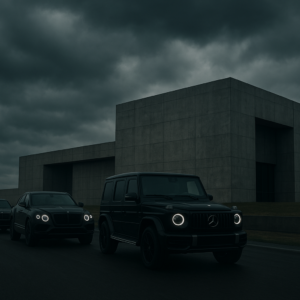
Outside, through the rain-streaked glass, headlights appeared. First one pair, then another, then a whole line of them. Black Chevrolet Suburbans and Bentleys rolled up the wet asphalt road and stopped in a precise row. Doors opened. Men in dark suits stepped out into the rain without hurry.
Rogan’s smile faltered. The laughter behind him died. One of the bikers muttered, “What the fuck…”
The suited men entered the dining room in silence. Water dripped from their coats onto the wooden floor. One of them—tall, expressionless—walked straight to Rogan and held out a second phone.
“For you.”
Rogan took it automatically. The line was already open.
A voice he recognised spoke his name once, low and final. Whatever was said next drained the colour from Rogan’s face. The cigarette dropped from his fingers and hissed out on the wet floorboards.
Silas ended his own call and set the phone down gently.
“You asked if I was calling for help,” he said. “I was calling for them. And now they are here.”
The room felt smaller. Rain continued to sheet against the windows. The bikers shifted, hands hovering near waistbands, but none of them moved. The men in suits did not need to draw weapons; their presence alone was enough.
Rogan licked his lips. “You think this changes anything? This is our place. Our table.”
Silas stood. The leather jacket creaked softly. He looked older than the rain, older than the building, yet something in his posture made every man in the room straighten.
“You don’t have a place,” he said. “You have a moment. And that moment is over.”
One of the suited men stepped closer to Rogan and spoke quietly, almost kindly.
“Mr. Voss is waiting outside. He would like a word about the shipment that never arrived. And about the girl who never came home.”
Rogan’s tattoos seemed to tighten across his skin. He glanced at the windows again. More black vehicles had arrived. Engines idled in the rain.
Silas walked past him toward the door, long grey hair damp from the humidity. He paused only once.
“Sit down, Rogan. All of you. Stay seated until I am gone. If any of you stands, the conversation ends differently.”
No one stood.
Silas stepped out into the rain. The suited men followed in perfect order. Doors closed. The convoy pulled away as quietly as it had arrived, leaving only the sound of water and the smell of cigarette smoke and spilled food.
Rogan remained where he was, the borrowed phone still in his hand, staring at the empty chair Silas had left behind.
The rain did not ease. It turned the parking lot into a shallow lake that reflected the grey sky like polished steel. Inside the dining room the silence stretched until it became painful.
Rogan finally threw the phone onto the table. It skidded across the wood and stopped against a salt shaker.
“Who the fuck was that old man?”
One of the older bikers, a man called Brick with a grey beard and knuckles the size of walnuts, shook his head.
“I don’t know. But those cars… those weren’t local. And the suits didn’t look like cops.”
Rogan lit another cigarette with hands that were not quite steady. The tattoos on his fingers flexed.
“Call the clubhouse. Get everyone here. Now.”
Brick hesitated. “Rogan—”
“Now.”
The call was made. Twenty minutes later the dining room filled with more black T-shirts and the smell of wet leather. Engines growled outside and then fell silent. Men crowded the long tables, muttering, checking phones, watching the windows.
No one came.
An hour passed. The rain softened to a steady drizzle. Someone ordered food that no one ate. Rogan paced the length of the room, silver bracelet catching the light, smoke curling around his bald head.
At 3:17 p.m. every phone in the room buzzed at the same moment.
The same message, word for word:
The old man is not finished. Leave the building. Leave the city. You have until midnight.
No sender. No number.
Brick read it twice, then looked at Rogan.
“What do we do?”
Rogan crushed the cigarette under his boot.
“We find him.”
They tried. Men were sent to every bar, every warehouse, every safe house they knew. The answers came back the same: no one had seen a seventy-year-old with long grey hair and a black leather jacket. No one had heard of him. It was as if Silas had stepped out of the rain and back into it without leaving a single footprint.
By six o’clock the first of Rogan’s men simply failed to report in. Two more followed. Their phones went straight to voicemail. Their bikes were found later, abandoned under bridges, keys still in the ignition.
Rogan stood at the window watching the last of the daylight die. The tattoos on his neck stood out darker against pale skin.
“He’s playing with us.”
Brick said nothing.
At 8:41 p.m. the black phone that the suited man had given Rogan rang again.
Rogan answered on speaker so the whole room could hear.
Silas’s voice was the same as before—calm, almost gentle.
“You still have three hours and nineteen minutes. I suggest you use them wisely.”
The line went dead.
Rogan hurled the phone against the wall. Plastic and glass scattered across the floor.
“We’re not running,” he snarled. “We hold this place. Anyone who walks out is a coward.”
Most of the men stayed. A few slipped away when they thought no one was looking. No one stopped them.
Midnight arrived without drama. The rain had stopped. The street outside was empty and shining under the streetlights.
At 12:01 a.m. the power in the dining room died.
Emergency lights flickered on, weak and yellow. In the sudden quiet the sound of footsteps on wet asphalt was very clear.
The doors opened.
Silas walked in alone. Same black leather jacket. Same long grey hair, now dry. Same white T-shirt. He carried nothing in his hands.
Behind him, filling the doorway and the parking lot beyond, stood the men in suits. Dozens of them this time. Silent. Waiting.
Rogan’s remaining crew rose as one, chairs scraping, weapons appearing. Silas raised one open hand.
“Put them away.”
Something in the tone made even the angriest of them hesitate.
Silas walked to the centre of the room and stopped beneath the emergency lights.
“You asked who I was calling,” he said, looking directly at Rogan. “I was calling the people who still remember what you did in Rotterdam. And in Marseille. And to the girl whose name you never bothered to learn.”
Rogan’s mouth opened, then closed.
Silas continued, voice never rising.
“You have one choice left. Walk out of this room without your weapons and without your pride, and you will be allowed to leave the city. Stay, and the men outside will come in. They are less patient than I am.”
The silence that followed was absolute.
Brick was the first to move. He laid his pistol on the table, turned, and walked out past the suited men without looking back. Three others followed. Then five more. Within two minutes only Rogan and four of his closest remained.
Rogan’s chest rose and fell hard. The silver bracelet on his wrist trembled.
“You’re bluffing.”
Silas smiled for the first time—small, almost sad.
“I never bluff.”
He turned and walked toward the door. The suited men parted for him. Just before he stepped into the night he spoke once more, without turning around.
“Choose quickly, Rogan. The rain is starting again.”
The door closed.
Rogan stood alone in the centre of the ruined dining room, surrounded by overturned chairs and the smell of cold food and fear. Outside, engines started in perfect unison.
He looked at the four men still with him. None of them met his eyes.
Slowly, as if every joint ached, Rogan reached up and unclipped the silver bracelet from his wrist. He set it on the table beside the shattered plate from hours earlier.
Then he walked out into the rain.
The suited men watched him go. No one stopped him. No one followed.
By the time the last of the black vehicles pulled away, the dining room was empty except for the broken porcelain, the abandoned phones, and the long grey hair of rain still sliding down the windows.