
The diner sat under a warm pool of amber light that made the wooden tables glow and the chrome edges of the counter soft. Outside the large front windows the neon sign still hummed OPEN in steady red letters, but inside the air had gone tight. Only a few customers remained at this hour, speaking in low voices that had already begun to fade.
Raymond “Ray” Soto sat alone at a corner table. Sixty-five years old, short grey hair, full grey beard, blue denim jacket over an olive-green T-shirt that still carried the word VETERAN in faded block letters and a short row of military ribbons above the heart. Blue jeans. A black coffee mug rested between his work-worn hands. He drank slowly, eyes half-lidded, as if the coffee were the only thing anchoring him to the present moment.
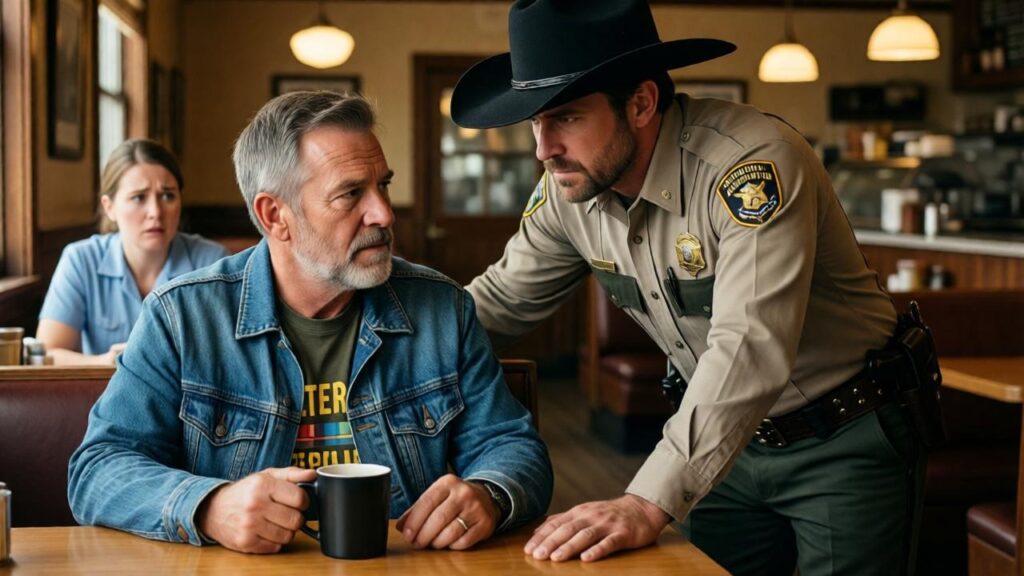
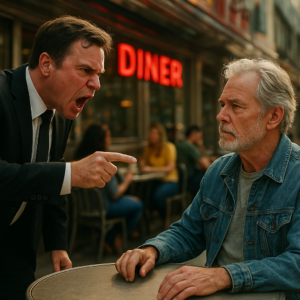
Sheriff Dale Crowe stood over him.
Forty-five years old, short dark-chestnut hair, black cowboy hat, beige-olive sheriff’s uniform with department patches on the shoulders, black tie, dark-green trousers, heavy black duty belt. He leaned forward, both hands planted on the edge of the table, and spoke in a voice that carried across the entire room.
“Move. Now.”
Ray did not look up. He took another slow sip from the black mug and answered in the same calm, defiant tone he had used for decades when someone tried to push him.
“No.”
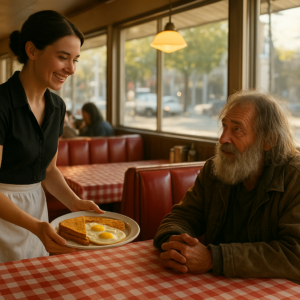
Behind the counter, Lena Miller—thirty-five, medium dark-chestnut hair with bangs, light-blue waitress uniform with white collar and white apron—watched with open worry. She had served Ray coffee three times a week for the past two years. She had never seen him raise his voice. She had never seen anyone try to make him leave.
Sheriff Crowe’s jaw tightened. The refusal hung in the warm air like a challenge. Without another word he shifted his weight, drove his right shoulder forward, and shoved Ray hard against the edge of the table. The black mug tipped. Coffee spilled across the wood. Ray’s ribs struck the table with a dull, solid sound. His head snapped forward. When he pushed himself upright again a thin line of blood had already appeared at the corner of his mouth.
Lena’s hand flew to her chest. “Sheriff—!”
Crowe ignored her. He kept pressure on Ray’s shoulder, pinning him against the table for three full seconds before finally stepping back. Ray stayed seated. He wiped the blood from his lip with the back of his hand, looked at the red smear, and said nothing.
The sheriff straightened his hat. “This is my town. When I say move, you move. Next time I won’t ask twice.”
He turned and walked out. The bell above the door gave a single bright ring. Outside, the neon OPEN sign continued to glow as if nothing had happened.
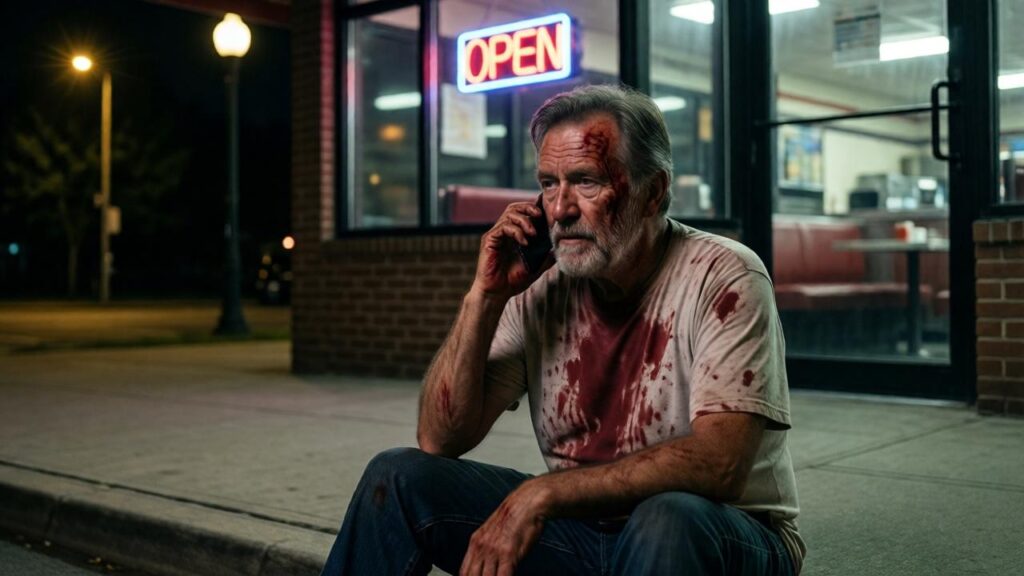
Ray sat very still for almost a minute. Then he stood, left two bills on the table for the coffee, and walked outside into the cool night air. He sat down heavily on the concrete curb directly in front of the diner, elbows on his knees. Blood had smeared across his lower lip and chin. A darker stain was spreading slowly across the front of the olive-green T-shirt where the table edge had caught him.
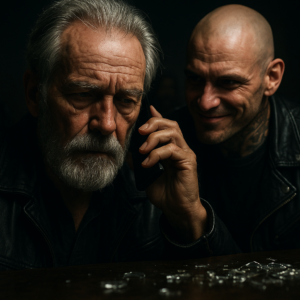
He pulled a black smartphone from his jacket pocket, unlocked it with a thumb that still trembled slightly, and pressed it to his ear.
The call connected on the third ring.
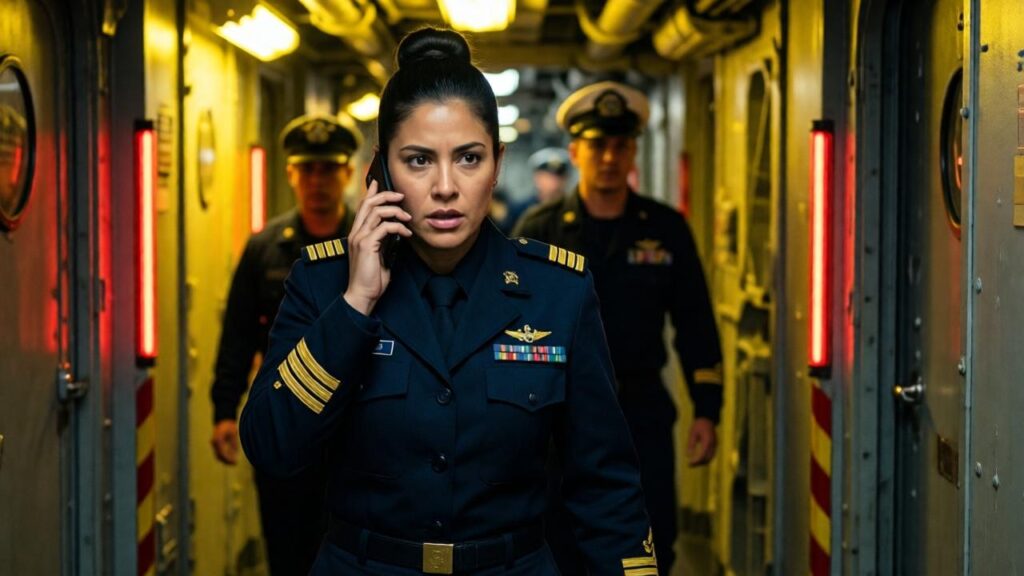
Half a world away, inside a narrow corridor of a naval vessel lit by harsh yellow emergency lights and the pulse of red warning strips along the bulkheads, Lieutenant Commander Sofia Soto walked at a rapid pace. Thirty-two years old, Latina, dark-chestnut hair pulled into a precise bun, dark-blue naval officer’s uniform with gold insignia on the collar and shoulders, white undershirt visible at the neck, a row of colorful service ribbons and a gold pilot’s wing badge on her chest. Two junior sailors in identical uniforms followed a few steps behind her, trying to keep up.
She held a black smartphone to her ear, face tight with concern.
“Did he touch you?”
On the curb outside the diner, Ray’s voice came back low and shaken but clear.
“Yes.”
Sofia stopped walking for half a second. The red emergency lights painted her face in alternating pulses of crimson. When she spoke again her voice had changed—no longer only concerned, but absolute.
“Then I’m coming home.”
She ended the call, turned to the nearest sailor, and began issuing orders in a tone that left no room for questions. Within minutes the ship’s communication room was awake. Within an hour a priority request for emergency leave had been filed, countersigned, and approved. Sofia Soto was already packing the single bag she would carry off the vessel at the next port.
Back in the small town the diner’s neon sign continued to hum. Lena Miller locked the front door at closing time and stood for a long moment looking at the empty corner table where coffee still darkened the wood. She had already called the county dispatcher to report what she had seen. She had given a clear statement. She had refused to be talked out of it.
Ray remained on the curb until a quiet unmarked car arrived. Two state investigators stepped out, showed credentials, and spoke to him in low voices. They photographed the blood on his face and shirt. They collected the black coffee mug still sitting on the table inside. They took Lena’s statement under the fluorescent lights of the closed diner. By the time the sky began to lighten, Sheriff Dale Crowe had been placed on administrative leave pending a full review of the incident.
Ray did not go to the hospital that night. He went home to the small single-story house on the edge of town, cleaned the cut on his lip, changed the stained T-shirt, and sat on the front porch with a fresh cup of coffee until the sun rose. He did not sleep. He simply waited.
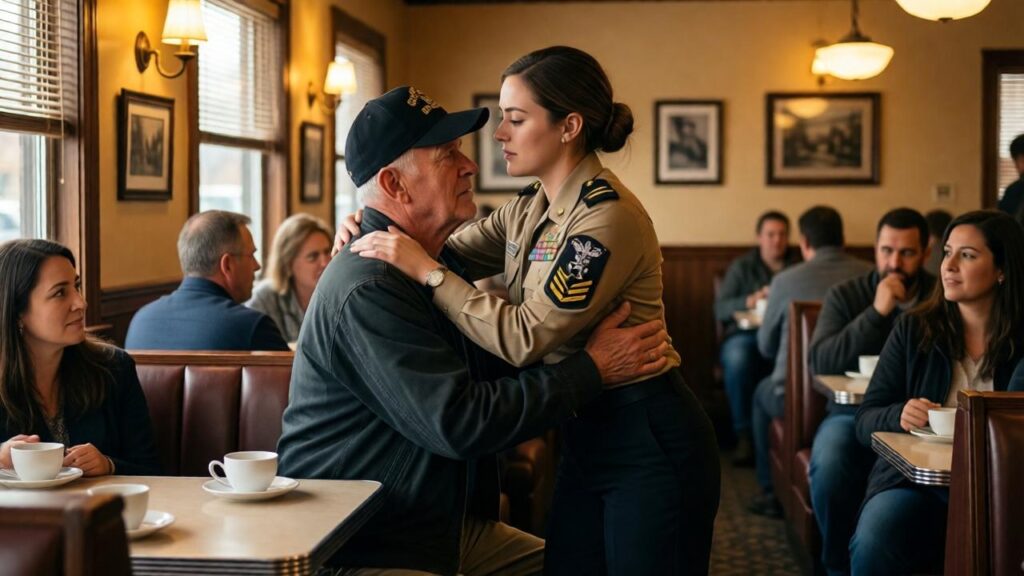
Three days later a dark blue Navy staff car pulled into the diner’s parking lot just after noon. Sofia Soto stepped out in civilian clothes—dark jeans, a simple grey jacket, her hair still in the same neat bun. She looked older than her years and younger at the same time. Ray was already waiting at the same corner table, black mug in front of him, denim jacket buttoned against the mild afternoon chill.
When she walked through the door the entire room seemed to go quiet. Lena Miller came out from behind the counter and stopped short. Sofia crossed the floor, stopped in front of her father, and for a moment neither of them spoke.
Then Ray stood and she stepped into his arms.
The embrace lasted a long time. When they finally separated, Sofia’s eyes were dry but fierce.
“He put his hands on you,” she said.
Ray nodded once. “It’s done. The state people are handling it.”
“I read the preliminary report on the plane. It’s not done until I say it is.”
They sat. Lena brought two fresh coffees without being asked and left them alone. Outside the neon sign still glowed OPEN, though the daylight made it look softer.
Sofia listened while her father told the story in the same calm voice he had used when he refused the sheriff’s order. She did not interrupt. When he finished she reached across the table and covered his hand with hers.
“You taught me to stand my ground,” she said. “You don’t get to be surprised when I do the same.”
Ray almost smiled. “I never taught you to fly halfway around the world over a bloody lip.”
“You taught me that some things are not about the size of the injury. They’re about the principle.” She squeezed his hand. “He doesn’t get to shove a veteran into a table in the middle of a diner and walk out like nothing happened. Not in this town. Not while I’m breathing.”
Over the next week the town changed in small, irreversible ways. The official investigation moved faster than anyone expected. Body-camera footage from a junior deputy who had been outside the diner at the time corroborated Lena’s statement. Sheriff Crowe’s claim that Ray had been “disorderly” collapsed under the weight of every witness who had been present. By the end of the second week Crowe had resigned rather than face a formal disciplinary hearing. The county commission appointed an interim sheriff the same afternoon.
Sofia stayed for twelve days. She accompanied her father to the follow-up interview with state investigators. She sat in the front row when the county board accepted Crowe’s resignation. She ate breakfast every morning at the same corner table, sometimes with Ray, sometimes alone, always tipping Lena far more than the check required.
On the final morning she stood with her father on the curb where he had made the phone call. The concrete still carried a faint dark stain that the rain had not completely washed away.
“You could have just moved,” she said quietly.
Ray looked at the stain, then at the neon sign above the diner door.
“I spent thirty years following orders that made sense and a few that didn’t. When I got home I promised myself I would never again stand up just because someone with a badge told me to. That seat was mine that night. The coffee was paid for. I wasn’t hurting anyone.” He shrugged once. “So I said no.”
Sofia nodded. “And I came home.”
“You didn’t have to.”
“Yes,” she said, “I did.”
They stood in silence for a while. Then Sofia checked her watch, embraced her father one last time, and walked to the waiting staff car. Ray watched until the vehicle disappeared around the corner. Only then did he turn and go back inside the diner.
Lena already had a fresh black mug waiting on the corner table.
“She seems like a force of nature,” Lena said.
Ray sat down, wrapped both hands around the warm ceramic, and allowed himself the smallest of smiles.
“She gets it from her mother,” he answered. “I just taught her how to aim it.”
In the months that followed, the story of the veteran who refused to move and the naval officer who crossed an ocean because of it settled into the quiet mythology of the town. People still pointed out the corner table. New deputies were told the story during their first week. Lena kept the coffee mug Ray had used that night on a special shelf in the back, never putting it back into regular rotation.
Ray continued to come in three times a week. He always sat in the same place. He always ordered the same black coffee. And every time the bell above the door rang he looked up for half a second longer than necessary, as if part of him still expected to see his daughter walk through it again in uniform or in civilian clothes, ready to stand beside him if anyone ever tried to push him again.
No one ever did.
Some refusals, once spoken clearly under warm diner lights, travel farther than the people who hear them. Some phone calls, once answered with the words “Then I’m coming home,” rearrange the map of what a family is willing to protect.
And some old veterans in olive-green T-shirts keep drinking their coffee in the same seat, year after year, because the simple word “No” turned out to be enough.