
Rain fell in a steady silver curtain across the covered outdoor patio of the Maple Street Diner. The green canvas awning stretched overhead, dripping at the edges, turning the wooden deck into a soft, muted world of its own. Round tables and chairs sat empty under the shelter. Beyond the open sides of the patio the parking lot glistened, empty except for a few scattered puddles that reflected the grey sky.
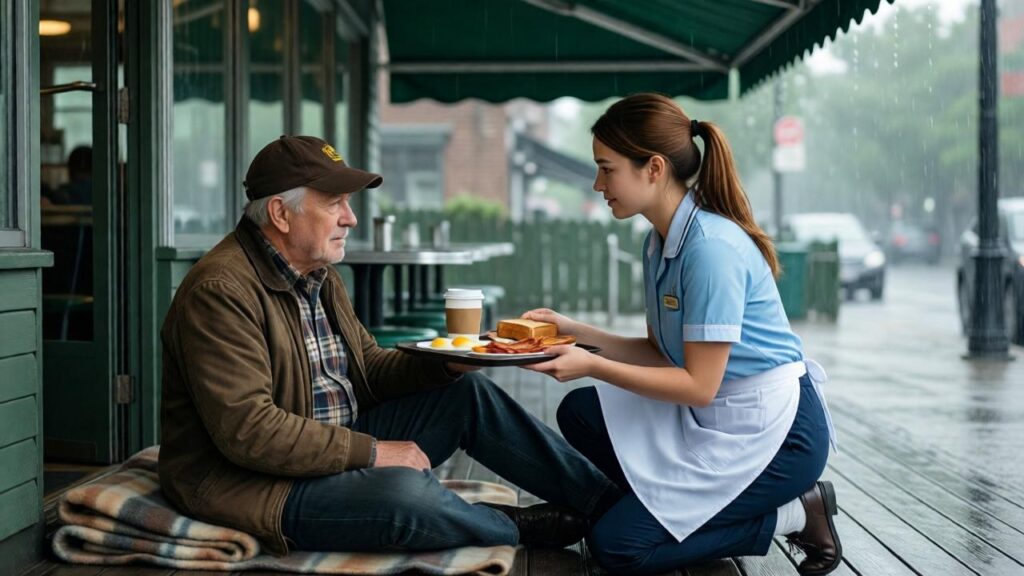
Walter Hayes sat on a folded moving blanket near the entrance that led from the patio into the main dining room. Seventy years old, European features, silver-grey hair visible beneath a brown cap with a faded yellow logo, brown jacket over a worn plaid shirt. He looked like a man who had been sitting in the same spot for a long time, waiting for something that might never arrive. His hands rested loosely on his knees. His eyes watched the rain without expectation.
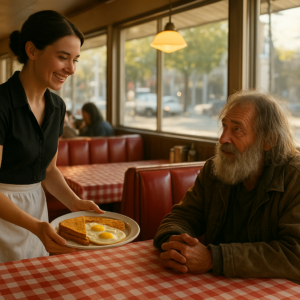
Emma Lang pushed open the screen door carefully, a metal tray balanced in both hands. Twenty years old, chestnut hair pulled into a practical ponytail, light-blue waitress uniform with a clean white apron, black leggings, white sneakers that were already dotted with rain. On the tray sat a full breakfast: scrambled eggs, two strips of bacon, buttered toast, and a thick white mug of black coffee still steaming in the cool air.
She knelt and held the tray out to him.
Walter looked at the food, then at her face, and spoke in a voice that carried quiet concern.
“Emma, I don’t have enough money today.”
Emma’s smile was soft and immediate.
“Then it’s on me today, Walter.”
He studied her for a moment longer, surprised and grateful in equal measure.
“Why are you always so nice to me?”
Emma’s answer came without hesitation, still smiling, still kind.
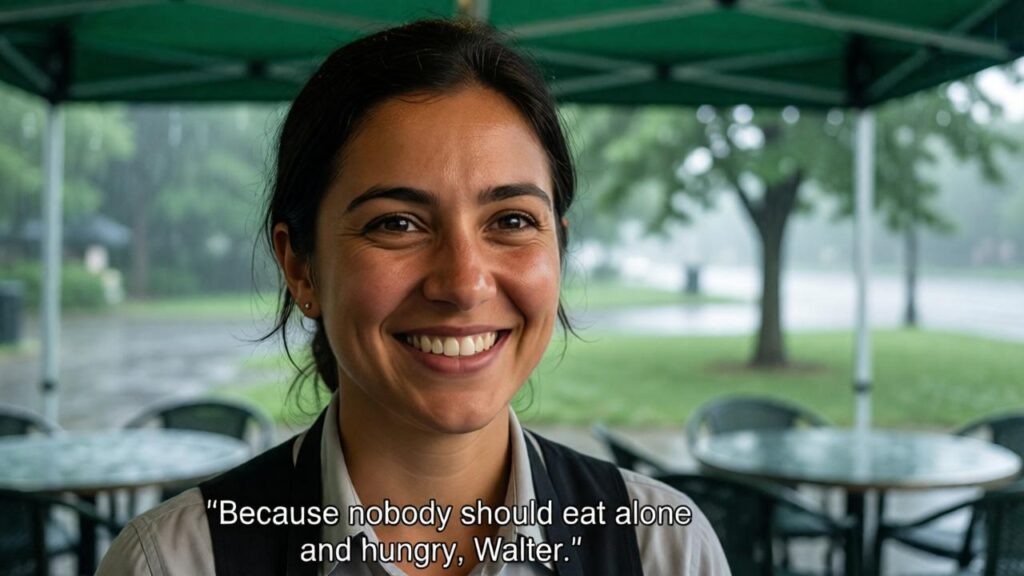
“Because nobody should eat alone and hungry, Walter.”
She set the tray carefully on the blanket in front of him, made sure the coffee was steady, and stood. Behind her the round tables of the patio stretched toward a single large tree whose leaves dripped steadily onto the canvas. She gave him one last small nod and stepped back inside to the warmth of the diner.
Walter sat looking at the food for a long time before he began to eat. The eggs were still hot. The coffee warmed his hands through the mug. Rain continued to fall, soft and constant, as if the sky itself had decided to keep the world quiet for a little while longer.
Twenty minutes later the quiet ended.
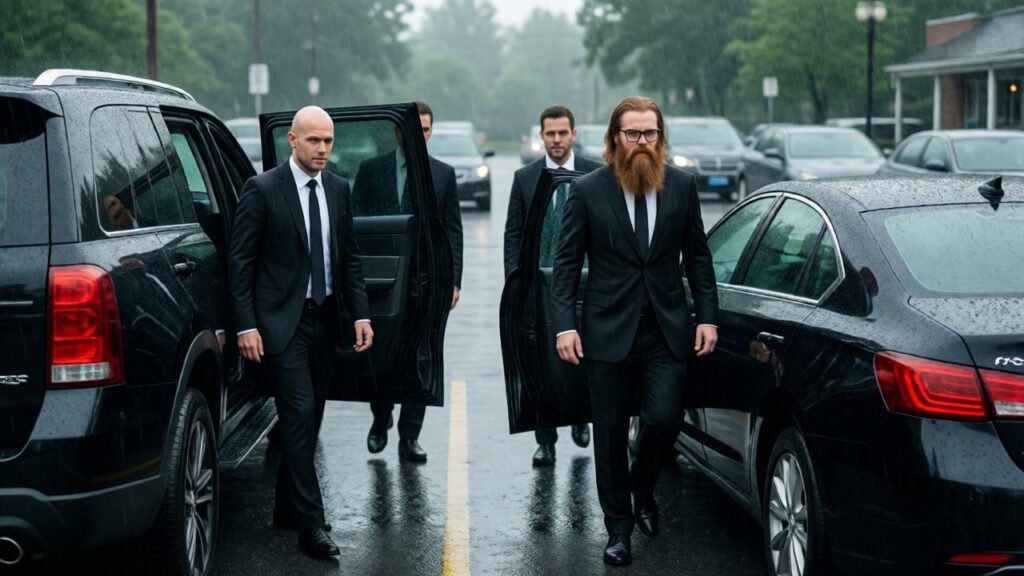
Two black vehicles turned into the parking lot at almost the same moment—one a heavy SUV, the other a long dark sedan. They parked opposite each other, engines idling, rain beading on their polished surfaces. Doors opened simultaneously.
From the SUV stepped two men in black suits. From the sedan stepped two more. All four moved with the controlled precision of people who had rehearsed arrivals like this many times.
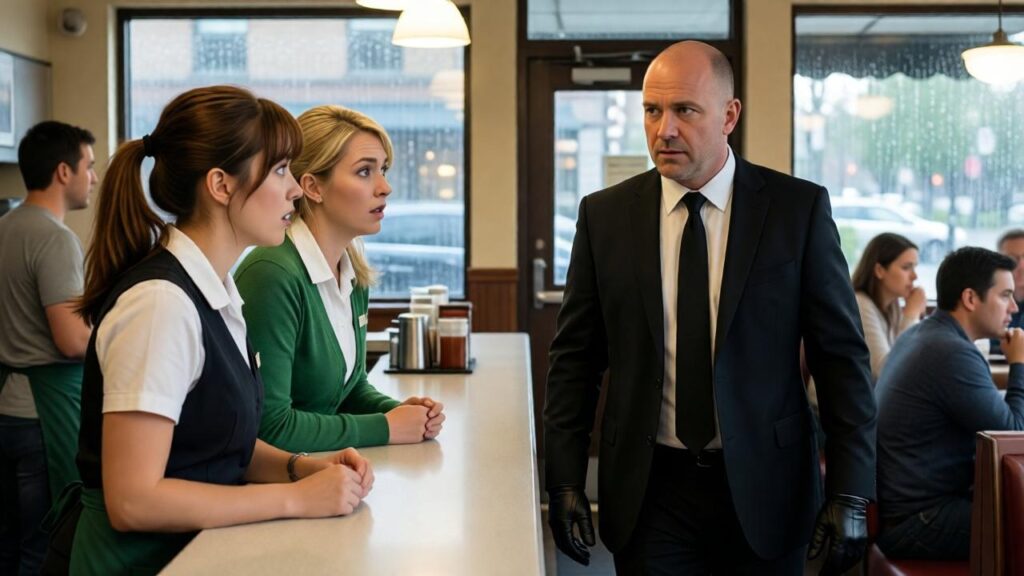
The first man was completely bald, clean-shaven, black suit, white shirt, black tie, and thin black gloves. His name was Marcus Hale. Beside him walked a taller, heavily built man with chestnut hair, a long full beard, wire-rimmed glasses, and the same black suit and tie—Roman Vale. The remaining two, Callum Reed and Darius Cole, took positions near the vehicles and waited.
Marcus Hale walked straight through the rain toward the diner entrance without hurrying. He pushed the door open and stepped inside, water sliding off his shoulders onto the mat.
The dining room was half full. The usual Tuesday morning mix of regulars, a few construction workers, two nurses finishing night shift. At the counter Sophie Miller—blonde hair, green cardigan over a beige shirt, white apron—looked up from the coffee machine and froze.
“Emma,” she said, voice low and shocked, “who the hell is that?”
Emma Lang stood a few feet away, still holding an empty order pad. She turned, followed Sophie’s gaze, and stared at the bald man in the black suit and gloves. Her expression moved from confusion to sudden, disbelieving recognition.
“Is that… Walter?”
The name hung in the air between them.
Marcus Hale’s eyes swept the room once, then settled on the open doorway that led to the covered patio. He walked toward it without speaking to anyone. Customers turned to watch. Conversations died mid-sentence.
On the patio Walter Hayes was still sitting on the blanket, the empty breakfast plate and coffee mug in front of him. He looked up as Marcus stepped under the green canvas. Rain drummed softly on the fabric above them. For a moment the two men simply regarded each other.
Marcus’s voice was quiet, almost respectful.
“We’ve been looking for you since six this morning, sir.”
Walter set the coffee mug down carefully.
“I told you I needed air.”
“You also told security you would stay within the perimeter of the hotel. This is eleven blocks outside that perimeter.”
Walter’s mouth twitched in something that might have been a smile. “The coffee here is better.”
Marcus glanced at the empty plate, then at the open doorway where Emma and Sophie now stood staring. Other customers had begun to gather at a polite distance, sensing that something larger than a regular morning was unfolding.
“The car is ready,” Marcus said. “Roman has the secondary vehicle. We can leave whenever you decide.”
Walter looked past him toward the two young women in the doorway. Emma’s face was pale with shock. Sophie’s mouth was slightly open.
Walter rose slowly, joints stiff from sitting on the floor. He picked up the empty tray and carried it inside himself, ignoring Marcus’s subtle offer to take it. He set the tray on the counter in front of Emma.
“Thank you for breakfast,” he said. His voice was the same gentle one she had heard every morning for the past three months. “And for the company.”
Emma found her voice with difficulty. “Walter… who are you?”
He considered the question for a moment, rain still dripping from the brim of his brown cap.
“Someone who got tired of eating alone in rooms that are too quiet,” he said. “Someone who likes the sound of rain on canvas. And someone who is very glad a young woman decided that nobody should sit hungry on a wet floor.”
Marcus cleared his throat politely. “Sir, the board meeting was moved to eleven. We still have time, but the longer we remain the more attention we draw.”
Walter nodded. He reached into the inner pocket of his brown jacket and drew out a simple black leather wallet. From it he removed a single business card and a folded cheque already filled out. He placed both on the counter in front of Emma.
“This is my private number,” he said. “The cheque is for the breakfast, the three months of coffee you never let me pay for properly, and a small thank-you for treating an old man like a person instead of a problem. You can cash it or tear it up. That choice is yours.”
Emma looked down. The cheque was drawn on a private account. The amount was large enough to change the next several years of her life. Her hands trembled slightly as she picked it up.
Sophie whispered, “Emma… that’s six figures.”
Walter adjusted the brown cap on his head. “If you decide to keep working here, I’ll still come for coffee when I can. If you decide to do something else, the number on that card will reach me directly. No assistants. No filters.”
He turned toward the door. Marcus stepped aside to let him pass. Roman Vale opened a large black umbrella and held it ready in the rain. The other two men remained by the vehicles, scanning the street with quiet professionalism.
At the threshold Walter paused and looked back once more at Emma.
“You asked why you were always so nice to me,” he said. “The better question is why so few people are. Don’t lose that, Emma. The world has enough people who look through others. It needs more who still see them.”
Then he walked out into the rain under the black umbrella, the four men in suits closing ranks around him with the seamless coordination of long practice. The SUV and the sedan pulled away from the curb together, taillights glowing briefly in the downpour before they disappeared around the corner.
Inside the Maple Street Diner the silence lasted almost a full minute.
Sophie was the first to speak. “That was Walter. Our Walter. The guy who sits on the floor and never has enough cash.”
Emma still held the cheque and the business card. Her voice was quiet. “I think he was never our Walter. I think we were just the place he chose to remember what ordinary felt like.”
Customers began to murmur. Someone near the window claimed they had seen the same black SUV in the financial district. Another swore the bald man looked familiar from a news segment about private security for high-net-worth clients. The story would grow and shift by evening, but the core remained the same: the old man who ate breakfast on a blanket under a green canvas awning had walked out under an umbrella held by men in black suits, and the waitress who had paid for his eggs had been left holding a cheque that could rewrite her future.
Emma did not cash it that day.
She finished her shift in a kind of daze, smiling automatically at customers, refilling coffee, wiping tables. Every time the door opened she glanced up, half expecting Walter to return in the brown cap and plaid shirt. He did not.
At closing time she sat alone at the counter with Sophie while the rain continued outside. The business card lay between them under the soft overhead lights.
“Are you going to call?” Sophie asked.
Emma turned the card over in her fingers. “I don’t know. Part of me wants to keep the version of him that sat on the floor and worried about money. The other part… I keep hearing him say nobody should eat alone and hungry.”
Sophie reached over and squeezed her hand. “Whatever you decide, you did something good. That’s not nothing.”
Three days later Emma stood in the small office at the back of the diner and dialled the number on the card. It rang twice.
Walter’s voice answered on the third ring, the same calm tone she knew from the patio.
“Emma.”
She swallowed. “I still have the cheque. I haven’t decided what to do with it.”
“There’s no deadline,” he said. “Keep it as long as you need. Or tear it up. Both are acceptable answers.”
“Why here?” she asked. “Why our diner? Why the floor?”
A short silence. Then: “Because the last time someone was kind to me without knowing my name, I was younger than you are now. I wanted to remember what that felt like. You reminded me.”
Emma looked out the small office window at the green canvas patio, still wet from the morning rain.
“I’m going to cash half of it,” she said finally. “The other half I’m putting into a small fund. For people who come in and can’t pay. So nobody has to sit hungry if I can help it.”
She could hear the smile in his voice.
“That sounds exactly right.”
“Will you still come by sometimes?”
“When I can,” he answered. “But next time I’ll sit at a table. And I’ll pay for my own eggs.”
Emma laughed softly, the first real laugh she had managed since the black cars appeared.
“Deal.”
After the call ended she walked back out to the patio. The rain had stopped. Sunlight was beginning to break through the clouds, turning the wet wooden deck the colour of honey. She stood under the green canvas for a long moment, remembering the man in the brown cap who had asked why she was always so nice, and the answer she had given without thinking.
Nobody should eat alone and hungry.
Some truths, once spoken under a rainy awning, refuse to stay small.
In the months that followed, the Maple Street Diner quietly became known for something more than its breakfast special. A small handwritten note appeared near the register: If you’re short today, just say so. We’ve got you. The fund Emma started with half of Walter’s cheque grew through small donations from regulars who had heard the story. Walter himself appeared three more times that year—once in the brown cap and jacket, twice in a simple grey coat that still managed to look ordinary. He always paid. He always asked how the fund was doing. He never stayed long.
Marcus Hale and the other men in black suits were never seen again at the diner. Their presence had been a single, precise interruption—a reminder that some people who sit on floors under green canvas awnings carry entire invisible worlds with them.
Emma kept the business card in the same apron pocket for years. She never needed to call the number again. The kindness she had offered freely had already returned in the only form that mattered: the certainty that one quiet morning under the rain had changed more lives than she would ever fully know.
And every time a new customer sat alone at the counter looking uncertain, Emma still smiled the same way she had smiled at Walter.
Because nobody should eat alone and hungry.