
The showroom of Greenfield Garden Equipment was bright and spacious, its high ceilings and polished concrete floor designed to make every lawn mower, every zero-turn rider, every professional-grade trimmer look like a prize on display. Large floor-to-ceiling windows ran along the entire front wall, flooding the space with natural light and offering a clear view of the half-empty parking lot beyond. Rows of gleaming machines stood in neat formation under carefully aimed spotlights. The air smelled faintly of new rubber, cut grass samples, and expensive oil.
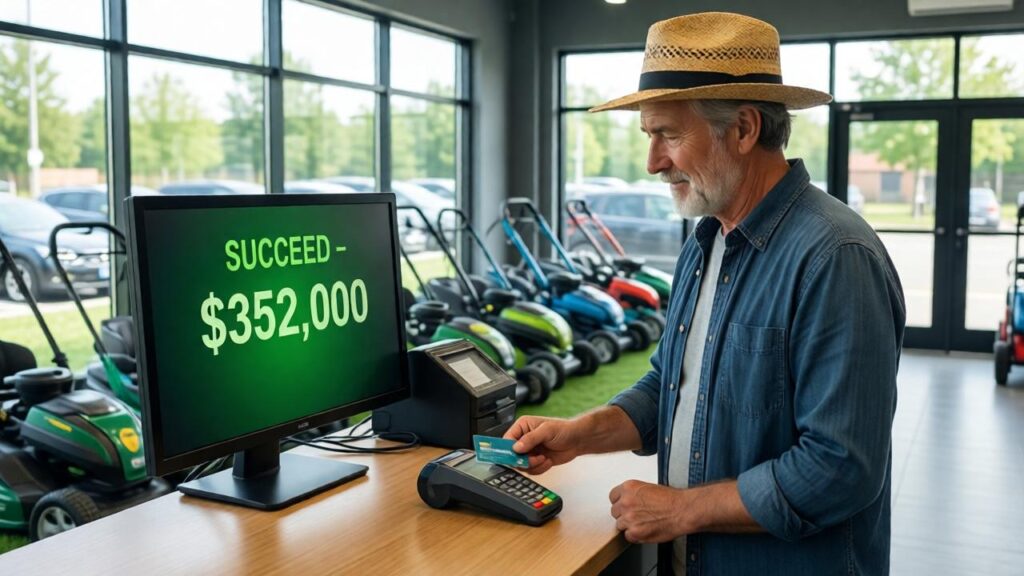
At the wooden sales counter near the centre of the floor stood Thomas “Tom” Whitaker. Sixty-eight years old, European features, silver-grey hair and a neatly trimmed grey beard, a well-worn straw hat tilted slightly back on his head. Beige long-sleeve work shirt, blue jeans, brown leather work boots that had seen real dirt. He held a matte-black credit card between two fingers and watched the payment terminal with quiet concentration as he drew the card through the reader.
Behind him, among a cluster of high-end commercial mowers, three younger people were laughing.
Claire Reynolds, thirty-two, chestnut hair pulled into a tight bun, red blazer over a black blouse, stood with one hand raised, pointing toward Tom as if the sight of the older man in the straw hat attempting a large purchase was the funniest thing she had seen all week. Beside her Daniel Croft, thirty-four, short dark hair, grey suit, chuckled openly, shoulders shaking. A few steps closer, John Ellison, thirty-three, short dark-chestnut hair, dark-blue suit and white shirt, was still smiling when he walked toward the counter.
“If the card works,” John said in an amused, friendly tone, “I’ll pay.”
The terminal beeped.
A bright green digital plaque appeared on the monitor in the middle of the counter:
SUCCEED – $352,000
The number hung there in clean white numerals against the green field, impossible to miss.
Tom Whitaker looked up from the screen. His eyes settled on John Ellison. For a moment the older man’s expression shifted from quiet focus to genuine surprise, then softened into something almost warm.
“John?” he said, voice calm and faintly amused. “Sorry, I didn’t recognise you. How are you?”

The laughter behind him died mid-breath.
Claire’s pointing hand lowered. The smile on her face flattened into seriousness. Daniel Croft’s chuckle stopped as if someone had cut the sound. Both of them stared at the green success message, then at the older man in the straw hat, then at John, who had gone very still.
Tom’s eyes narrowed slightly. He studied the three of them for two full seconds, the way a man studies a ledger that no longer balances. Then he spoke again, voice still low, still steady, but carrying a new edge.
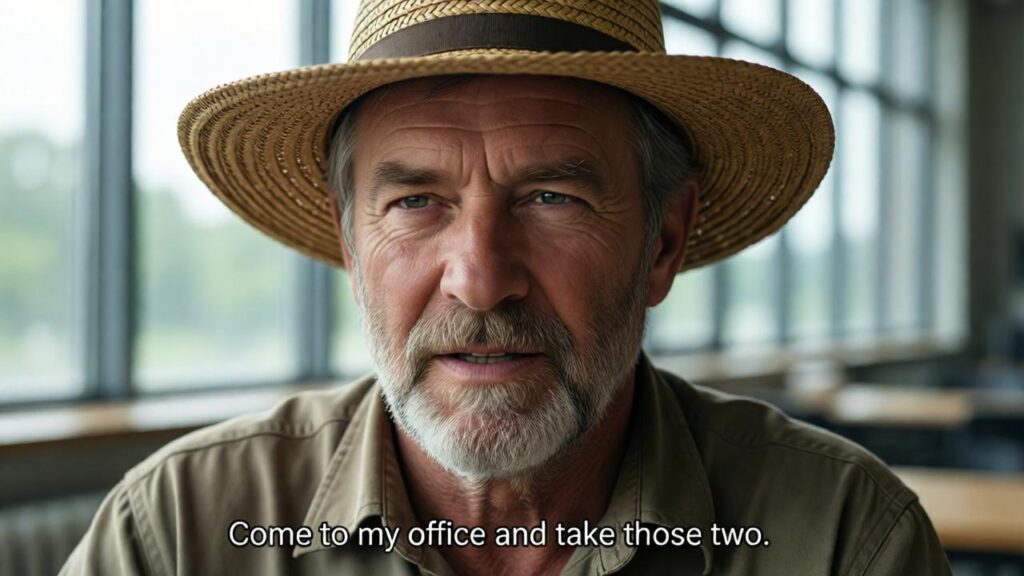
“Come to my office,” he said, “and take those two.”
John Ellison’s face drained of colour. Claire opened her mouth and closed it again. Daniel took one involuntary step backward.
Tom Whitaker did not raise his voice. He simply slipped the credit card back into his wallet, picked up the printed receipt that the terminal had quietly produced, and folded it once. Then he turned and walked toward a glass-walled office at the far end of the showroom, the straw hat still sitting easily on his head.
John hesitated only a moment before following. Claire and Daniel remained frozen among the lawn mowers until Tom’s voice carried back across the floor without him turning around.
“Both of you. Now.”
They followed.
The glass office was modest: a solid oak desk, two visitor chairs, a single bookshelf of technical manuals and sales binders, a large monitor that currently showed the same green success message mirrored from the front counter. Tom closed the door behind the three younger people and gestured for them to sit. Only John sat. Claire and Daniel remained standing.
Tom removed the straw hat and set it carefully on the desk. Without it he looked older and, somehow, more dangerous. The silver hair and beard framed a face that had spent decades making decisions other people only read about afterward.
“John Ellison,” he said. “Last time I saw you, you were running the regional accounts for Meridian Outdoor Group. That was four years ago. You transferred, I was told. Quietly.”
John’s voice was tight. “Yes, sir. I… I didn’t expect to see you here. Not like this.”

Tom’s gaze moved to Claire, then to Daniel. “And these two?”
John swallowed. “Claire Reynolds, sales lead for the commercial division. Daniel Croft, finance liaison. They… we were discussing the possibility of a large walk-in purchase. It seemed unlikely. We were—”
“Laughing,” Tom finished. “Pointing. Making jokes about whether an old man in work boots could clear a third of a million dollars on a single swipe.”
Claire found her voice. “Mr. Whitaker, we had no idea who—”
“You had eyes,” Tom said. “You had a customer standing at the counter with a card in his hand. Your job was to assist. Instead you turned him into entertainment.”
Daniel shifted his weight. “It was just—”
“It was unprofessional,” Tom cut in. “And it was visible to every camera in this showroom, including the one above the counter that recorded the exact moment the terminal returned a success of three hundred and fifty-two thousand dollars.”
He tapped the folded receipt on the desk. “That purchase covers twelve commercial zero-turn mowers, four heavy-duty utility vehicles, a full suite of professional attachments, and the extended service package. The equipment will be delivered to Whitaker Estates by Friday. The invoice is already paid.”
John’s eyes widened further. “Whitaker Estates… that’s—”
“Mine,” Tom said simply. “Has been for twenty-three years. The garden division alone runs two hundred and forty acres of managed landscape across three counties. We buy in volume. We buy quietly. And we prefer to deal with people who do not treat a customer like a punchline.”
He leaned back in the chair. The straw hat remained on the desk like a quiet reminder of the man they had underestimated.
“John, you and I go back far enough that I’m willing to assume you were following the lead of the two people laughing the loudest. That assumption is the only reason you’re still sitting in that chair. Claire Reynolds and Daniel Croft, on the other hand, demonstrated a level of disrespect I don’t tolerate in any organisation connected to my name—even temporarily.”
Claire’s face had gone pale. “Mr. Whitaker, please. We can—”
“You can leave,” Tom said. “Effective immediately. John will escort you to collect your personal belongings. Security will walk you to your cars. Your access cards will be deactivated before you reach the parking lot.”
Daniel’s voice rose. “You can’t just—”
Tom’s eyes settled on him with the calm finality of a closing ledger. “I own forty percent of the holding company that owns this dealership chain. The other sixty percent belongs to people who return my calls within three minutes. I can, Daniel. And I just did.”
Silence filled the glass office. Outside, through the large windows, two customers walked past a row of mowers without noticing anything unusual. The parking lot remained half-empty under a clear sky.
Tom turned to John. “You’re staying. Effective this afternoon you are interim commercial sales director for this location. You will review every open quote over fifty thousand dollars personally. You will also write a formal apology—on company letterhead—to every customer who was present in the showroom during the last thirty minutes. I want those letters on my desk by close of business.”
John nodded once, sharply. “Yes, sir.”
Tom stood. He picked up the straw hat and settled it back on his head. The gesture somehow restored the milder appearance he had worn at the counter, but no one in the room was fooled any longer.
“One more thing,” he said. “The next time someone walks into this showroom looking like they just stepped off a tractor, you treat them as if they might clear three hundred and fifty-two thousand dollars with a single swipe. Because some of them will.”
He opened the glass door and stepped back into the bright showroom. John rose immediately and gestured for Claire and Daniel to follow. They did, faces tight, footsteps unnaturally quiet across the polished concrete.
Tom walked back to the wooden counter. The green success message still glowed on the monitor. He touched the screen once and the display returned to the standard sales interface. The receipt remained folded in his shirt pocket.
The store manager—a middle-aged woman named Helen who had watched the entire sequence from a respectful distance—approached carefully.
“Mr. Whitaker… is everything all right?”
“Everything is exactly as it should be,” Tom answered. “Helen, I’ll need the delivery schedule for the commercial order confirmed by four o’clock. And please have the security footage from the last hour archived under my private account.”
“Of course.”
Tom nodded, then glanced once more toward the glass office where John was already speaking quietly to the two people whose careers at Greenfield had just ended. He felt no particular satisfaction. He felt only the familiar, quiet certainty that standards, once allowed to slip, cost more than money to restore.
He spent the next forty minutes walking the floor, examining a new line of battery-powered commercial trimmers, asking precise technical questions of the remaining staff. Word of what had happened moved through the showroom in low voices and quick glances. By the time Tom returned to the counter, the atmosphere had shifted. Sales associates stood a little straighter. Conversations with customers carried a new attentiveness.
At 3:47 p.m. John Ellison reappeared, face composed, and handed Tom a single printed page—the first draft of the customer apology letters. Tom read it once, made two small corrections in the margin with a ballpoint pen, and handed it back.
“Send them before five,” he said. “And John—next time you see someone you think you recognise, speak first. It saves everyone time.”
“Yes, sir.”
Tom left the showroom at 4:10 p.m. The parking lot was warmer now, the late afternoon light turning the asphalt the colour of old honey. His own vehicle—a practical, slightly dusty crew-cab pickup—sat in the far corner, deliberately chosen to look like it belonged to a man who still worked with his hands. He climbed in, set the straw hat on the passenger seat, and started the engine.
As he pulled out onto the main road he glanced once in the rear-view mirror at the bright glass front of Greenfield Garden Equipment. Inside that building two people were packing boxes under the watchful eye of security. A third was rewriting letters of apology. And a green success message that had briefly glowed with the number 352,000 had already been cleared from every public screen.
Tom Whitaker drove toward Whitaker Estates with the windows down and the radio off. The $352,000 purchase would arrive on schedule. The landscape contracts would continue without interruption. And somewhere in a glass office that still smelled of new carpet and nerves, the lesson of the afternoon would settle into place like soil after rain:
Appearances are data. Laughter is a choice. And some credit cards clear for amounts that rewrite the rest of the day.
He reached the main gate of the estate twenty-three minutes later. The security guard recognised the pickup and waved him through without requiring the usual check. Tom parked near the main equipment barn, put the straw hat back on, and walked inside to inspect the space that would soon hold twelve new commercial mowers.
Behind him the day continued, ordinary and bright.
In the Greenfield showroom the story of the man in the straw hat had already begun its quiet circulation—embellished in places, stripped of names in others, but always ending with the same two facts:
The card worked.
And two people left carrying boxes.