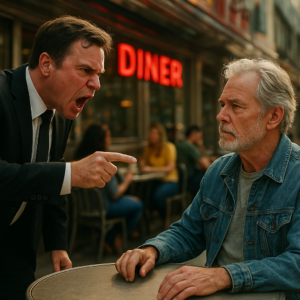

The Chrome Diner sat on the edge of a forgotten highway strip like a time capsule that refused to die. Red vinyl booths, checkerboard floors, chrome-edged counters, and a long row of high stools facing the wide front windows. Outside, rain fell in thick grey sheets across an empty parking lot, turning the asphalt into a dark, unbroken mirror. Neon signs flickered weakly against the downpour: OPEN 24 HRS, COFFEE, PIE. Inside, the air smelled of burnt toast, old fryer oil, and the sharp tension that always arrived just before something broke.
Arthur Blackwood sat alone at the counter, eighty years old, silver-grey hair combed neatly back, grey jacket over a crisp white shirt, blue trousers, black shoes planted firmly on the footrest. A single white ceramic cup of black coffee rested in front of him. He did not look like a man who belonged to this decade, or the last three. He looked like someone who had simply outlasted them.
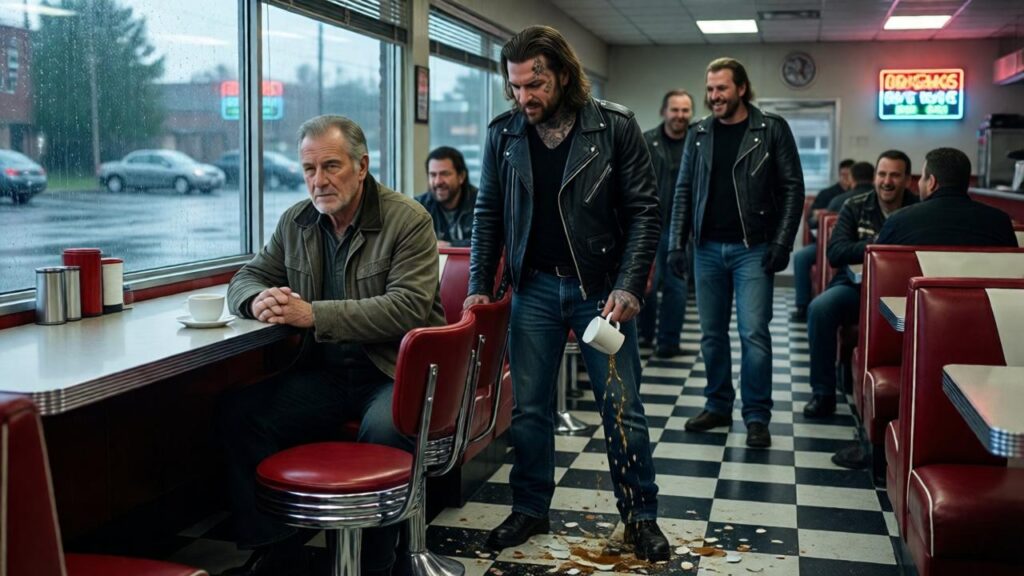
Jake “Reaper” Malone entered with the rest of his crew at 10:47 a.m. Forty years old, shoulder-length dark hair still wet from the rain, a black ink tattoo of a scythe curling across the left side of his shaved scalp, thick beard, black leather jacket over a white T-shirt, blue jeans, heavy black boots. He was smiling the smile of a man who had never been told no for longer than thirty seconds. Behind him came four others: Dutch Keller (42, bald, heavy beard, scar across the left eyebrow), Cobra Raines (38, long hair tied back, neck tattoos), Hank “Brick” Vargas (45, massive shoulders, grey-streaked beard), and Snake Delaney (33, lean, restless eyes, constant smirk). All in black leather and denim, all carrying the same arrogant swagger.
They took the far end of the counter, laughing too loud, ordering nothing. Reaper’s eyes found Arthur almost immediately. He watched the old man for a full minute, then pushed off his stool and walked the length of the counter with deliberate, heavy steps.
Arthur did not turn.
Reaper stopped behind him, reached past his shoulder, and picked up the white coffee cup. He held it high for a moment so the others could see, then opened his fingers. The cup hit the checkerboard floor and shattered. Hot coffee spread in a dark puddle around Arthur’s shoes.
The crew laughed.
Reaper turned, walked three steps toward his friends, then stopped. He looked back over his shoulder, still smiling, and said with lazy aggression:
“What you gonna do, old man?”
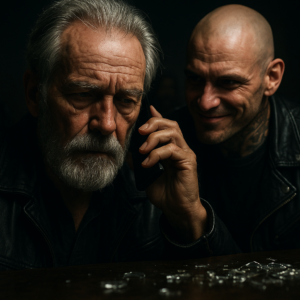
Arthur Blackwood did not answer. He simply reached into the inside pocket of his grey jacket, drew out a slim black mobile phone, and pressed it to his ear. His voice was calm, low, and completely steady.
“It’s me.”
A short pause.
“Bring them.”
He ended the call and set the phone face-down on the counter beside the spreading coffee stain. Then he folded his hands and waited.
Reaper’s smile widened. “You hear that, boys? Grandpa just ordered more coffee.” The others laughed again. Dutch slapped the counter. Cobra pretended to wipe tears from his eyes. Brick cracked his knuckles loud enough to be heard over the rain.
Outside, through the rain-streaked windows, the empty parking lot suddenly filled with motion.

Three black vans appeared at the far end of the lot, headlights cutting white tunnels through the downpour. They did not slow. Tires screeched on wet asphalt as they swung into a precise line directly in front of the diner’s glass doors and stopped hard. Doors slid open before the engines finished settling.
Men stepped out.
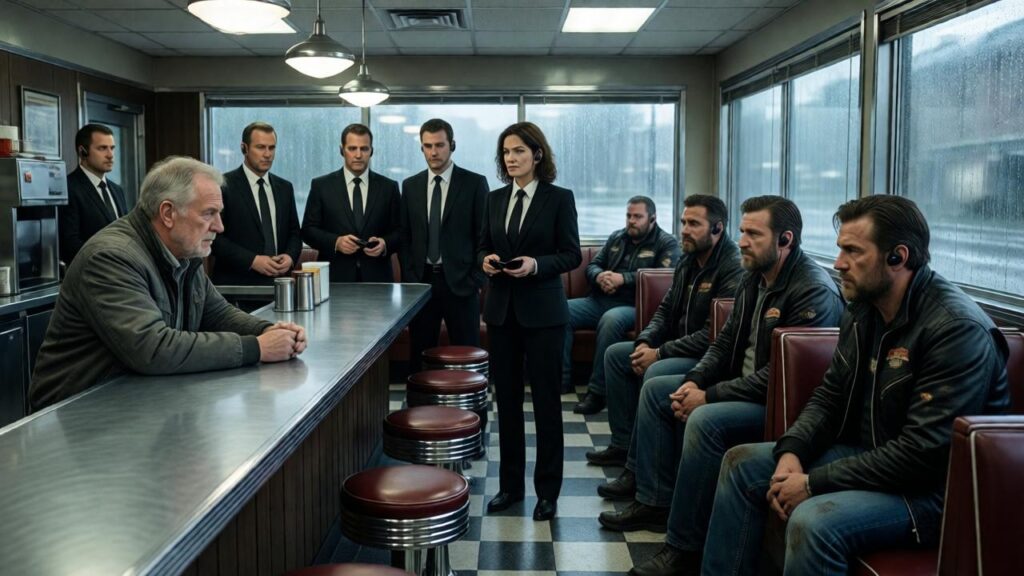
They wore black suits, white shirts, dark ties, polished black shoes. Each had a discreet earpiece and black sunglasses despite the grey daylight. They moved with the quiet coordination of people who had rehearsed this exact arrival many times. Six of them. Then eight. Then twelve. They did not rush. They simply crossed the short distance from the vans to the entrance and pushed the glass doors open in perfect silence.
The diner’s little bell above the door chimed once, soft and almost apologetic.
Reaper’s smile finally cracked.
Arthur Blackwood still had not turned around.
The lead man in the black suit stopped three metres from the counter. He was in his early fifties, silver at the temples, expression unreadable behind the dark lenses. His name was Marcus Hale. Beside him stood Lena Voss (mid-forties, short silver-streaked hair, the only woman in the group), Callum Reed (early thirties, lean, sharp-featured), Darius Cole (early thirties, heavy-shouldered, silent), and eight others whose faces carried the same controlled emptiness.
Marcus removed his sunglasses, folded them carefully, and slipped them into his jacket pocket. His eyes found Arthur.
“Sir.”
Arthur inclined his head a fraction. “Marcus. You’re early.”
“Traffic was light.”
Reaper recovered enough to laugh, though the sound had lost its earlier confidence. “What is this, Halloween? You bring the entire funeral home with you, old man?”
Arthur finally turned on his stool. His face remained calm, almost mild. “These gentlemen are here to clean up a small mess. You’re part of that mess.”
Dutch stepped forward, chest out. “You think a bunch of suits scare us? We’ve put bigger men in the ground for less.”
Lena Voss spoke for the first time, voice quiet and precise. “You haven’t. And you won’t.”
Brick Vargas took two heavy steps toward Callum Reed. “Pretty boy in a tie. You ever actually hit anyone, or do you just look expensive?”
Callum’s reply was soft. “I hit people who ask better questions.”
The tension stretched until it felt like the chrome edges of the counter might snap.
Reaper’s hand drifted toward the inside of his jacket. Marcus Hale noticed the movement and gave the smallest shake of his head. Reaper froze.
Arthur Blackwood stood. At eighty he was still tall, still straight-backed. He looked at the coffee stain on the floor, then at the shattered pieces of the white cup.
“You dropped my coffee,” he said to Reaper. “You laughed. You asked me what I was going to do.” He paused. “I am going to finish my morning in peace. You and your friends are going to leave. You are going to tell every member of the Reaper Crew that this diner, this stretch of road, and anything within sight of that parking lot are closed to them from this moment forward. If any of you return, the next conversation will not include words.”
Reaper’s face darkened. “You don’t give orders here, old man. This is our town.”
Arthur’s voice did not rise. “It was your town. That ended the second you touched my cup.”
For three full seconds no one moved.
Then Reaper lunged.
He never reached Arthur.
Darius Cole was already between them. The larger man met Reaper’s charge with a short, brutal shoulder check that drove the biker backward into the nearest row of stools. Chrome and vinyl screeched across the floor. Reaper hit hard, breath exploding from his lungs.
Dutch and Brick came next. Marcus Hale stepped into Dutch with a single precise strike to the throat that dropped him gasping to his knees. Lena Voss moved like water; her boot found the side of Brick’s knee with a wet, decisive crack. Brick went down roaring.
Cobra and Snake tried to flank. Callum Reed caught Cobra’s wrist, twisted, and used the momentum to drive the biker’s face into the counter. Snake swung wild; one of the other suited men simply stepped inside the arc and folded him with an elbow to the solar plexus.
The entire exchange lasted less than twenty seconds.
When it ended, four of the five Reaper Crew members were on the checkerboard floor in various states of pain. Reaper himself was on one knee, blood running from a split lip, staring up at Arthur with pure disbelief.
Arthur looked down at him without expression.
“Clean it up,” he said.
Reaper’s breathing was ragged. “What?”
“The coffee. The broken cup. Clean it up. All of you.”
For a long moment pride fought pain. Pain won. Slowly, cursing under their breath, the five men gathered the ceramic shards, wiped the floor with napkins from the dispenser, and stacked the debris in a neat pile near the trash can. The suited men watched in complete silence. Outside, the rain continued to hammer the black vans.
When the floor was clean again, Arthur returned to his stool. Marcus Hale nodded once to the others. They filed out as quietly as they had entered. The vans’ engines started. One by one they pulled away into the rain until only the empty lot remained.
Reaper and his crew stood in the doorway, soaked and humiliated, staring at the old man who still had not raised his voice.
Arthur picked up a fresh cup of coffee that the waitress—silent, pale, and carefully invisible until now—had placed in front of him. He took a slow sip.
“Next time you decide to test someone,” he said without looking at them, “make sure you know whose coffee you’re spilling.”
They left.
The little bell above the door chimed once more, soft and final.
Arthur Blackwood finished his coffee in silence. Outside, the rain washed the last tire tracks from the asphalt. Inside the Chrome Diner the neon still flickered, the chrome still shone, and the black walls of the old place kept their newest secret.
Three days later the first message arrived.
It came in the form of a single black motorcycle that parked across the street at 2:13 a.m. and stayed there for forty minutes before leaving. The next night there were two. By the end of the week a quiet word had spread through every bar and garage the Reaper Crew used: the old man in the grey jacket at the Chrome Diner was not to be touched. Not for laughs. Not for money. Not for pride.
Some of the younger members wanted revenge. Reaper himself wanted it more than any of them. But the older ones—the ones who still remembered certain names from twenty and thirty years earlier—pulled them back. They spoke of docks that had once been controlled by men who never raised their voices. Of people who simply disappeared after one quiet phone call. Of a network that had gone dormant so long that most had forgotten it ever existed.
Arthur Blackwood had not forgotten.
On the following Tuesday he sat at the same stool, same grey jacket, same black coffee. The rain had finally stopped, leaving the parking lot silver under a weak sun. At 11:04 a.m. a single black sedan pulled in. Marcus Hale stepped out alone, walked inside, and took the stool beside Arthur without being invited.
“They’re still talking,” Marcus said.
“Let them talk.”
“Reaper wants a second chance. He thinks if he comes alone and apologises, the matter ends.”
Arthur took a slow sip. “It already ended. The second he dropped the cup.”
Marcus was quiet for a moment. “You could have let it go. He was just a loud boy showing off.”
Arthur set the cup down. “Loud boys who are not stopped become louder men. I stopped being patient with louder men a long time ago.”
Marcus nodded once. “We’ll keep the perimeter for another week. After that, if they stay away, we stand down.”
“They will stay away.”
Marcus almost smiled. “You sound very sure.”
Arthur looked out at the empty lot. “I am eighty years old, Marcus. Certainty is one of the few luxuries I still allow myself.”
Marcus left. The sedan disappeared down the wet highway.
Arthur remained at the counter until the afternoon light turned gold across the chrome. The waitress finally found the courage to speak.
“Mr. Blackwood… who were those men?”
Arthur considered the question for a long time. Then he answered, almost gently:
“They were the reason some people learn to leave certain cups alone.”
She did not ask again.
Weeks later the Chrome Diner returned to its ordinary rhythm. Truckers. Night-shift nurses. The occasional lost tourist. The high stools faced the same wide windows. The rain still came and went. But every Tuesday, without fail, Arthur Blackwood sat at the same place, ordered the same black coffee, and drank it in complete peace.
No one ever touched his cup again.
And somewhere across the city, in a garage that smelled of oil and old leather, Jake “Reaper” Malone stared at the fading bruise on his jaw and finally understood the oldest rule of the road:
Some old men are not old.
They are simply finished explaining themselves.