
Tales

The For Sale Sign and the Sacred Orange Tree

The ‘For Sale’ sign in front of Doña Rosa’s weathered cottage was less an invitation and more a declaration of surrender. Her neighbors, clustered by their manicured hedges, saw only a crumbling eyesore finally exiting the neighborhood. “Finally getting rid of that dump,” one muttered, the words carrying on the dry country air. “Who would ever buy that place? It looks like it could fall apart any second. Not even for free.” Unseen in her kitchen, Doña Rosa heard the echoes of their scorn, her heart heavy as she traced the cracks in her wall—each one a timeline of a life fully, if quietly, lived.

Her name was Doña Rosa. For sixty-five years, the small, humble house had been her universe. She raised her son within its cracked walls, buried her husband under the shade of the yard’s solitary orange tree, and spent her entire life listening to the rhythm of its old tile roof in the rain. But time, as it does, had turned harsh. Medicine grew expensive, her pension shrank, and her own body began to fail. “I thought that if I sold the house,” she confided to a framed photo of her late husband, Antonio, “I could move somewhere smaller, closer to the hospital.” That night, in her rocking chair, she looked up at the sky and whispered, “Forgive me, old man. I can’t take care of it by myself anymore.”
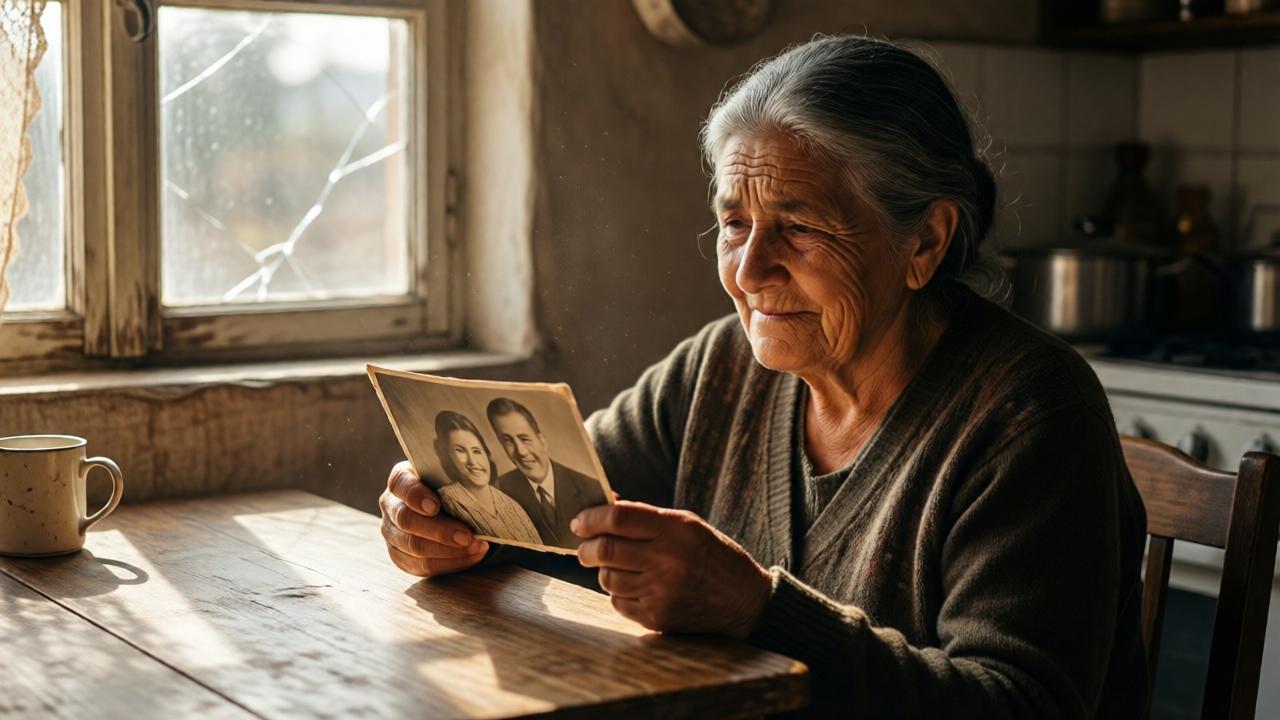
A poignant scene of an elderly woman, Doña Rosa, sitting alone in a simple, sun-dappled kitchen. She holds an old, faded photograph of herself and her husband smiling, her expression a mix of love and sorrow. Morning light streams through a window with a slightly cracked pane, illuminating dust motes in the air and the well-worn surface of a wooden table. The style is photorealistic with a warm, slightly faded color palette, evoking memory and nostalgia. The composition is intimate, a close-up focusing on her hands and face, with the humble details of her home—a chipped mug, a lace curtain—softly visible in the background.

The next morning, as she swept fallen orange blossoms from the yard, the sound of a car horn shattered the quiet. A sleek, expensive sedan was parked at her gate. A man in an impeccably tailored suit stepped out. “Are you Doña Rosa?” he asked, his voice surprisingly gentle. “Yes,” she answered, confused, clutching her broom like a shield. “Is the house still for sale?” With a trembling voice, she said yes, but hurried to explain, “It’s a very simple house. It has no luxury at all.” The man smiled, a warmth reaching his eyes. “I’m not looking for luxury.” Then he asked a question that froze her in place. “Is it true that Don Antonio lived here?”

Doña Rosa turned pale. “You knew my husband.” The man’s composed demeanor softened, his eyes glistening. “He saved my life,” he said, emotion thickening his voice. “When I was a kid, I lived on the streets. I had no parents, no food, nothing. One day, Don Antonio found me, starving behind the market. He brought me into this very house, gave me food, taught me how to read, and paid for my school. He told me, ‘Everyone deserves a second chance.’” The man, named Leonardo, took a deep breath. “I came to buy the house, but you are never leaving this place. This house is sacred.” On the sidewalk, the mocking neighbors stood in stunned silence, their mouths agape.
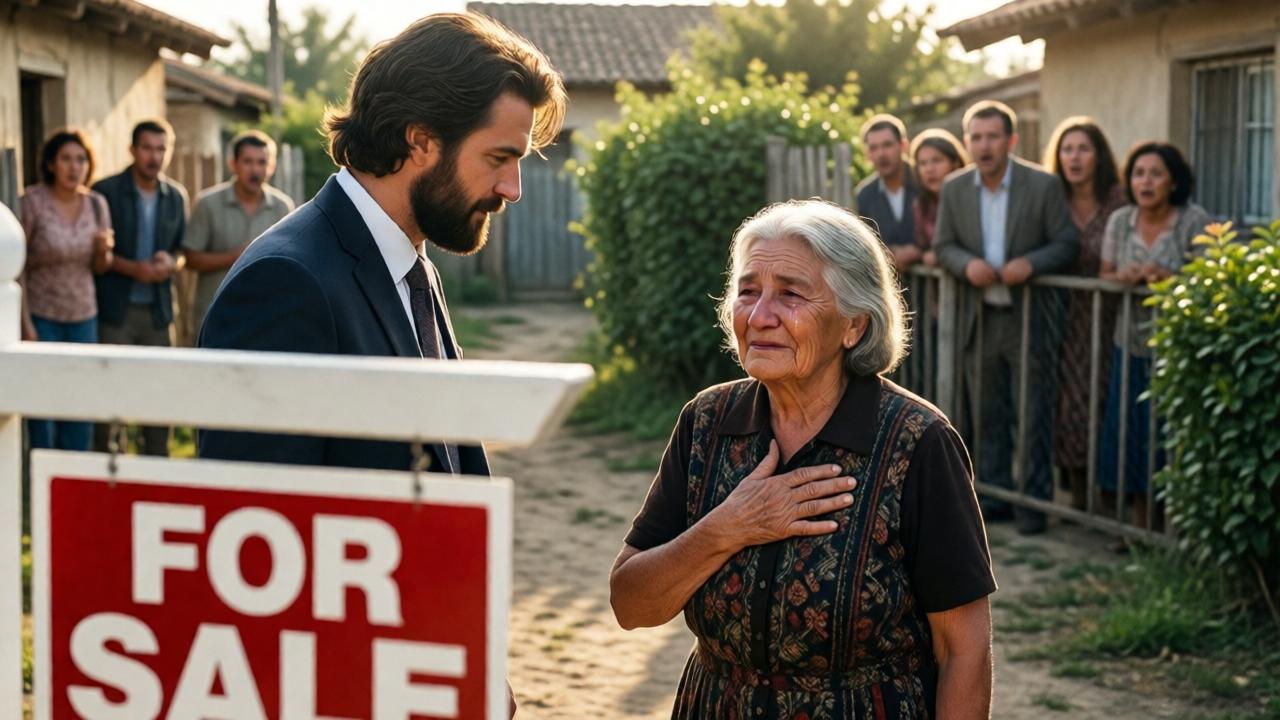
A powerful emotional moment in the dusty front yard. Leonardo, a well-dressed businessman, stands respectfully before the elderly Doña Rosa, who has one hand over her heart, tears streaming down her weathered cheeks. The iconic 'For Sale' sign is visible slightly out of focus in the foreground. In the background, a group of shocked neighbors peer from behind fences and hedges, their expressions of mockery replaced by awe and shame. The lighting is dramatic late morning sun, casting long shadows and highlighting the emotional intensity. The style is cinematic realism, with a focus on the contrast between Leonardo's modern suit and the rustic, humble setting.

Leonardo was one of the richest businessmen in the country, but as he later said, his greatest wealth wasn’t money—it was gratitude. The following week, crews arrived. They installed a new roof, repaired the walls, and laid down new floors. But Leonardo gave one firm instruction: the orange tree, the rocking chair, and the photos on the wall were not to be touched. “That doesn’t get touched,” he told the foreman. “That’s memory.” Humbled, one of the neighbors finally approached Doña Rosa to ask for forgiveness. She simply smiled, her face serene. “There’s no need. May God bless you, because the good things we do in silence are never forgotten.”

But the story, as Doña Rosa hinted, had a second part. After the renovations were complete, Leonardo asked to see her late husband’s old desk. Tucked inside a hidden drawer, behind a stack of faded letters, was a small, yellowed note in Don Antonio’s handwriting. It read: “For the boy, Leonardo. If I am gone and he ever finds his way back, this house and the tree are his. The fruit of kindness is the only harvest that never spoils.” It was a formal addendum to his will, never filed with a lawyer, a silent promise kept by the universe itself. Leonardo held the note, his own tears now falling freely. He hadn’t just repaid a debt; he had fulfilled a sacred trust, proving that the echoes of a single quiet act of kindness can rebuild a home, redeem a community, and shelter a heart for a lifetime.
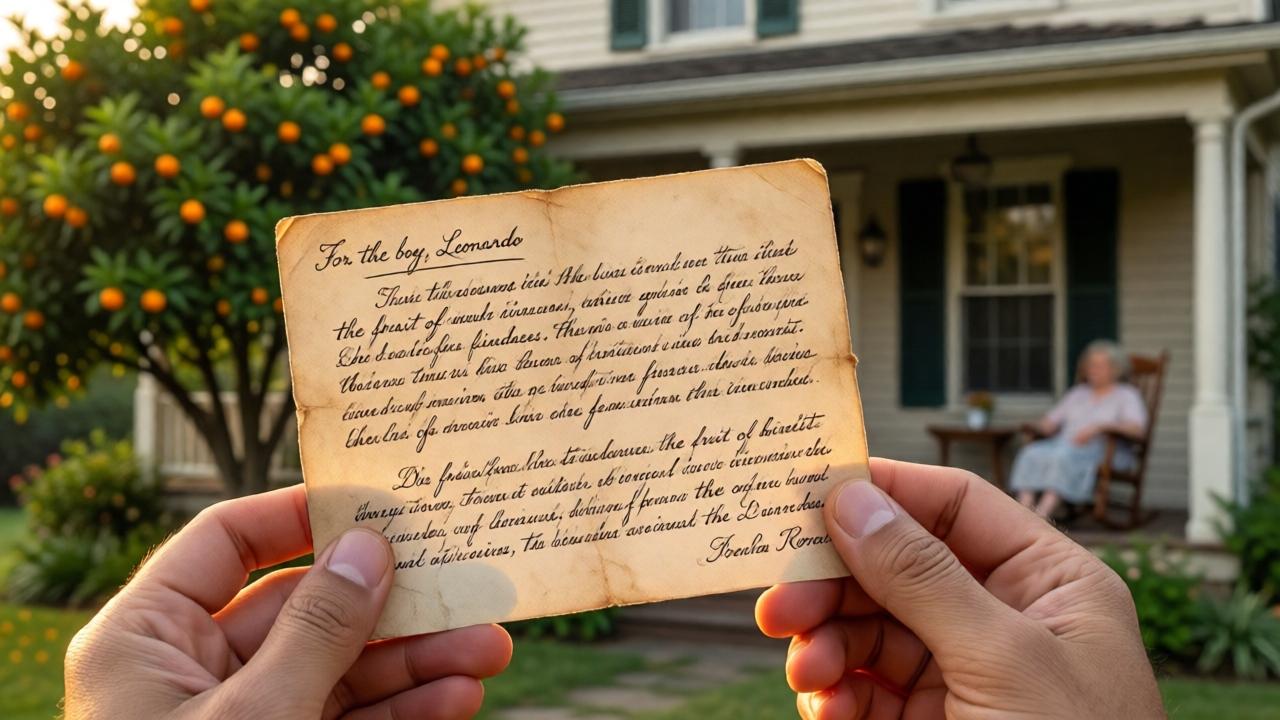
A close-up, highly detailed shot of a weathered, handwritten note on aged paper, held gently in the hands of Leonardo. The text, in elegant cursive, is partially visible, including the phrases 'For the boy, Leonardo' and 'the fruit of kindness...' In the soft background, out of focus, is the fully restored but characterful house, with the orange tree in bloom and Doña Rosa sitting peacefully in her rocking chair on the porch. The lighting is warm golden hour, creating a glow around the note and hands. The style is evocative and textured, emphasizing the timelessness of the message and the tangible connection between past and present.

Related Posts

Close-up of a tense conversation between an older gentleman in a navy suit and a young maid in a black uniform, the woman's face determined yet anxious, the man's expression angry and demanding, with a blurred elegant woman in the background, cinematic lighting.

The Envelope of Truth

The marble floors of the villa gleamed under the soft glow of the crystal chandelier, casting dancing shadows across the high ceilings. In this palace of opulence, secrets…

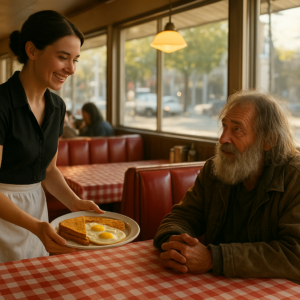
A bustling American diner interior with red and white checkered tablecloths and red vinyl booths, bright natural light streaming through large windows, a young European waitress with dark chestnut hair in a black blouse and white apron smiling as she serves a plate of eggs and toast to an elderly homeless man with long gray hair and beard in a worn brown jacket, cinematic realistic style, warm morning ambiance

The Owner’s Test

The morning sun streamed through the windows of Rosie’s Diner, casting a warm glow over the red-and-white checkered tablecloths and the gleaming chrome of the counter. The air…

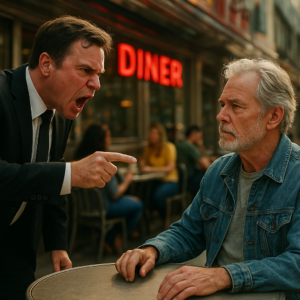
A cinematic street scene outside a bustling diner on a sunny day. A man in a black suit aggressively points at an older man in a denim jacket seated at a table. The suited man's face is red with anger, while the older man remains calm. The background shows blurred patrons and a silver trash bin. Realistic, natural lighting, shallow depth of field, tense atmosphere.

The Lease on the Table

The midday sun beat down on the cracked pavement outside Rosie’s Diner, where the smell of grilled onions and stale coffee mingled with the exhaust of passing cars….

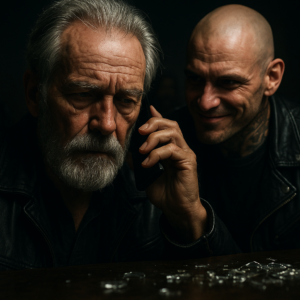
A close-up dramatic shot of an elderly man with grey hair and beard holding a black smartphone to his ear, his expression unreadable, while a bald tattooed man stands behind him with a mocking smirk, other bikers visible in the background, glass shards glinting on the table, moody lighting with a sense of impending confrontation

The Glass Rooster and the Coming Storm

The kitchen smelled of stale bread and fresh violence. Viktor, sixty-eight, sat motionless at the oak table, a half-eaten sandwich on the plate before him. His black leather…

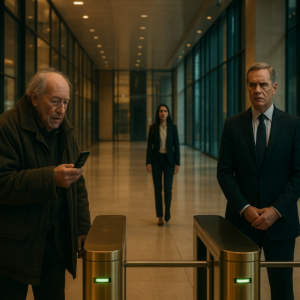
A wide shot of a luxurious modern office lobby with high ceilings, polished floors, and glass walls, golden turnstiles with green lights in the foreground, an elderly man in a worn coat holding an old flip phone, a stern executive in a suit, and a young female assistant in the background, cinematic lighting, warm golden tones mixing with cool glass reflections

The Chairman’s Call

The lobby of Meridian Tower was a cathedral of glass and polished stone, a monument to corporate success. Sunlight streamed through the vast windows, catching the golden turnstiles…

A grey sky over an asphalt road, a convoy of black Mercedes-Benz G-Wagen and Bentley SUVs approaching a modern building with concrete walls, ominous and powerful mood, cinematic wide shot

The Call That Changed Everything

The air in the modern canteen was thick with tension, a stark contrast to its minimalist design of grey concrete walls and warm wooden floors. Dim lighting cast…