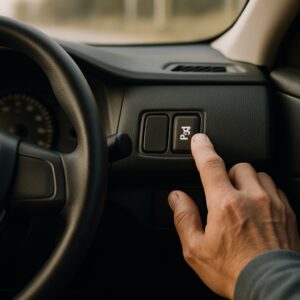

In everyday life, a car’s dashboard is full of symbols and switches. Many vehicles have a button with a small car and curved lines – often overlooked or misunderstood. For drivers over 50, it is helpful to know what this button does and when it can be used effectively.
What Does the Button Do?
The button disables or influences the electronic stability or traction control of your vehicle. Simply put, the system helps regulate the car’s behavior when a wheel spins or the car starts to skid. It intervenes through braking or power reduction to stabilize the vehicle.
Simple Explanation
Imagine a wheel losing grip on a wet road. The system detects the spinning and reduces engine power or brakes individual wheels to help the car run smoothly again. The button allows you to temporarily turn off this system – usually by pressing and holding or pressing it once.
When and Why Is It Useful?
For the vast majority of driving conditions, stability and traction control is activated and provides unobtrusive support. However, there are situations where turning it off can be beneficial.
Useful Situations
If you are stuck in deep snow, mud, or on very loose ground, slight wheel spinning can help you get free. In such cases, the system prevents exactly this spinning and makes it harder to get out. Similarly, when trying to move forward on a very steep, slippery driveway, it may be worth considering turning it off until you are back on normal pavement.
For sporty driving on closed tracks or under special test conditions, deactivating it may also be necessary. However, this is rarely required in normal road traffic.
Common Misunderstandings
There are many assumptions about this button. Some of them are incorrect and lead to confusion.
Popular Myths
A common myth is that turning off the system significantly reduces fuel consumption. In practice, this has little noticeable impact on consumption in everyday operation. Another misunderstanding is that an activated system completely takes control of the vehicle. In reality, it only provides support and does not replace the driver’s responsibility.
Some believe the button is a warning signal for a defect. This is not the case: if a malfunction occurs, a separate warning light usually illuminates, and a message appears on the display. The button itself is usually a control element for temporary deactivation.
Practical Safety Tips
In everyday life, a few simple rules are helpful to use the function correctly and stay safe on the road.
Before Driving
Familiarize yourself with the location of the button and the meaning of the warning lights, ideally in daylight in the parking lot. Briefly read in the manual how your vehicle handles the system – operation can vary slightly from model to model.
While Driving
For normal driving conditions, keep the system activated. It works in the background and supports you without intervention. If you notice that the road is very slippery, reduce your speed and drive cautiously instead of turning off the control.
In Case of Getting Stuck
If you get stuck, first try simple maneuvers: gentle acceleration, changing direction, or placing materials under the wheels. If that doesn’t help and wheel spinning is necessary, you can temporarily turn off the system. However, turn it back on afterward.
Regular Maintenance
Have your vehicle checked regularly. Modern assistance systems work most reliably when brakes, tires, and sensors are in good condition.
Many older drivers appreciate vehicles that make driving easier for them. The discussed button is not a “luxury” but a control element that, when used correctly, makes everyday life safer. Familiarity with its function and a few simple behavioral rules are enough to take advantage of the benefits without losing control.