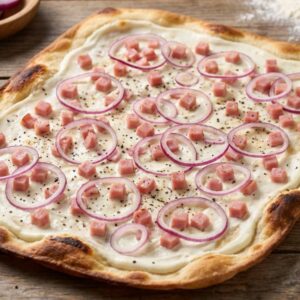
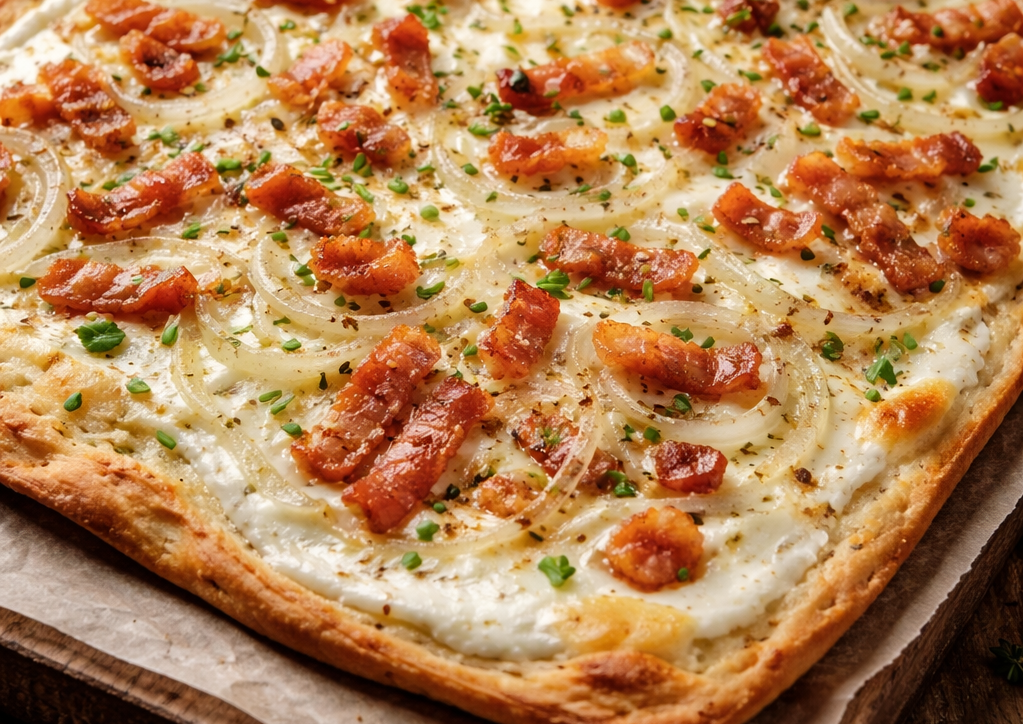
Golden, paper-thin, crisp at the edges and generously topped with tangy cream, smoky bacon and sweet onion: Flammkuchen is the kind of food that makes a kitchen feel like a small Alsatian winstub. Often compared with pizza, this regional classic has its own identity, a fascinating farmhouse history and a wonderfully simple ingredient list.
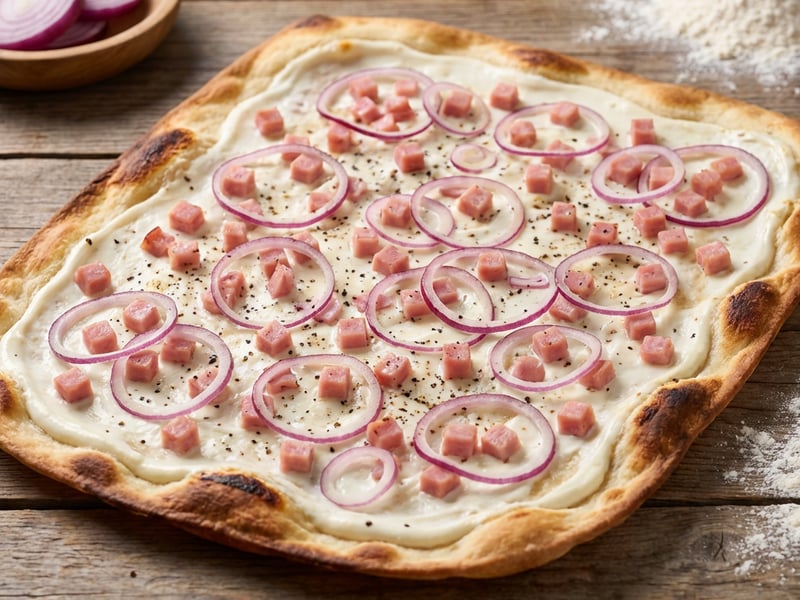
In Alsace, the dish is also called flammekueche; across the border in France it is known as tarte flambée. The name sounds dramatic, but the tart is not set on fire at the table. It earned its name from the fierce flames and high heat of the wood-fired ovens in which it was traditionally baked.
A little history: born beside the bread oven
Long before Flammkuchen became a restaurant favourite, it belonged to the rhythm of rural life in Alsace and the Upper Rhine. Families and village communities did not necessarily bake bread every day. A large wood-fired oven was heated for a baking day, and getting its temperature right mattered: too hot, and the loaves would scorch before the centre was baked.
One traditional account says that bakers rolled a small piece of dough very thin, spread it with cream, added onions and bacon, then slid it into the oven while the flames were still lively. The little tart baked in minutes. Its colour and crispness helped show whether the oven was ready for the bread. Another version says that the topping was a delicious way to use leftover dough after the loaves had been baked. Both stories connect the dish to the same practical farmhouse setting, although the exact first recipe and date are not known.
What began as a quick bite around the communal oven gradually became a regional speciality. Flammkuchen only moved into restaurants on a wider scale in the twentieth century, especially from the 1960s. Today it is loved in Alsace and neighbouring parts of Germany, including Baden, the Palatinate and Saarland. It is still best enjoyed straight from the oven, shared in the middle of the table.
Why it is not just another pizza
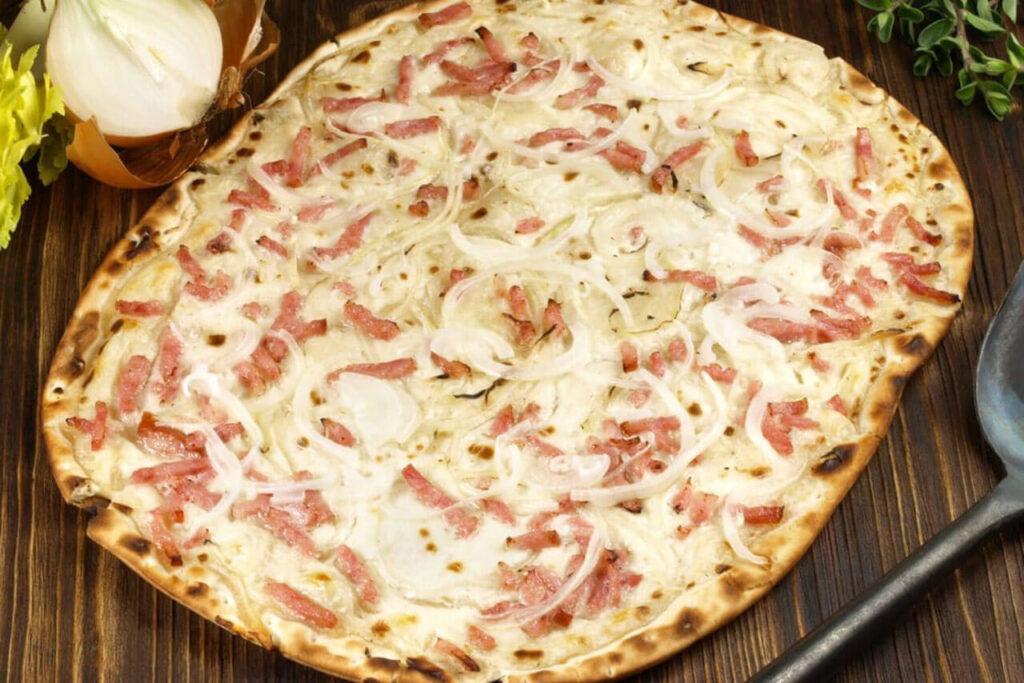
The resemblance is understandable: both are baked dough with toppings. But a proper Flammkuchen has an exceptionally thin base, no tomato sauce and no thick, airy rim. Its creamy layer is usually made with crème fraîche, sour cream or a mixture of cream cheese and fromage blanc. The result should be crisp and delicate rather than soft and bready. The classic topping is restrained: finely sliced onion, small pieces of smoked bacon, black pepper and sometimes a little nutmeg.
Classic Alsatian Flammkuchen
Serves: 4 as a light meal or 6 as a starter
Preparation: 20 minutes, plus 20 minutes resting
Baking: 8–12 minutes per tart
Oven: as hot as it will safely go, ideally 250°C
Ingredients
- 250 g plain flour
- 125 ml lukewarm water
- 2 tbsp neutral oil or olive oil
- ½ tsp fine salt
- 200 g crème fraîche or Schmand
- 150 g smoked bacon lardons (Speck)
- 2 medium onions, very thinly sliced
- Freshly ground black pepper
- A small pinch of freshly grated nutmeg (optional)
- Chives, to finish (optional)
Method
- Make the dough. Mix the flour and salt in a bowl. Add the water and oil, then knead for 5–7 minutes until smooth and supple. The dough should be firm, not sticky. Cover and leave to rest for 20 minutes.
- Heat the oven. Preheat to 250°C, or to the highest setting available. If you have a pizza stone or steel, heat it in the oven. A preheated inverted baking tray also helps the base crisp up.
- Prepare the topping. Stir the crème fraîche until smooth and season lightly with pepper and nutmeg. Slice the onions as thinly as possible. Keep the bacon ready; there is no need to cook it first.
- Roll it very thin. Divide the dough into two pieces. On a lightly floured surface, roll each piece into a large oval or rectangle, roughly 1–2 mm thick. Thin dough is the secret to the characteristic crunch.
- Top lightly. Spread a very thin layer of crème fraîche over the dough, leaving a narrow border. Scatter over the onions and bacon. Avoid piling on too much topping, or the centre may turn soft.
- Bake quickly. Transfer to the hot tray or stone and bake for 8–12 minutes, depending on your oven, until the edges are deeply golden and the bacon is sizzling. Keep an eye on it: the tart should blister in places but not burn.
- Serve at once. Finish with chives if you like, cut into strips or squares and bring it straight to the table. Traditionally, everyone helps themselves from the board.
Three delicious ways to make it your own
1. Pear, goat cheese and walnut. Replace the bacon and onions with thin slices of ripe pear, small pieces of goat cheese and chopped walnuts. Bake, then drizzle with a little honey. The sweet-and-savoury combination makes an excellent autumn version.
2. Mushroom and herb. Use thinly sliced mushrooms, red onion and thyme. Pat the mushrooms dry before topping the tart so they do not release too much water. A little grated cheese is optional, though purists may raise an eyebrow.
3. Smoked salmon and dill. Bake the base with crème fraîche and a little red onion. Add smoked salmon and fresh dill after baking, so the fish stays silky and delicate.
Small details that make a big difference
- Roll thinner than you think. A thick base turns the dish into ordinary flatbread. Aim for almost paper-thin dough.
- Use a very hot oven. Flammkuchen cooks fast. Preheating the tray or stone gives the base a head start.
- Do not overload it. A restrained layer of cream and a modest amount of topping keep the centre crisp.
- Slice onions finely. Thick pieces may remain too sharp during the short baking time.
- Eat immediately. Flammkuchen waits for nobody. The crisp texture is at its best in the first few minutes.
How to serve it
Serve Flammkuchen in the centre of the table with a simple green salad dressed with a sharp vinaigrette. In Alsace, it is often enjoyed with a dry white wine such as Riesling or Pinot Blanc; sparkling water or apple juice works just as well. For a relaxed dinner, bake one tart, cut it into strips, and let everyone take a piece while the next one cooks.
That is the charm of Flammkuchen: a handful of everyday ingredients, a fiercely hot oven and a dish made for sharing. Its farmhouse origins are part of the pleasure, but you do not need a wood-fired oven or an Alsatian address to bring a little of that atmosphere home.
Historical note: The oven-testing and leftover-dough stories are traditional explanations of the dish’s origins; the precise first preparation is not documented. For background, see the Kochersberg tourism office’s history of tarte flambée and Germany Travel’s guide to Flammkuchen.