
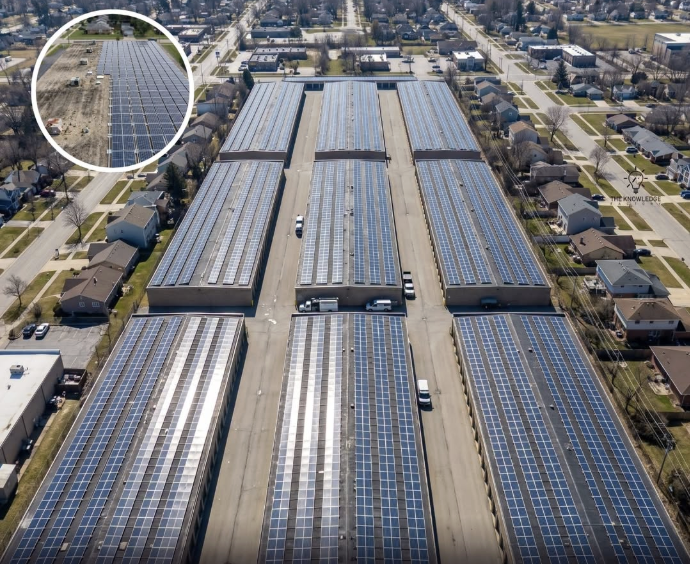
Public Storage, Solar Landscape, and ComEd announced plans to develop 60 rooftop community solar projects on Public Storage facilities across northern Illinois (ComEd territory) over the next two years. Ten sites are already online and generating power.
Key facts on the project (announced July 2026)
Public Storage, Solar Landscape, and ComEd announced plans to develop 60 rooftop community solar projects on Public Storage facilities across northern Illinois (ComEd territory) over the next two years. Ten sites are already online and generating power.
- Capacity: About 44 MW total.
- Rooftop space: Approximately 5 million square feet.
- Generation: Enough electricity annually to power roughly 6,150 households.
- Subscriber savings: An estimated $750,000 per year once all projects are operating (more than $36 million over the life of the systems). Average residential subscriber savings: about $120 annually.
This ranks among the largest rooftop community solar deployments in Illinois. Panels sit on existing large, flat, underused self-storage rooftops, so no new land or farmland is required.
How the model works
Solar Landscape (the largest commercial rooftop solar developer in the U.S.) builds, owns, and operates the systems. Public Storage leases the rooftops (no capital outlay or operational risk on its part) and receives lease payments. ComEd handles grid interconnection and the subscription framework. Subscribers—including renters, apartment residents, and others who cannot install panels on their own roofs—receive bill credits for their share of the solar generation.
The projects participate in Illinois’ Community-Driven Community Solar (CDCS) program under Illinois Shines. This structure prioritizes local residential, small-business, and nonprofit subscribers rather than a few large offtakers. Rooftop projects receive additional incentives, including higher Renewable Energy Credit values.
Policy and market context in Illinois
Electricity demand in northern Illinois is rising faster than supply due to economic growth, electrification, and new technologies. Community solar helps close the gap, lower customer bills, and add clean capacity without major new transmission or substations.
Key supporting policies:
- Climate and Equitable Jobs Act (CEJA, 2021) — significantly expanded incentives for community solar and distributed generation.
- Clean and Renewable Grid Affordability (CRGA) Act — further supports growth, including larger projects (up to 10 MW) and measures for affordability and grid reliability.
ComEd expects more than 400 community solar installations across its territory by the end of 2026 (roughly 100 of them rooftop). Illinois already has more than 1.8 GW of distributed energy resources connected and is the Midwest leader in this category. About one-fifth of existing community solar is on rooftops (the rest ground-mounted or on brownfields); the rooftop share is growing, especially in the Chicago area.
Jobs and community benefits
Construction is expected to support approximately 300 jobs. Workforce partners include STEP-UP Solar, the Chicago Urban League, the Hispanic American Construction Industry Association (HACIA), YouthBuild Lake County, and other Illinois YouthBuild programs. The International Brotherhood of Electrical Workers also plays a role. Since 2024, STEP-UP and its partners have trained 139 people for solar careers.
Example operating site: a 763 kW array in Justice, Illinois (online since March 2026). The village mayor has publicly supported it, noting that it puts idle roof space to productive use, creates jobs and tax revenue, and avoids taking farmland.
Broader Public Storage and Solar Landscape strategy
Public Storage runs one of the largest solar programs in the self-storage industry. Its target is rooftop solar at 1,300 properties by the end of 2026 (more than 1,060 already reached by mid-2026). The partnership with Solar Landscape began around 2022–2023 with an initial portfolio of 133 projects (roughly 87–105 MW) across Maryland, New Jersey, and Illinois, many focused on low- and moderate-income households. The collaboration has since expanded; some reports cite more than 200 projects and over 130 MW jointly.
For property owners the model is attractive: unused rooftops become a source of recurring lease income with no capital expenditure and no operational responsibility. The developer handles engineering, financing, construction, interconnection, and long-term maintenance.
Potential and industry trends
Analyses of U.S. commercial, industrial, and school rooftops indicate hundreds of gigawatts of theoretical potential—nearly enough to meet national electricity demand. Metropolitan areas such as Cook County rank high in this potential. Developers emphasize speed and scalability: large portfolios of logistics, warehouse, and storage properties allow rapid deployment on already-developed sites close to load.
Similar rooftop community solar efforts exist with other real-estate owners (e.g., Prologis working with ComEd on an ~82 MW portfolio).
Useful sources for further research
- Official announcement: Business Wire / ComEd (July 31, 2026).
- Coverage: Solar Power World, Canary Media (on-the-ground reporting from the Justice site), ChargedUp Pro (owner-economics analysis), Inside Self-Storage, Daily Energy Insider, Yahoo / Mother Jones.
- Company materials: Solar Landscape case studies, Public Storage sustainability reports, ComEd community solar pages, Illinois Shines program information.
- Policy background: CEJA, CRGA Act, Illinois Power Agency / Illinois Shines guidebooks.
This material covers technical and economic details, benefits for residents and property owners, Illinois policy drivers, land-use advantages, and job creation. Let me know if you need deeper information on any specific angle (financing structures, exact locations, comparisons with other states, etc.).