
The bell rang at 3:15, but Walter never left with the crowd. He stayed behind, wiping chalk dust from his hands, watching the empty desks as if they might still hold the boys and girls who had once sat there. Philosophy and law, he taught. Two subjects that most teenagers considered useless, and yet he had a way of making them feel like weapons.
“You cannot understand justice,” he would tell them, “until you understand power. And you cannot understand power until you understand fear. Which one owns you?”
Most of them slept through it. One of them didn’t.
Michael sat in the back row, a bald eighteen-year-old with two lightning bolts tattooed across his skull, a white tank top, blue jeans, a chain hanging from his pocket, and black combat boots that thudded against the floor whenever he wanted attention. He was the kind of student teachers wrote off in the first week. Walter never did.
Michael was in a gang. Everyone knew it. He wrote obscenities on the blackboard before Walter arrived, threw stones at other students during breaks, and laughed when the principal threatened expulsion. But Walter saw something else — a boy who flinched when he thought no one was looking, who read the assigned pages even when he claimed he hadn’t.
“You’re not stupid,” Walter told him once, after catching him alone in the classroom, staring at a passage from Plato. “You’re just surrounded by people who profit from your stupidity.”
Michael didn’t answer. He just left, boots echoing down the corridor.
Walter defended him three times before the principal. Three times he sat in that cramped office, arguing that Michael deserved a chance, that punishment without guidance only hardened the clay. The principal nodded, signed the suspension papers anyway, and told Walter he was wasting his retirement years on a lost cause.
Maybe he was. But Walter kept teaching, and Michael kept listening — even if he never admitted it.
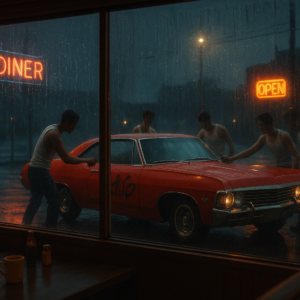
Years passed. The students graduated. Walter retired, moved to a quiet neighborhood on the edge of town, and bought himself a bright red 1967 Chevrolet Impala. He washed it every Sunday. He kept his brown cap and plaid shirt, his kind smile, and his belief that people could change.
What he didn’t know was that his old students had not forgotten him. And they had grown up angry.
It was a Tuesday night when they came.
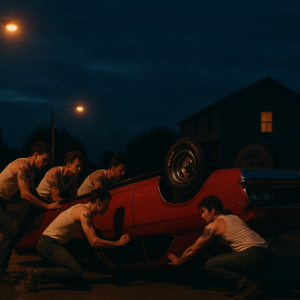
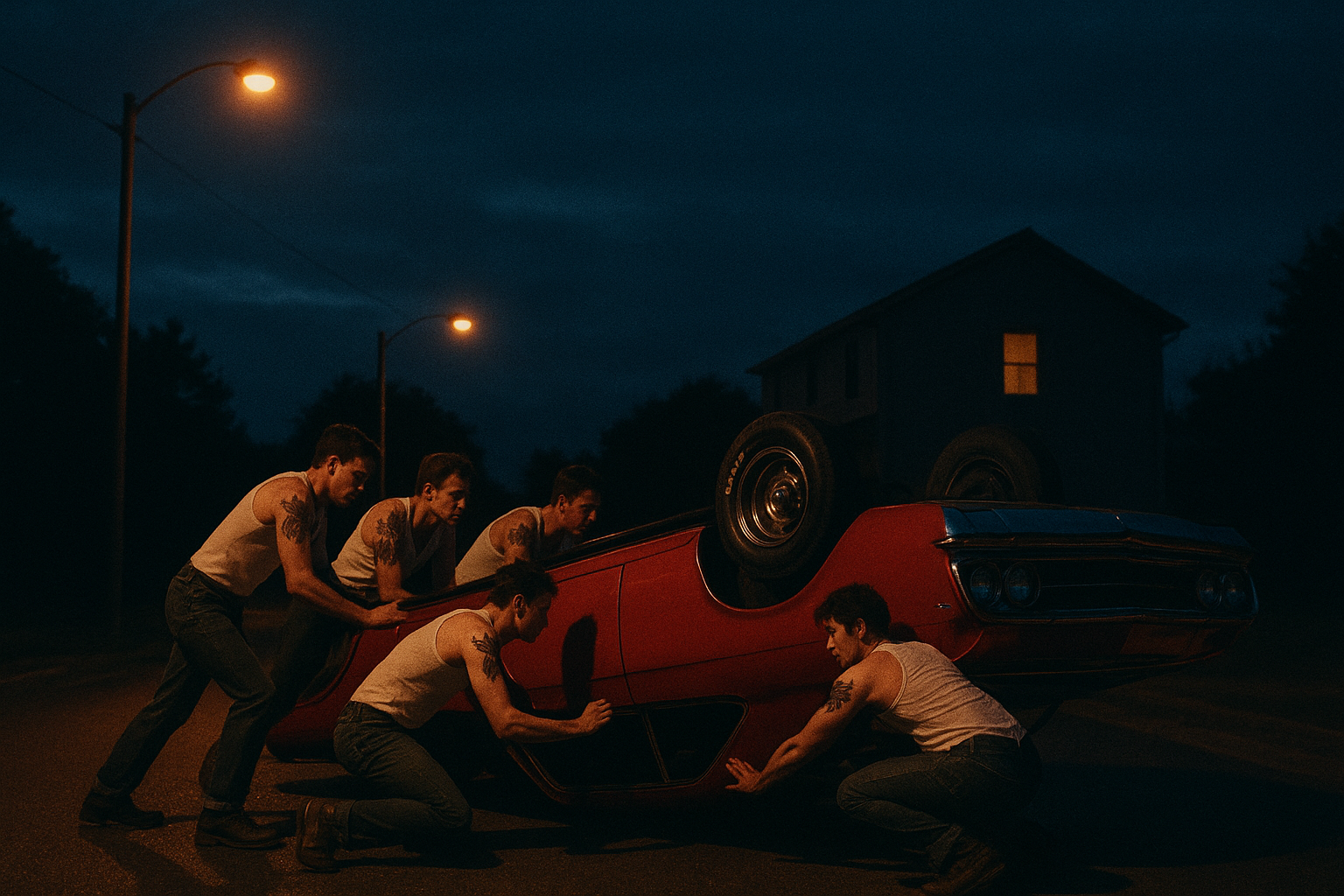
The street was calm, the kind of calm that makes violence feel louder. Orange lamps buzzed overhead. A few cars sat parked along the curb. And then there was the sound of grunting, of metal scraping asphalt, of laughter that didn’t belong.
Six of them, all between eighteen and twenty-five, Europeans in white tank tops and blue jeans, eagle tattoos on their shoulders. They surrounded the Impala like wolves around a wounded deer. And they pushed.
The car tipped. The roof hit the ground with a scream of crushed metal. Glass shattered. The alarm wailed once and died.
In the house across the street, a light flicked on upstairs.
Michael stood in the middle of the road, bald head gleaming under the lamps, two lightning bolts dark against his skull. He turned toward the house and shouted, his voice cracking with arrogant joy:
“And what you gonna do?”
The camera pulls back. Thirty meters down the street, the gang looks small, almost harmless. And there, standing on the sidewalk, is Walter. Brown cap. Brown jacket. Plaid shirt. He watches them, and he smiles.
Beside him, Emma — twenty years old, chestnut hair tied in a ponytail, white sports headband, red nylon tracksuit with a white stripe, white sneakers — stares at the wreckage with wide, terrified eyes.
“Walter,” she says. A pause. “They gonna destroy your car!”
Walter looks at her. He smiles.
He doesn’t move. He doesn’t call the police. He just watches, as if he’s waiting for something.
Michael spins in the street, arms wide, and howls like a wolf. “AUUUUUU! AU! AU!”
The others laugh. They stand around the overturned Impala, chests heaving, proud of themselves.
The camera cuts to Walter in close-up. His smile doesn’t fade. He tilts his head, and says, softly, kindly:
“It’s Mr. Bennet’s car.”
Emma freezes.
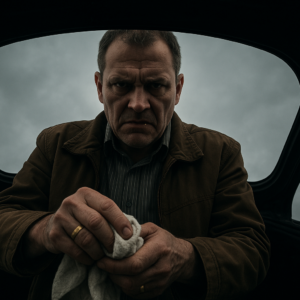
And then the sound changes. A sharp, dissonant chord — the kind that makes your stomach drop. The camera snaps to the inside of a car trunk. The lid is slightly open. A man peers down into it — fifty years old, European, brown blazer, striped shirt, a massive gold ring on his finger, a gold tooth glinting when he speaks. His face is cold. His voice is rough.
He looks straight into the lens. He wipes his hands on a white tank top. He tosses a denim chain into the trunk.
“And what should I tell Mr. Bennet, punk?”
The trunk slams shut. The screen goes black.
—
Michael woke up in the dark, his head pounding, his wrists bound with zip ties. He could feel the vibration of an engine beneath him. He tried to kick, but the space was too tight. He screamed, but the sound died against metal.
He didn’t know how long he’d been in there. Minutes. Hours. The car stopped twice. Once, he heard voices — low, calm, the kind of voices that didn’t need to shout. The second time, he heard nothing at all.
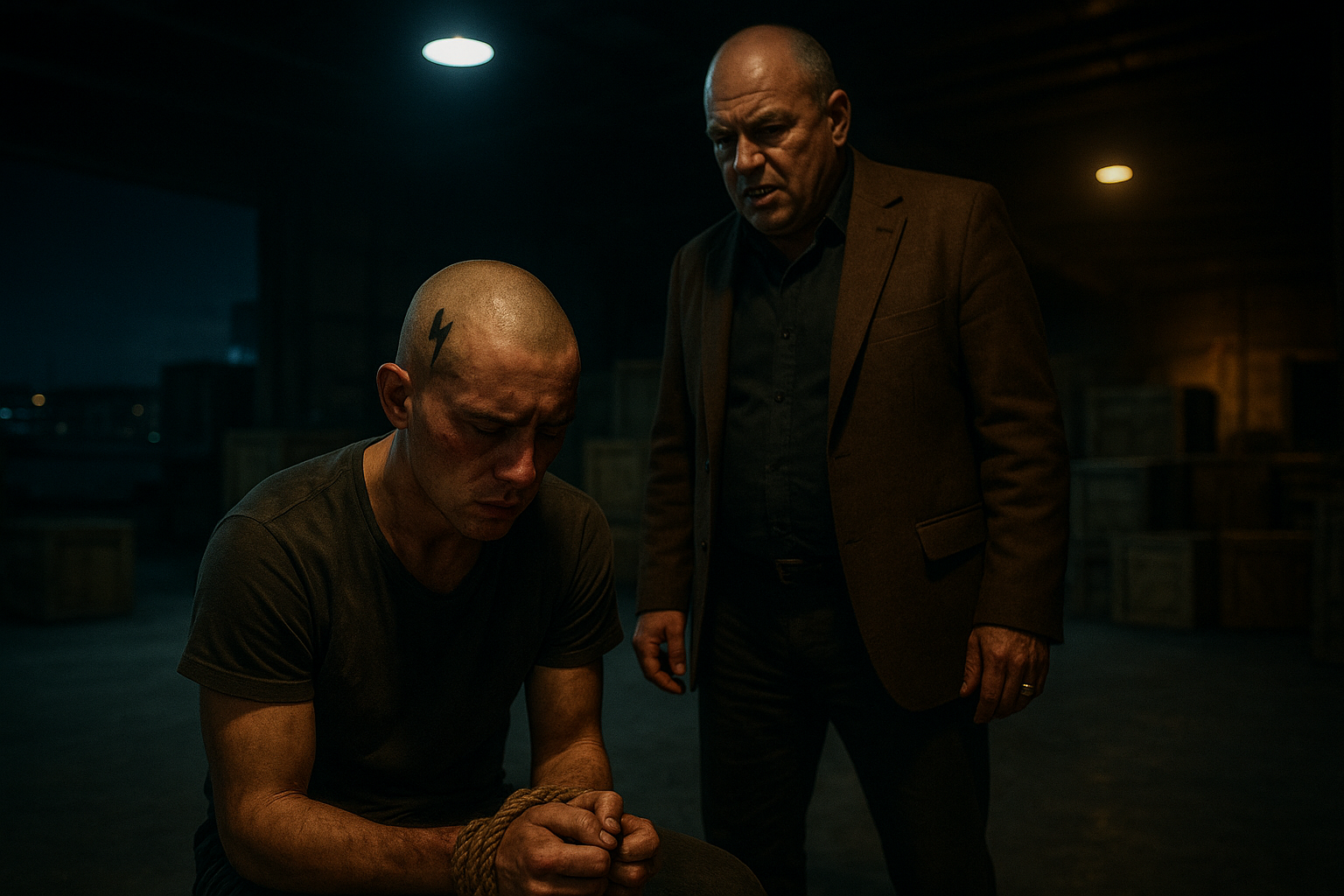
When the trunk finally opened, the light stabbed his eyes. He was dragged out by two men in black jackets and thrown onto a concrete floor. He looked up. The room was huge, dimly lit, filled with crates and the smell of oil and cigarettes. A warehouse. Somewhere near the docks, maybe.
And in front of him, sitting on a wooden chair like a king on a cheap throne, was the man from the trunk.
Mr. Bennet.
“You know what you did?” Bennet asked. His voice was quiet, but it carried. “You flipped my car. My father’s car. The only thing he ever gave me that wasn’t a beating.”
Michael said nothing. His jaw was clenched. His eyes were defiant, but his hands were shaking.
Bennet stood up. He walked slowly, circling Michael like a shark. “You think you’re tough? You think because you run with those little boys in white tank tops, you’re something?” He stopped. “You’re nothing. You’re a punk who broke a toy that didn’t belong to him.”
He nodded to one of his men. The man stepped forward and drove a fist into Michael’s stomach. Michael doubled over, gasping.
“That’s just the beginning,” Bennet said. “You’re going to work for me now. You’re going to pay off what you broke. And if you try to run…” He smiled, gold tooth flashing. “Well. You won’t.”
—
The next three years were a blur of pain and silence.
Michael worked for Mr. Bennet. He ran packages across the city. He stood guard at doors while deals were made inside. He learned how to keep his mouth shut, how to take a punch without falling, how to read a room full of dangerous men and know which one would kill him first.
He wasn’t a gang member anymore. He was property.
But he watched. He listened. He learned.
And sometimes, late at night, when the warehouse was quiet and the only sound was the hum of the docks, he thought about Walter. The old teacher with the brown cap and the kind smile. The man who had defended him three times. The man who had believed in him when no one else did.
He wondered if Walter was still alive. He wondered if Walter would even recognize him now.
One night, Michael decided to leave.
He waited until the guards changed shifts. He slipped out through a side door he’d been watching for months. He ran through the dark streets, lungs burning, heart pounding, not daring to look back.
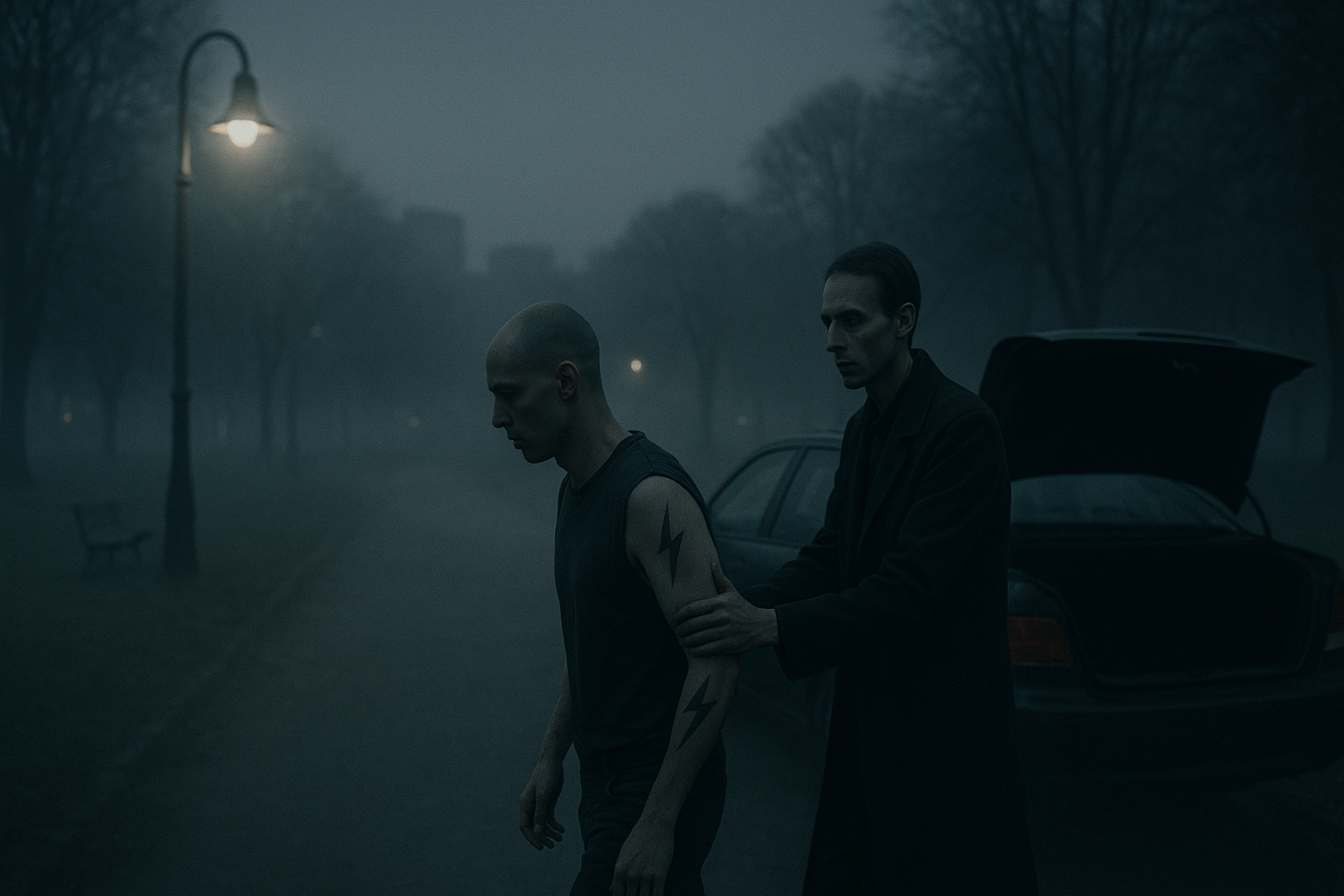
He made it three blocks before a car pulled up beside him. The window rolled down. Bennet’s assistant — a thin man with dead eyes — looked at him without expression.
“Get in,” he said.
Michael ran. The car followed. He cut through an alley, climbed a fence, dropped into a backyard. He heard footsteps behind him, calm and unhurried. They knew he had nowhere to go.
They caught him at the edge of a park, under a broken streetlight. The assistant didn’t say a word. He just opened the trunk, and Michael climbed in without being told. He knew the drill.
As the lid closed, he thought of Walter again. And for the first time in three years, he cried.
—
But that’s another story.
What matters is this: Walter never stopped believing that people could change. He never stopped teaching, even when no one was listening. And somewhere, in a dark warehouse by the docks, a boy with lightning bolts on his skull was still learning.
The lesson wasn’t over. It never is.