No one at the rooftop restaurant knew the boy’s name when he stepped into the light. They only noticed the contrast. The marble table. The skyline behind the glass. The chandelier glow on crystal and gold. And then this thin little boy in torn clothes, hair uncombed, shoes half-broken, standing directly in front of Julian Voss like fear had somehow forgotten to follow him inside.
Julian looked up from his wine glass with mild amusement. He was used to people staring at the wheelchair. Used to pity, curiosity, fake politeness. But this boy’s face held none of those things. Only certainty. “Sir,” the boy said. The word landed strangely. A few guests nearby smirked. One woman in sequins leaned toward her bald companion as if a joke was about to begin.
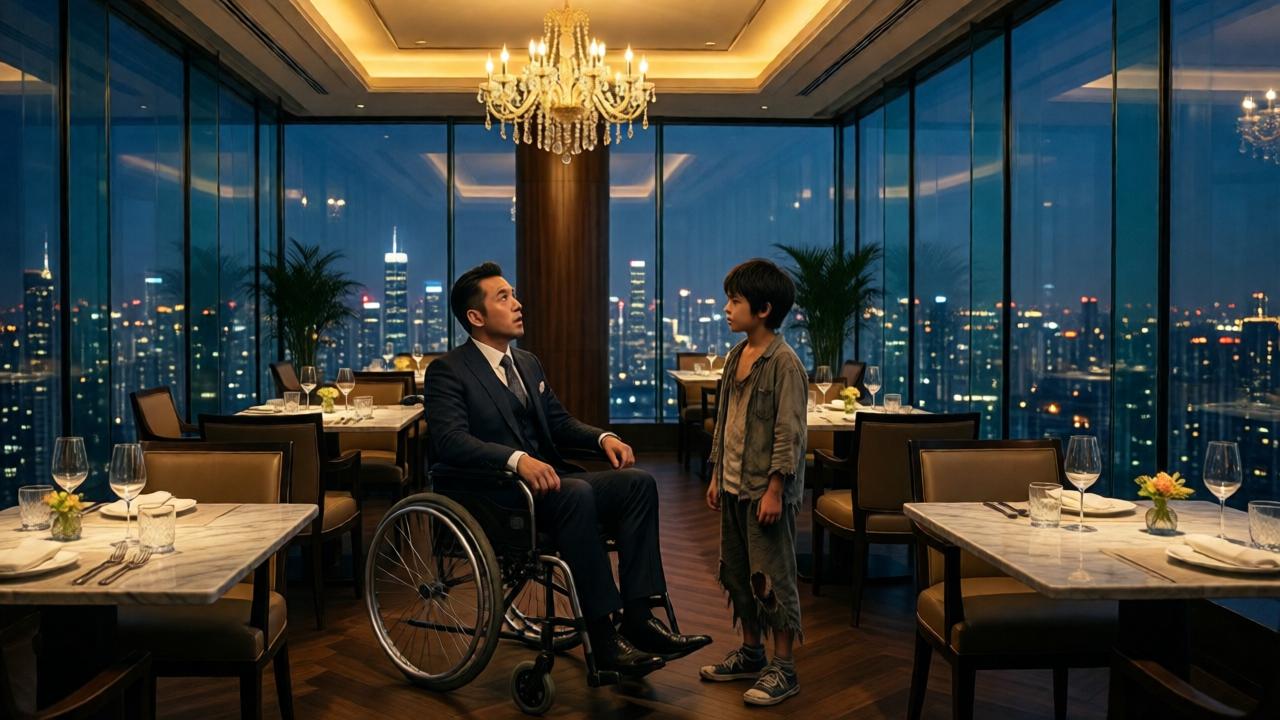
Julian lowered the glass. “You?” he asked. The boy stepped closer. “I can fix your leg.” That made the woman laugh under her breath. Julian almost laughed too. Almost. Instead, he leaned forward, studying the child more carefully. “How long would that take?” The boy did not blink. “A few seconds.” Julian set the glass down on the marble. “I’ll give you a million.” Now people were watching openly.
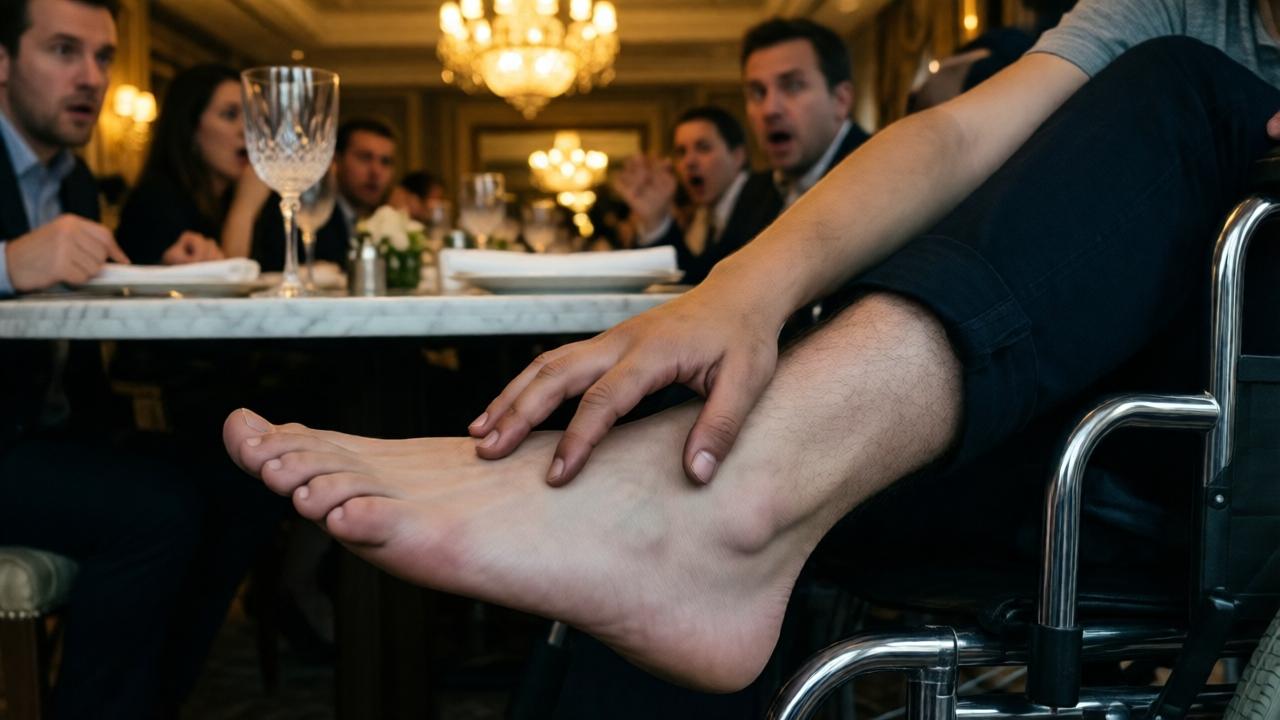
The boy crouched beside the wheelchair. The room changed with that movement. It stopped being entertainment and became something harder to name. He was close enough now for Julian to see the dirt under his nails, the fine shake in his fingers, and the strange sadness in his eyes. The boy looked once at Julian’s exposed foot on the footrest. Then up into Julian’s face. Like he recognized him. Then he placed his hand on the foot. A strange little sound seemed to pass through the silence — so soft Julian almost thought he imagined it. “Count with me,” the boy said.
Julian gave a thin smile. “This is ridicu—” “One.” Julian jerked so hard his hand slammed the edge of the table. The wine glass trembled. A woman gasped. Julian’s breath caught in his throat. Because something had happened. Something real. His toes twitched. Not in memory. Not in fantasy. Not in one of the false little ghost-sensations doctors always warned him about. They moved. The boy’s own breathing was shaking now, but his hand stayed steady. “Two.” Julian stared at his foot in horror. Another twitch. Then a second toe. The laughter in the restaurant was gone. The guests had gone still. Even the waitstaff had stopped moving.
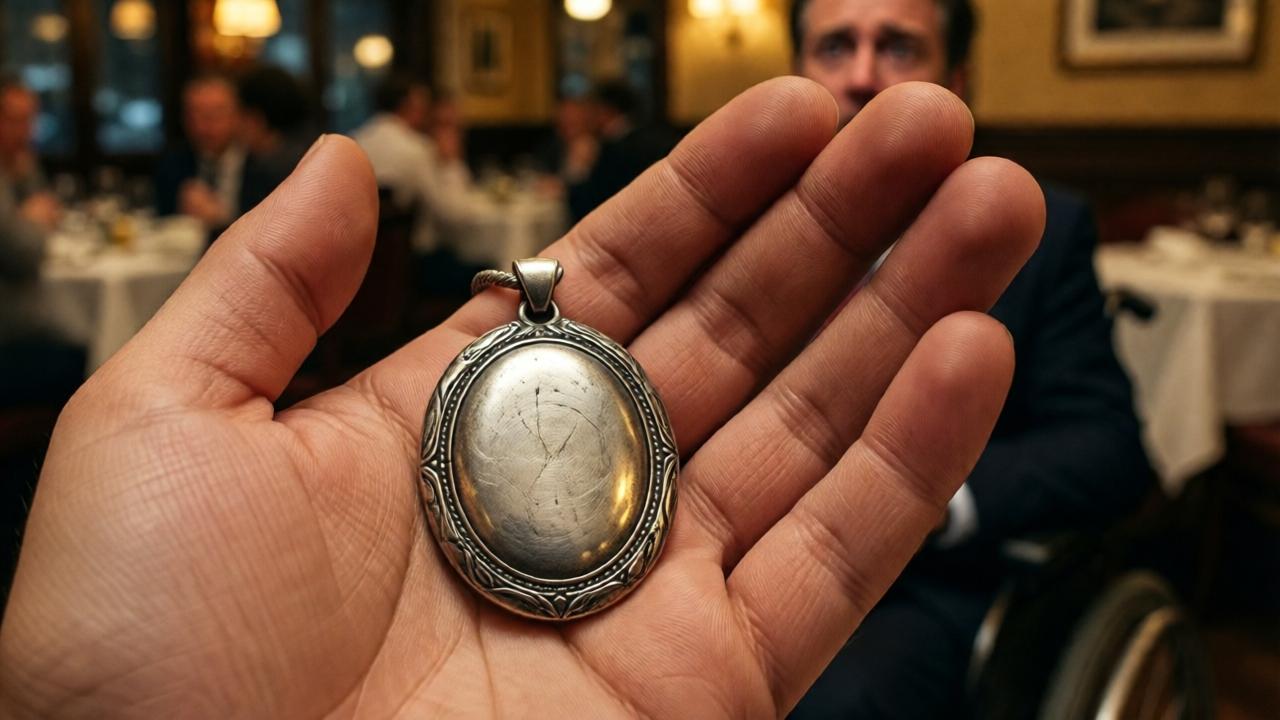
Julian lifted his eyes slowly to the child’s face. “What did you do?” The boy swallowed hard. Tears stood in his eyes now. “My mother begged you to help her too.” That sentence cut deeper than the touch. Julian’s face changed. Not because he understood it immediately. Because something old and buried had just been called by name without using the name. The boy lifted his free hand and opened it. A small pendant lay in his palm. Oval. Worn. Silver faded smooth with time.
Julian stopped breathing. He knew that pendant. He had clasped it around a young woman’s neck twelve years earlier in a one-room apartment above a pharmacy, promising he would come back before sunrise. Her name had been Elena. And by morning, she was gone. At least, that was the story his family gave him. “She said if your leg ever woke up…” the boy whispered, “…you’d finally look at me.” Julian stared at the pendant, then at the boy’s face, and something sickening began to rise inside him. The eyes. He had noticed the eyes first but refused to let himself think about them. Now he could not unsee it. Elena’s eyes. His own mouth. His own brow when frightened.
The boy’s lips trembled. Then he said the words that emptied the whole room of air: “My mother told me not to hate you until I saw your face myself.” Julian’s hands gripped the arms of the wheelchair. The guests behind him looked from the boy to Julian and back again, sensing the shape of something terrible before they fully understood it. Julian tried to speak. Nothing came out. The boy took one tiny step closer. His voice dropped to almost nothing. “She’s dying downstairs.”
Julian went white. “What?” “In Saint Claire’s charity clinic,” the boy said. “Three floors below this building. She said rich people like to eat close to suffering as long as the glass is dark enough.” The woman in sequins covered her mouth. Julian’s hand began to shake violently. The boy’s eyes filled completely now. “She told me one more thing.” Julian could barely force out the words. “What?” The child looked at him with quiet, devastating steadiness. “She said if your foot moved…” His throat tightened. “…ask him why his brother paid to hide his son.”
Julian froze. Because only one person in the world could have known that his brother had handled Elena’s disappearance. And in that exact moment, behind the glass doors of the private dining entrance, a tall man in a charcoal suit stepped into view—Julian’s brother. And the moment he saw the boy kneeling beside the wheelchair, all the color drained from his face. The restaurant fell into a silence so deep that the distant hum of the city below seemed to swallow everything. Julian looked from his brother’s ashen face back to the boy, who was now crying silently, and felt the full weight of twelve years of lies pressing down on him like a collapsing ceiling.