

The evening had begun with the soft clink of crystal glasses and the murmur of polite conversation. The restaurant, Le Ciel d’Or, was known for its golden chandeliers and marble floors that reflected the city lights of Paris like a mirror of dreams. Wealthy patrons dined on truffle risotto and sipped vintage Bordeaux, while a young waitress named Camille moved quietly among them, her hands steady despite the weight of her own hidden story. She had been working there for only three months, ever since her mother died, leaving behind a small apartment in Montmartre and a single instruction: “If anyone ever recognizes the necklace, ask him why he never came back for us.”
Tonight, that instruction became a storm. A glamorous woman in black, Madame Delacroix, had been showing off a diamond necklace to her guests when she noticed Camille staring. “You there, girl!” she snapped, her voice cutting through the ambiance. “Stop gawking at things you could never afford.” But Camille couldn’t look away; the necklace was identical to the one her mother had hidden in a velvet box for twenty-three years. Before she could retreat, Madame Delacroix grabbed her wrist and accused her of theft, pulling a second necklace from Camille’s apron pocket. The entire restaurant fell silent the moment the old man stood up.
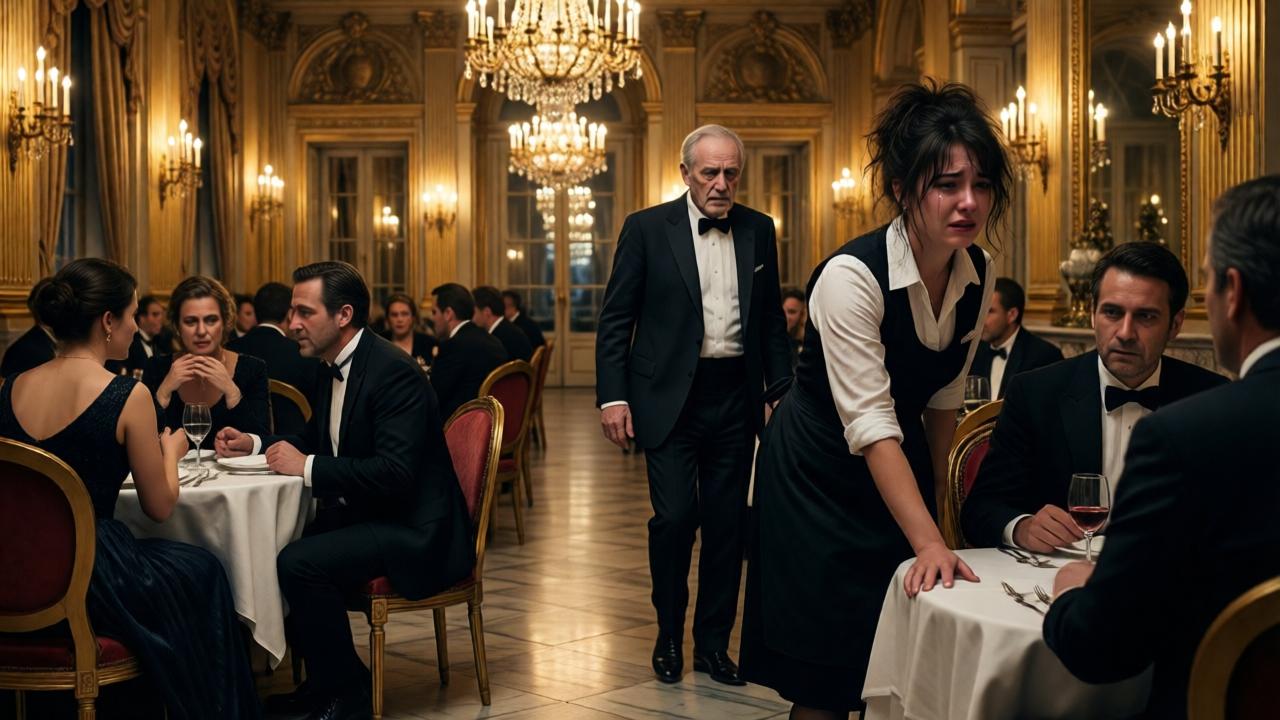
The old man, Monsieur Henri Laurent, was a retired jeweler whose name was once whispered in the same breath as Cartier and Van Cleef. He had not spoken publicly about his past in decades, but the moment he saw the necklace, his world tilted. “That engraving…” he said again, stepping closer with trembling breath. “Only my wife had one like that.” The glamorous woman in black let out a sharp laugh, trying to keep control of the room. “Your wife?” she snapped. “This girl was hiding it in her hand.” But nobody was looking at her anymore. Every guest was staring at the young waitress.
Camille stood there shaking, her hair disheveled, tears streaming down her face, one hand pressed against the table to keep herself from collapsing. She had never expected this moment to come so violently. Her mother had always warned her: “The necklace is a key, but it might open a door you’re not ready to walk through.” Now, that door was swinging wide, and the old man was walking straight toward her. He came closer, closer. His eyes moved from the necklace to the waitress’s face. Then the color drained from his face completely. “My God…” he whispered. “Her eyes…”
The rich woman’s expression shifted. “What are you doing? She’s a thief.” But the old man barely heard her. Twenty-three years earlier, on the night of a grand charity ball in Paris, his pregnant wife, Isabelle, had disappeared after a violent argument with his family. They told him she had run away in shame. Days later, he was handed a letter he never fully believed — a letter claiming she wanted to vanish and never see him again. But now the necklace was here. And the engraving inside it was not just initials. It was a private phrase he had commissioned for only one woman: To my eternal light — come back to me.
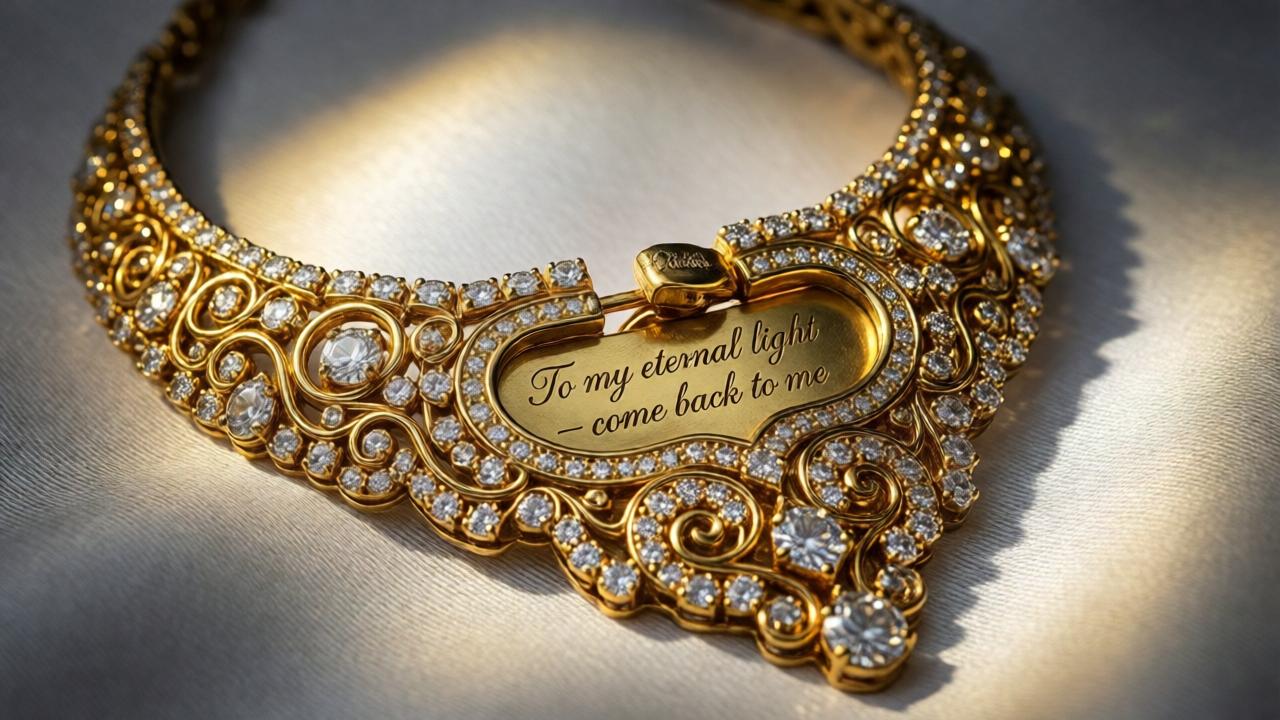
His hands shook violently. The rich woman stepped in front of him. “This is absurd. She probably copied it.” But the waitress suddenly whispered, barely able to breathe: “My mother told me… if anyone ever recognized that necklace… I should ask him why he never came back for us.” The old man staggered backward like he had been struck. Gasps spread across the restaurant. The rich woman went pale. The waitress’s voice broke as she continued: “She said the night she disappeared… she was already carrying your child.” A glass shattered somewhere in the room. The old man stared at her, speechless.
- Henri Laurent, a retired jeweler, lost his wife Isabelle in 2003 after a family argument at a charity ball.
- Isabelle was pregnant at the time and later gave birth to a daughter, Camille, in secret.
- The necklace, a diamond piece with a custom engraving, was the only clue left behind.
- Madame Delacroix, the rich woman, had purchased the necklace from an antique dealer who never revealed its origin.
The room held its breath as Henri reached toward the necklace with trembling fingers. He turned it over, and noticed something hidden behind the clasp — a second engraving. One that had never been there before. It was a date: the day Isabelle had left, followed by a single word — “Forgive.” And just as he read the first word, his face turned to horror. He realized that his wife had not run away; she had been forced out by his own family, who had lied to him for decades. The waitress, his daughter, had been living in poverty while he dined in luxury.

Henri fell to his knees, the necklace dangling from his fingers like a chain of truth. “Isabelle…” he whispered, his voice cracking. “She never left me. They took her from me.” Camille stepped forward, her tears now mingling with a strange relief. “My mother always said you were a good man,” she said softly. “She told me to find you, but I never knew how.” The rich woman, Madame Delacroix, backed away, realizing the necklace she had flaunted was a stolen relic of a broken family. The restaurant manager called for silence, but it was too late; the story was already spreading like wildfire through the room.
In the days that followed, Henri Laurent would learn the full truth: his family had paid Isabelle to leave, threatening to harm her child if she ever returned. She had fled to a small town in the south, where she raised Camille in secret, always hoping that one day the necklace would lead her daughter back to her father. That night, in the golden restaurant, a twenty-three-year-old secret was finally laid bare. And as Henri embraced his daughter for the first time, the chandeliers above them seemed to shimmer with a light that was no longer cold, but warm — a light that promised a new beginning.