
The most expensive jewelry store in the city glittered like a place where poverty could never exist. Crystal chandeliers cast prisms of light across velvet displays, and the air smelled of expensive perfume and polished mahogany. Customers in tailored suits and silk dresses browsed casually, their conversations a soft hum beneath classical music. Then a homeless little boy stopped in front of the glass display.
He was perhaps seven years old, with matted hair and clothes that had seen better days. His bare feet left smudges on the marble floor. A wealthy customer nearby instantly stepped back in disgust, her nose wrinkling. “Don’t touch that,” she snapped, her voice sharp as a blade. The boy quickly pulled back his hand, his eyes already filling with tears. “I’m not trying to take it…” he whispered, his voice trembling. “My mother said it belongs to the woman who lost me.”
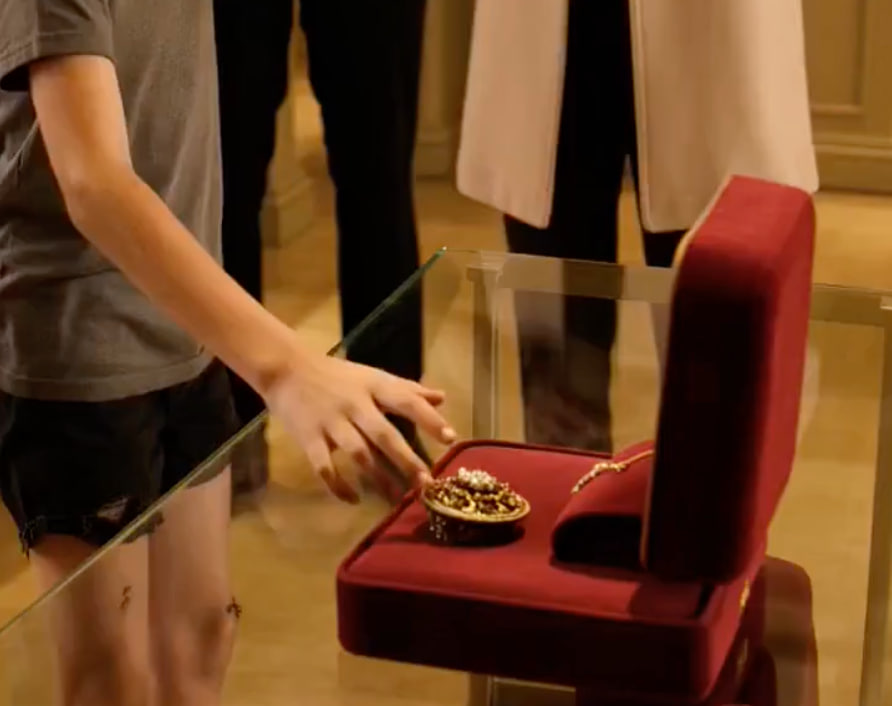
The jeweler, a stern man in his fifties named Mr. Aldridge, frowned deeply. He had seen many desperate people try to steal from his cases, but something in the boy’s eyes made him pause. He unlocked the case with a click that seemed to echo through the suddenly silent room. He turned over the necklace clasp, revealing a tiny engraving that had been hidden for years. The letters read: For our little Elena.
An elegant woman standing nearby, who had been examining a diamond bracelet, suddenly covered her mouth. Tears filled her eyes as she stepped forward, her heels clicking on the marble. “That…” she whispered, her voice cracking. “That was my baby’s name. She disappeared the night of the hospital fire.” The boutique fell into a profound silence. Customers and staff alike held their breath, watching the scene unfold like a play they never expected to witness.
- The necklace had been in the store for over six years, untouched and unsold.
- The hospital fire occurred in 2019, killing three and displacing dozens.
- The boy’s mother had found him wandering near the hospital and raised him as her own.
- The engraving was the only clue to the boy’s true identity.
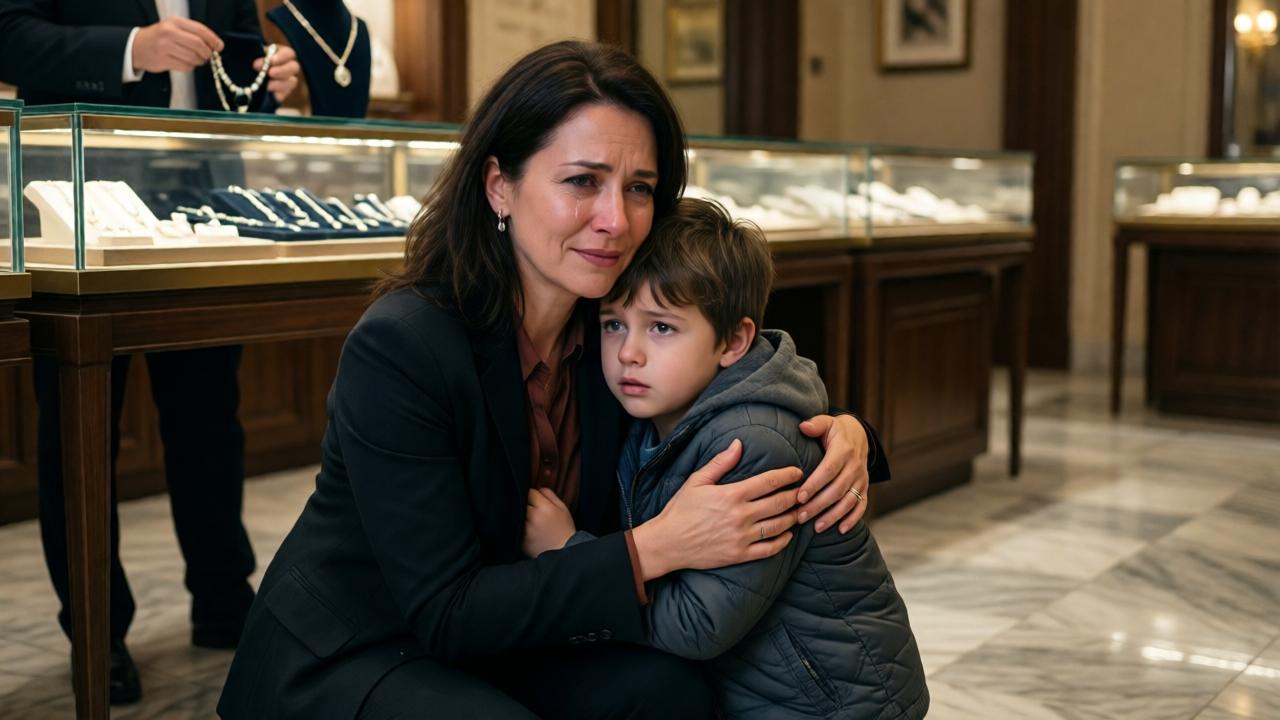
The boy’s voice shook as he spoke again, his eyes locked on the woman’s tear-streaked face. “My mother said if you heard that name, you would finally know who I am.” The woman—Elena’s mother, a widow named Clara—dropped to her knees, her hands trembling as she reached for the boy. “Oh, my God,” she sobbed. “You’re my son. You’re my little Luca.” The boutique erupted in gasps and muffled cries.
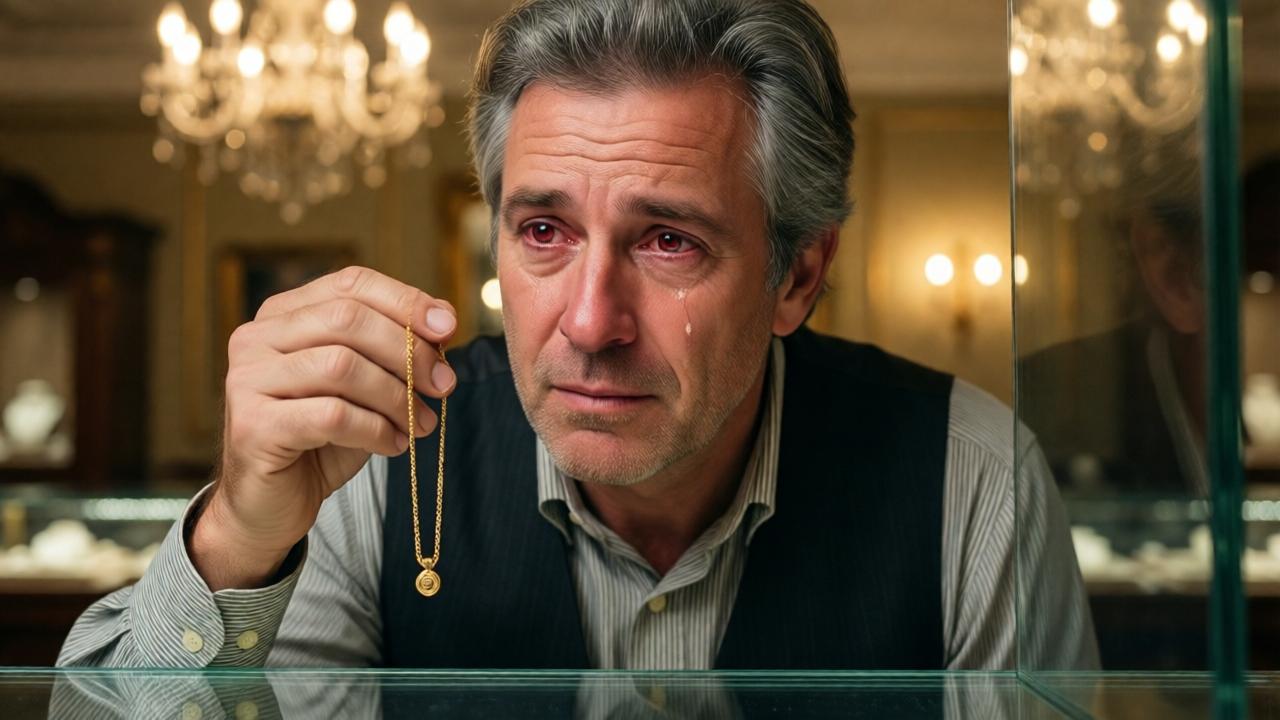
Mr. Aldridge, the jeweler, quietly closed the case and wiped his eyes with the back of his hand. “I’ve had this necklace for six years,” he said softly. “The woman who brought it in said she found it near the hospital after the fire. She never explained why she didn’t return it. I kept it, thinking someone would come looking.” He looked at Clara. “It seems the necklace finally found its way home.”
Clara held Luca close, her tears soaking his dirty hair. “I never stopped looking for you,” she whispered. “Every day, every night. I kept your nursery exactly as it was.” Luca buried his face in her shoulder, his small body shaking with sobs he had held back for years. The wealthy customer who had recoiled earlier now stood frozen, her hand over her mouth, tears streaming down her face. She quietly slipped out of the store, unable to face the irony of her earlier disdain.
As Clara and Luca walked out of the boutique hand in hand, the entire store applauded. Mr. Aldridge insisted they take the necklace, saying it had served its purpose. “Some things,” he said, “are worth more than any price tag.” Outside, the city lights glittered, but for Clara and Luca, the brightest light was the one they had found in each other. The boy who had been homeless was no longer lost—he was finally home.