
Tales

From Mockery to Mastery: The Street Singer’s 100,000 Triumph

The wave of laughter crashed over Emma like a physical blow. The host’s mocking smile, the audience’s cruel delight, the blinding stage lights—it all fused into a single, suffocating moment of humiliation. She stood frozen, her knuckles white around the neck of her cracked guitar, the only solid thing in a world that seemed to be spinning. ‘If you sing well, I’ll give you $100,000, and I’ll even marry you,’ he had said, his voice dripping with condescension. The promise was a joke, and she was the punchline. In the front row, she could see Victoria and the other contestants smirking, their earlier backstage taunts now validated for a national audience. Emma closed her eyes, seeking the dark, familiar silence of the bus shelter, but found only the roar of the crowd.

Then, a memory surfaced—not of the streets, but of home. Her mother’s voice, soft and clear, singing a lullaby. Her father’s rough hand strumming the very guitar she now held. ‘Sing for the joy of it, Emmy,’ her mother had said. ‘The song is yours, no one can take that.’ The host was still chuckling, adjusting his cufflinks, waiting for her to flee. Instead, Emma opened her eyes, looked directly into the nearest camera, and whispered into the microphone, ‘This isn’t for the money. Or a plate of food. This is for them.’ A hush, curious and tentative, began to fall over the auditorium.
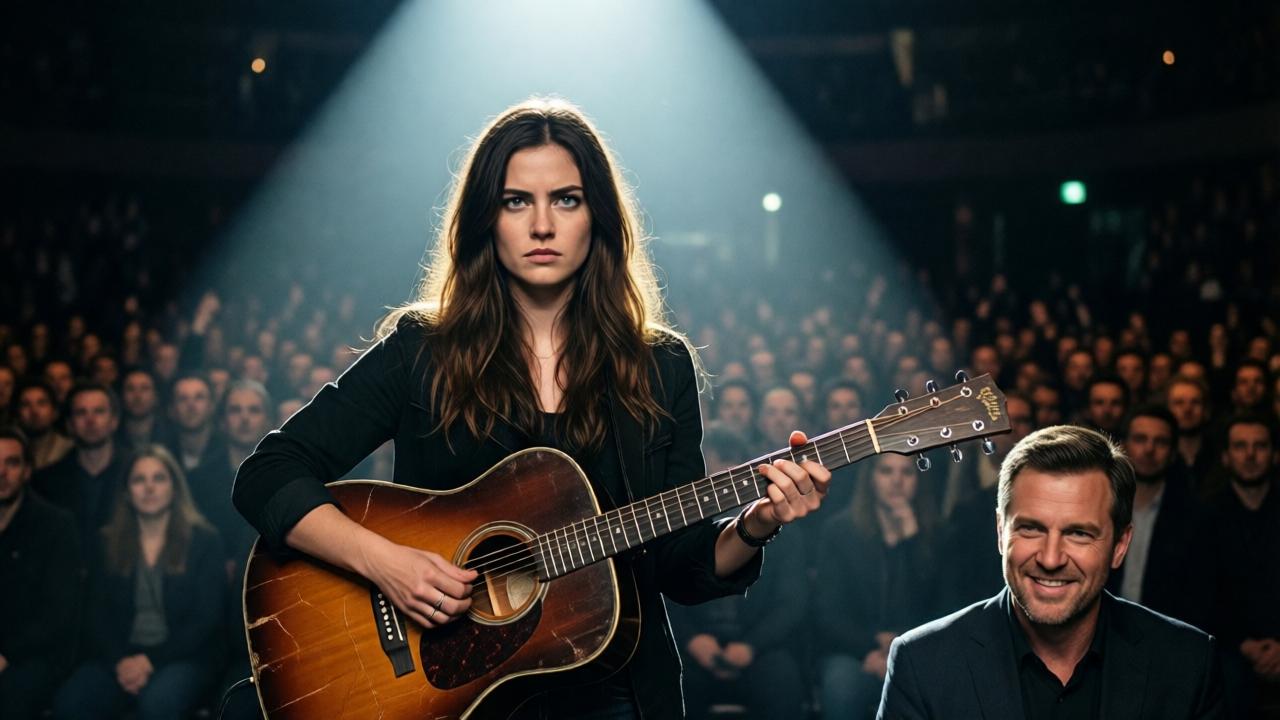
A powerful cinematic shot of a young woman with determined eyes standing alone on a vast, dark stage. She holds a worn, cracked acoustic guitar. A single, dramatic spotlight illuminates her from above, creating a stark contrast with the shadowy, blurred figures of a massive audience and a smirking host in the foreground. The style is photorealistic with a mood of intense anticipation. Lighting is high-contrast and theatrical. Colors are muted except for the warm glow on her face and hands. Composition is centered on her resilient expression.


Her fingers found the strings, calloused and sure. She began to play a simple, haunting melody, one she had composed during countless cold nights. The first note that left her lips was pure, clear, and filled with a raw, aching vulnerability that sliced through the last remnants of laughter. She sang of loss, of empty doorways and hungry nights, but also of stubborn hope, of stars seen through shelter roofs, and the kindness of strangers like David, Sarah, and Marcus. ‘You see a shadow where I stand,’ she sang, her voice gaining strength, ‘but I’m built from dust and dreamland.’ In the audience, the mocking smiles vanished, replaced by stunned silence. The host shifted uncomfortably in his shiny shoes.

As the chorus swelled, something magical happened. The technical imperfections—the slight rasp, the old guitar’s muted tone—melted away, leaving only undeniable, soul-shaking truth. The camera cut to Victoria, whose arrogant smirk had completely dissolved into open-mouthed shock. It panned to Richard, the contest owner, who was leaning forward, his earlier paternalistic kindness replaced by the sharp calculation of a man recognizing a goldmine. Backstage, Marcus pumped his fist, whispering, ‘That’s my sister. That’s my street sister.’

A split-screen reaction shot. On the left, a close-up of the arrogant blonde contestant Victoria, her hand over her mouth, eyes wide with shock and dawning respect. On the right, a medium shot of the contest owner Richard in a luxury booth, watching a stage monitor with intense, calculating eyes and a faint, surprised smile. The style is sharp and photorealistic, capturing the pivotal moment of perception shifting. Mood is revelatory. Lighting contrasts the cool, shadowy booth with the warm glow from the stage monitor on Richard's face.


The final note hung in the air, trembling, then faded into absolute silence. For three full seconds, nothing moved. Then, a single person in the balcony stood up and began to clap. Then another. And another. The applause erupted not as polite recognition, but as a thunderous, cathartic roar. The host, utterly flustered, stumbled toward her, microphone in hand. ‘I… I don’t know what to say,’ he stammered, the mocking tone entirely gone. Emma simply looked at him, her chest heaving. ‘The offer,’ she said quietly, the stage mic catching her words. ‘The $100,000. And the marriage. Were you serious?’ The audience’s laughter this time was warm, cheering for her boldness. The host turned beet red, saved only by Richard striding onto the stage.

Richard took the microphone, placing a seemingly protective arm around Emma’s shoulders. ‘Ladies and gentlemen,’ he boomed, ‘America, you have just witnessed the birth of a true star! This is what Rising Stars is all about!’ He turned to Emma, his smile broad and televisual. ‘The offer from our host was made in poor taste, and we apologize. But your talent, young lady, is priceless. You have a place in the next round, and a contract waiting backstage.’ The audience cheered again. Yet, as Emma looked from Richard’s gleaming smile to the host’s embarrassed grimace, and then out to the sea of applauding strangers, she realized the game had only changed, not ended. She had won the battle for the stage, but the war for her own voice was just beginning.

A wide shot from behind Emma on the stage. She is facing a massive, cheering audience that is a blur of light and color. The contest owner Richard stands beside her with a performative, arm-around-her-shoulders pose, holding a microphone. Emma's posture is slightly rigid, her head turned just enough to see his profile, her expression a complex mix of triumph, uncertainty, and wariness. The mood is victorious yet ambiguous. Lighting is bright and flashy from stage lights and camera flashes. The composition emphasizes her small, solitary figure against the overwhelming scale of her new reality.


Related Posts

The Stall Boy’s Warning: A Helicopter, a Bomb, and the Truth That Wouldn’t Stay Buried

The sun hung high over the von Auerbach estate, pouring gold across the manicured lawn that stretched like a green carpet toward the great house. It was the…

The Man Who Waited: A Story of Max, Walter, and the Dog Who Came Home

The 7:42 train to Alexanderplatz was always half-empty on Tuesday mornings. The fluorescent lights hummed their sterile white hymn, bleaching the orange seats and the tired faces of…

A young girl with long wavy light-brown hair, barefoot, wearing a pale pink dress with a white collar, stands facing a stern female judge in a black robe inside a wood-paneled courtroom. The girl's face is tear-streaked but determined. Behind the judge, an American flag hangs softly lit. Warm afternoon light filters through tall windows, casting long shadows across the wooden benches. The atmosphere is tense yet hopeful, with muted browns, golds, and the soft pink of the girl's dress dominating the composition. Camera angle is slightly low, emphasizing the child's courage.

The Little Girl Who Stopped a Trial: A Courtroom Drama Unfolds

The heavy oak doors of the county courthouse groaned open, and a small figure burst through. Bare feet slapped against the cold marble floor as a girl of…

A dramatic sunset over a marina, wooden pier stretching into calm water, a large white yacht gleaming under orange and gold sky, palm trees silhouetted in the background, an elderly man in a gray jacket and brown leather bag standing alone, a young man in a beige polo walking away with his head down, cinematic lighting, warm tones, emotional atmosphere, wide shot

The Sunset Key A Yacht, a Stranger, and the Secret That Changed Everything

The sun hung low over the marina, bleeding orange and gold across the water. The wooden pier creaked gently underfoot as an elderly man walked slowly toward the…

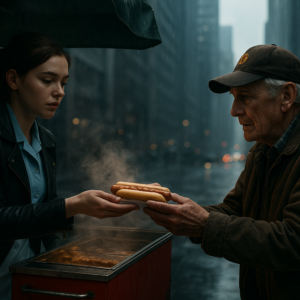
Cinematic shot of a rainy city street with towering skyscrapers, cold and wet. Emma, a 20-year-old European woman with chestnut hair in a ponytail, wears a light blue waitress uniform with a white apron under a black leather jacket, black leggings, and white sneakers. She stands behind a red hot dog cart with steam rising under a green fabric awning. Close-up on her hands passing a hot dog over the cart to the hands of Walter, a 70-year-old European man with gray hair, in a brown cap with a yellow logo, brown jacket, and plaid shirt. The background is blurred, focus on the exchange. Mood is cold yet warm, lighting is dim with rain reflections.

Rain Over the City: The Hot Dog Cart Encounter

The rain fell in sheets over the city, turning the streets into mirrors that reflected the cold, indifferent glow of skyscrapers. Emma pulled her black leather jacket tighter…

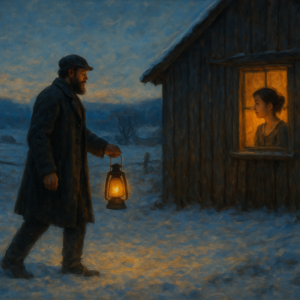
A snowy farmyard at dawn, a tall bearded man in a dark grey coat carries a lantern toward a weathered wooden barn while soft blue morning light spreads across the fields, inside the cabin window a young woman with chestnut hair in a bun watches him go, her expression thoughtful and moved, warm golden light spilling from the window onto the snow, painterly historical style, mood of quiet hope and new beginnings, palette of deep blues, warm ambers, and soft whites

No Child Sleeps in My Barn: The Unexpected Mercy of Jesse Brand

The lantern sputtered against the log walls, throwing long, restless shadows across the cabin. Mary Campbell set the last empty plate down on the rough timber table with…